GS Paper III — Q11
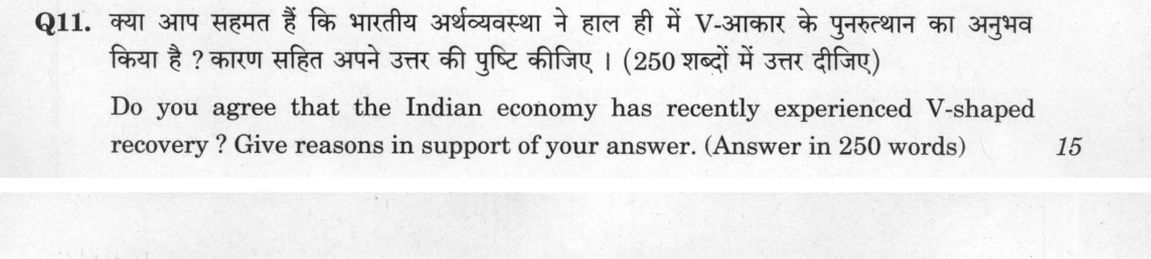
Do you agree that the Indian economy has recently experienced V-shaped recovery? Give reasons in support of your answer. (Answer…
Do you agree that the Indian economy has recently experienced V-shaped recovery? Give reasons in support of your answer. (Answer in 250 words)
हिंदी में प्रश्न पढ़ें
क्या आप सहमत हैं कि भारतीय अर्थव्यवस्था ने हाल ही में V-आकार के पुनरुत्थान का अनुभव किया है ? कारण सहित अपने उत्तर की पुष्टि कीजिए। (250 शब्दों में उत्तर दीजिए)
Model answer
Written by UPSC Answer Check against this question's marking rubric, to the 250-word length. UPSC does not publish answers for Mains — this is one way to score well, not an official key.
A V-shaped recovery is characterized by a steep economic decline followed by a rapid, continuous rebound to the pre-crisis growth trajectory. Following the pandemic-induced contraction, India’s aggregate macroeconomic data initially exhibited this pattern.
Evidence Supporting a V-Shaped Rebound
Headline Gross Domestic Product (GDP) rebounded sharply from a contraction of -7.3% in FY21 to 8.7% in FY22 and sustained at 7.2% in FY23. High-frequency indicators affirmed this resurgence: both Manufacturing and Services Purchasing Managers' Index (PMI) surged into expansionary territory, gross monthly Goods and Services Tax (GST) collections consistently crossed ₹1.5 lakh crore, and capital markets reached record highs, signalling robust organized sector buoyancy.
Counter-Evidence and K-Shaped Divergence
However, evaluating disaggregated data reveals that the recovery was largely K-shaped rather than uniformly V-shaped. The headline spike was magnified by a statistical base effect. While the formal corporate sector adapted quickly and captured market share, the informal economy and Micro, Small, and Medium Enterprises (MSMEs) faced severe working capital erosion and closures.
Furthermore, broad-based recovery was undermined by rural distress, stagnant real wages, elevated demand for MGNREGS work, and lingering underemployment as reflected in Periodic Labour Force Survey (PLFS) trends. This exacerbated wealth inequality, where urban, premium consumption rebounded while mass consumption remained subdued.
Verdict
India avoided an extended stagnation (L-shape) or prolonged trough (U-shape), but headline growth does not equal broad-based revival. For a sustained V-shaped trajectory, statistical recovery must translate into foundational recovery through broad-based Private Final Consumption Expenditure (PFCE), revival in private Gross Fixed Capital Formation (GFCF), and robust non-food credit growth. Ultimately, while macro-level output staged a statistical V-shaped rebound, the underlying socio-economic reality remained unevenly K-shaped.
What "Evaluate" is asking you to do
Judge how well something has performed against the standard it set for itself — its stated aim, mandate or promise — and commit to a verdict. Name the yardstick before you judge; an unanchored judgement reads as opinion.
Structure that answers it
Name the yardstick — stated aim, mandate or benchmark → performance against it → shortfall against it → why the gap exists → verdict
Where marks are lost
Presenting both sides and then declining to decide, or delivering a verdict against a standard you never stated, which makes it look arbitrary.
How this answer will be evaluated
Approach
Framework: Economic Analysis (Situation > Analysis > Assessment). justify: claim > 3-4 reasons > evidence > conclusion Full marks: Clear position with 4+ specific indicators, balanced conclusion, and one current scheme with number
Key points expected
- Explicitly state agreement or disagreement in the first line
- Define V-shaped recovery as sharp fall followed by rapid rebound
- Cite 3-4 specific economic indicators (GDP, IIP, exports, etc.)
- Provide a balanced conclusion acknowledging limitations or caveats
Evaluation rubric
Each sub-part is marked on its own, against the marks and word limit printed on the paper.
- The answer State a clear position on the V-shaped recovery claim and support it with 3-4 economic reasons. · 250 words
justify— claim → 3-4 reasons → evidence → conclusion
Must cover
- Explicitly state agreement or disagreement in the first line
- Define V-shaped recovery as sharp fall followed by rapid rebound
- Cite 3-4 specific economic indicators (GDP, IIP, exports, etc.)
- Provide a balanced conclusion acknowledging limitations or caveats
Loses marks
- Vague generalities without specific economic data
- No clear position stated (ambiguity on agreement/disagreement)
- Newspaper summary style without analytical depth
Earns more
- Mention specific sectors driving the recovery (e.g., manufacturing, services)
- Reference RBI or NITI Aayog data points
- Compare with other recovery patterns (U-shaped, L-shaped)
- Discuss role of government stimulus measures
Extra mark
- Include a simple flowchart showing the V-shape with data points
- Cite a specific current scheme with a number (e.g., PLI scheme amount)
Practice this exact question
Write your answer and it is marked point by point against the model answer above — what you covered, what you missed, what you got wrong.
Evaluate my answer →More from General Studies 2021 GS Paper III
- Q8 Discuss about the vulnerability of India to earthquake related hazards. Give examples inc…
- Q9 Discuss how emerging technologies and globalisation contribute to money laundering. Elabo…
- Q10 Keeping in view India's internal security, analyse the impact of cross-border cyber attac…
- Q11 Do you agree that the Indian economy has recently experienced V-shaped recovery? Give rea…
- Q12 "Investment in infrastructure is essential for more rapid and inclusive economic growth."…
- Q13 What are the salient features of the National Food Security Act, 2013? How has the Food S…
- Q14 What are the present challenges before crop diversification? How do emerging technologies…