GS Paper III — Q3
How did land reforms in some parts of the country help to improve the socio-economic conditions of marginal and small farmers?…
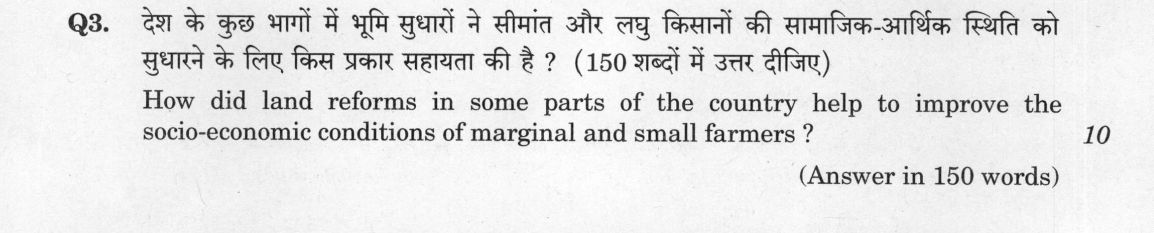
How did land reforms in some parts of the country help to improve the socio-economic conditions of marginal and small farmers? (Answer in 150 words)
हिंदी में प्रश्न पढ़ें
देश के कुछ भागों में भूमि सुधारों ने सीमांत और लघु किसानों की सामाजिक-आर्थिक स्थिति को सुधारने के लिए किस प्रकार सहायता की है ? (150 शब्दों में उत्तर दीजिए)
Model answer
Written by UPSC Answer Check against this question's marking rubric, to the 150-word length. UPSC does not publish answers for Mains — this is one way to score well, not an official key.
Post-independence land reforms restructured agrarian relations, directly uplifting marginal and small farmers through secure ownership and institutional inclusion.
Abolition of Intermediaries and Land Redistribution: The abolition of the zamindari system and the enforcement of land ceiling acts transferred surplus land to the tillers, creating secure property rights and eliminating feudal extractions.
Tenancy Security and Protection: Tenancy reforms regulated fair rents and protected cultivators from arbitrary evictions. Measures like Operation Barga in West Bengal and decisive tenancy legislations in Kerala and Karnataka conferred ownership or inheritable recording rights, drastically reducing exploitative agrarian bondage.
Credit Access and Productivity Gains: Formal land titles transformed smallholders into bankable entities, enabling access to institutional credit, quality inputs, and capital investment. Secure tenure incentivized farmers to invest in land improvement and irrigation, which boosted crop productivity, raised farm incomes, and elevated social status.
While uneven implementation across states limited pan-India outcomes, successful land reforms proved that secure land rights are foundational to breaking rural poverty cycles.
What "Explain" is asking you to do
Make the working of something clear — what sets it off, what follows from what, and what it produces. Explain is the Commission's mechanism word: it dominates the technical papers and the “explain why” stems, where the marks sit in the causal chain and not in the label.
Structure that answers it
State what it is → the initiating condition → the chain of cause, step by step → an instance where it plays out → what the chain produces
Where marks are lost
Describing what something looks like instead of why it works that way. Naming the stages without linking them reads as description too.
How this answer will be evaluated
Approach
Framework: Situation > Analysis > Measures > Assessment. explain: definition/context > points in order > small example > short close Full marks: Detailed analysis of specific reforms (Zamindari, Tenancy, Ceilings) with clear link to socio-economic improvement.
Key points expected
- Abolition of intermediaries (Zamindari/Abolition of Intermediaries Act)
- Ceiling on land holdings and redistribution
- Tenancy reforms and security of tenure
- Consolidation of land holdings
Evaluation rubric
Each sub-part is marked on its own, against the marks and word limit printed on the paper.
- The answer Explain the specific mechanisms of land reforms that improved socio-economic conditions for marginal and small farmers. 10 marks · 150 words
explain— definition/context → points in order → small example → short close
Must cover
- Abolition of intermediaries (Zamindari/Abolition of Intermediaries Act)
- Ceiling on land holdings and redistribution
- Tenancy reforms and security of tenure
- Consolidation of land holdings
Loses marks
- Generalizing without naming specific reform measures
- Focusing only on MSP or subsidies
- Ignoring the 'marginal and small' farmer context
Earns more
- Mention of specific states (e.g., West Bengal, Kerala)
- Linking land ownership to access to credit
- Reduction of exploitation by moneylenders
- Improvement in agricultural productivity
Extra mark
- Reference to specific Acts (e.g., Zamindari Abolition Act 1950)
- Mention of 'Bhoodan' or 'Gramdan' movements
Practice this exact question
Write your answer and it is marked point by point against the model answer above — what you covered, what you missed, what you got wrong.
Evaluate my answer →More from General Studies 2021 GS Paper III
- Q1 Explain the difference between computing methodology of India's Gross Domestic Product (G…
- Q2 Distinguish between Capital Budget and Revenue Budget. Explain the components of both the…
- Q3 How did land reforms in some parts of the country help to improve the socio-economic cond…
- Q4 How and to what extent would micro-irrigation help in solving India's water crisis? (Answ…
- Q5 How is S-400 air defence system technically superior to any other system presently availa…
- Q6 Explain the purpose of the Green Grid Initiative launched at World Leaders Summit of the…