GS Paper III — Q7
Describe the key points of the revised Global Air Quality Guidelines (AQGs) recently released by the World Health Organisation…
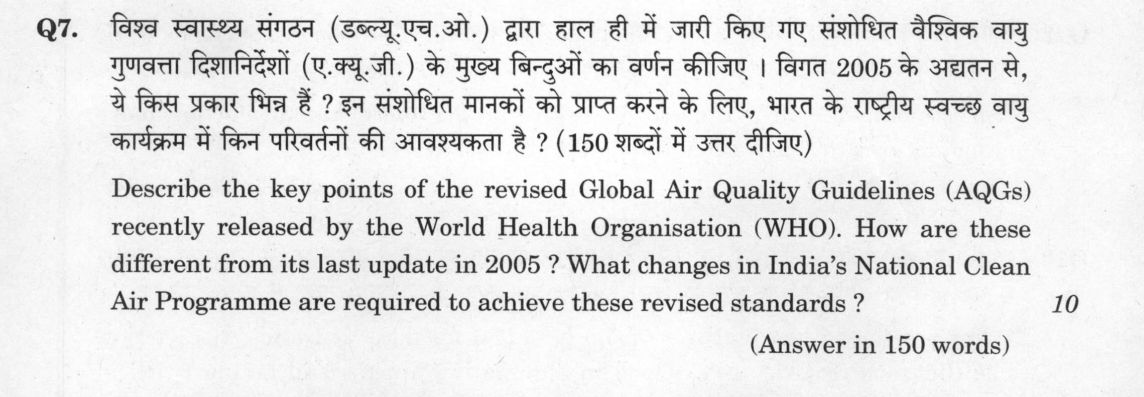
Describe the key points of the revised Global Air Quality Guidelines (AQGs) recently released by the World Health Organisation (WHO). How are these different from its last update in 2005? What changes in India's National Clean Air Programme are required to achieve these revised standards? (Answer in 150 words)
हिंदी में प्रश्न पढ़ें
विश्व स्वास्थ्य संगठन (डब्ल्यू.एच.ओ.) द्वारा हाल ही में जारी किए गए संशोधित वैश्विक वायु गुणवत्ता दिशानिर्देशों (ए.क्यू.जी.) के मुख्य बिंदुओं का वर्णन कीजिए। विगत 2005 के अद्यतन से, ये किस प्रकार भिन्न हैं ? इन संशोधित मानकों को प्राप्त करने के लिए, भारत के राष्ट्रीय स्वच्छ वायु कार्यक्रम में किन परिवर्तनों की आवश्यकता है ? (150 शब्दों में उत्तर दीजिए)
Model answer
Written by UPSC Answer Check against this question's marking rubric, to the 150-word length. UPSC does not publish answers for Mains — this is one way to score well, not an official key.
2021 AQGs. The 2021 WHO AQGs lower annual limits: PM2.5 5 µg/m³ (2005:10), PM10 15 (20), NO2 10 (40). They also revise short-term guidelines for O3, CO and SO2: CO 24-h tightened; SO2 24-h was relaxed from 20 to 40 µg/m³; O3 8-h remains 100 µg/m³, with a new 60 µg/m³ peak-season value.
Difference from 2005. The revision reflects stronger evidence that low-level exposure causes mortality/morbidity and adds black carbon and ultrafine particles as health-relevant components.
NCAP changes. India’s NCAP targets 20–30% reductions in 131 cities, but these are process-oriented, not outcome-based; NAAQS PM2.5 at 40 µg/m³ is eight times WHO 2021. NCAP must adopt WHO-aligned phased NAAQS, expand monitoring beyond 131 cities, mandate sectoral emission inventories, and strengthen CPCB–SPCB enforcement. Sectorally, accelerate BS-VI Phase II, tighten industrial emission norms, and shift to distributed renewables to cut crop-residue burning and thermal power dependence. This is a health-economic imperative for India.
What "Describe" is asking you to do
Give a full, ordered account of the thing named — its parts, stages or mechanism — in the sequence in which it actually exists or occurs. Most describe questions come from the science optionals, where the marks sit in correct technical detail and, where the stem says so, a labelled diagram.
Structure that answers it
One-line identification of the subject → the parts or stages in their real order, each with its defining detail → labelled diagram where the subject is structural → closing line on function or significance
Where marks are lost
Loose general prose where the examiner is ticking named parts, correct terminology and their sequence; and in the General Studies papers, turning to evaluation before the description is finished.
How this answer will be evaluated
Approach
Framework: GS3 Environment: threat, causes, impact, mitigation. describe: define > structure or process in order > labelled diagram > significance Full marks: Precise comparison of 2005/2021 limits and specific, implementable NCAP policy shifts.
Key points expected
- Mentions specific pollutants (PM2.5, NO2, O3) in revised guidelines
- Notes the significant reduction in permissible limits vs 2005
- Identifies NCAP's current 20% reduction target as insufficient
- Suggests specific NCAP changes (e.g., stricter targets, sectoral plans)
Evaluation rubric
Each sub-part is marked on its own, against the marks and word limit printed on the paper.
- The answer Outline revised WHO AQGs, contrast with 2005, and suggest NCAP changes. · 150 words
describe— define → structure or process in order → labelled diagram → significance
Must cover
- Mentions specific pollutants (PM2.5, NO2, O3) in revised guidelines
- Notes the significant reduction in permissible limits vs 2005
- Identifies NCAP's current 20% reduction target as insufficient
- Suggests specific NCAP changes (e.g., stricter targets, sectoral plans)
Loses marks
- Vague generalities about 'pollution control' without specific pollutants
- Failing to explicitly compare 2005 vs 2021 standards
- Suggesting generic measures not linked to NCAP structure
Earns more
- Cites specific numerical values for PM2.5 (e.g., 5 µg/m³)
- Mentions 'interim targets' or 'transition period' for developing nations
- References specific NCAP mechanisms (e.g., city action plans)
Extra mark
- Mentions the 2021 date of the new guidelines
- References the 'National Clean Air Programme' (NCAP) 2019 launch
Practice this exact question
Write your answer and it is marked point by point against the model answer above — what you covered, what you missed, what you got wrong.
Evaluate my answer →More from General Studies 2021 GS Paper III
- Q4 How and to what extent would micro-irrigation help in solving India's water crisis? (Answ…
- Q5 How is S-400 air defence system technically superior to any other system presently availa…
- Q6 Explain the purpose of the Green Grid Initiative launched at World Leaders Summit of the…
- Q7 Describe the key points of the revised Global Air Quality Guidelines (AQGs) recently rele…
- Q8 Discuss about the vulnerability of India to earthquake related hazards. Give examples inc…
- Q9 Discuss how emerging technologies and globalisation contribute to money laundering. Elabo…
- Q10 Keeping in view India's internal security, analyse the impact of cross-border cyber attac…