GS Paper III — Q16
The Nobel Prize in Physics of 2014 was jointly awarded to Akasaki, Amano and Nakamura for the invention of Blue LEDs in 1990s…
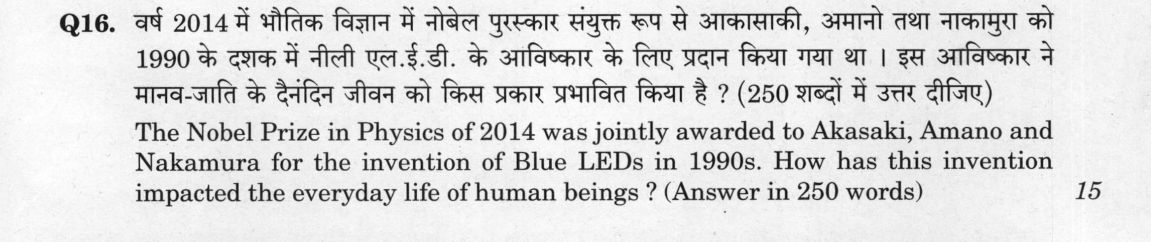
The Nobel Prize in Physics of 2014 was jointly awarded to Akasaki, Amano and Nakamura for the invention of Blue LEDs in 1990s. How has this invention impacted the everyday life of human beings? (Answer in 250 words)
हिंदी में प्रश्न पढ़ें
वर्ष 2014 में भौतिक विज्ञान में नोबेल पुरस्कार संयुक्त रूप से आकासाकी, अमानो तथा नाकामुरा को 1990 के दशक में नीली एल.ई.डी. के आविष्कार के लिए प्रदान किया गया था । इस आविष्कार ने मानव-जाति के दैनंदिन जीवन को किस प्रकार प्रभावित किया है ? (250 शब्दों में उत्तर दीजिए)
Model answer
Written by UPSC Answer Check against this question's marking rubric, to the 250-word length. UPSC does not publish answers for Mains — this is one way to score well, not an official key.
The blue LED mattered because it filled the missing high-energy end of the visible spectrum. With red and green already available, blue completed RGB, allowing full-colour displays; when coated with phosphor, it also produced efficient white light, turning LEDs from niche indicators into a general-purpose light source. This was the missing piece because white light and full-colour displays both required a short-wavelength source.
Lighting and energy This enabled the modern lighting revolution. LEDs use about 85% less energy than incandescent bulbs and last roughly ten times longer, lowering household electricity bills and reducing national demand. LEDs also reduce heat output, making lights safer for homes, offices and street lighting. In India, UJALA’s distribution of over 36 crore LED bulbs has cut annual energy consumption by about 4,700 crore kWh, easing peak-load stress, reducing coal-based generation and lowering carbon emissions.
Displays and communication Blue light made compact, bright, low-power screens practical, and has made thin, battery-friendly devices possible. Smartphones, LED televisions, laptops, tablets and outdoor advertising now rely on it, making digital communication, entertainment and information access more portable and ubiquitous.
Health, sanitation and emerging uses High-energy blue and UV-LEDs enable water purification, sterilisation of medical equipment and phototherapy for neonatal jaundice, extending from household sanitation to clinical care. They also support Li-Fi, smart agriculture through LED grow lights and precision medical treatments.
Thus, the 1990s invention transformed everyday life by making light cheaper, cleaner and more functional, while creating the foundation for future digital, health and climate solutions.
What "Explain" is asking you to do
Make the working of something clear — what sets it off, what follows from what, and what it produces. Explain is the Commission's mechanism word: it dominates the technical papers and the “explain why” stems, where the marks sit in the causal chain and not in the label.
Structure that answers it
State what it is → the initiating condition → the chain of cause, step by step → an instance where it plays out → what the chain produces
Where marks are lost
Describing what something looks like instead of why it works that way. Naming the stages without linking them reads as description too.
How this answer will be evaluated
Approach
Framework: Technology: why it matters, use, benefit, risk, policy. explain: definition/context > points in order > small example > short close Full marks: Detailed, specific impacts on energy, health, and industry with clear examples.
Key points expected
- Energy efficiency and reduced electricity consumption
- Enabling white light for general illumination
- Impact on display technologies (TVs, screens)
- Health and safety benefits (reduced heat, no UV)
Evaluation rubric
Each sub-part is marked on its own, against the marks and word limit printed on the paper.
- The answer Explain the specific impacts of Blue LED invention on daily human life. 15 marks · 250 words
explain— definition/context → points in order → small example → short close
Must cover
- Energy efficiency and reduced electricity consumption
- Enabling white light for general illumination
- Impact on display technologies (TVs, screens)
- Health and safety benefits (reduced heat, no UV)
Loses marks
- Focusing on the history of the Nobel Prize
- Vague generalities about 'technology is good'
- Ignoring the specific role of the 'Blue' component
Earns more
- Mention of solid-state lighting replacing incandescent
- Impact on agriculture (grow lights)
- Longer lifespan and lower maintenance costs
- Environmental impact (reduced carbon footprint)
Extra mark
- Specific statistic on energy savings (e.g., 80% efficient)
- Mention of specific applications like medical lighting
Practice this exact question
Write your answer and it is marked point by point against the model answer above — what you covered, what you missed, what you got wrong.
Evaluate my answer →More from General Studies 2021 GS Paper III
- Q13 What are the salient features of the National Food Security Act, 2013? How has the Food S…
- Q14 What are the present challenges before crop diversification? How do emerging technologies…
- Q15 What are the research and developmental achievements in applied biotechnology? How will t…
- Q16 The Nobel Prize in Physics of 2014 was jointly awarded to Akasaki, Amano and Nakamura for…
- Q17 Describe the major outcomes of the 26th session of the Conference of the Parties (COP) to…
- Q18 Describe the various causes and the effects of landslides. Mention the important componen…
- Q19 Analyse the multidimensional challenges posed by external state and non-state actors, to…