GS Paper IV — Q1
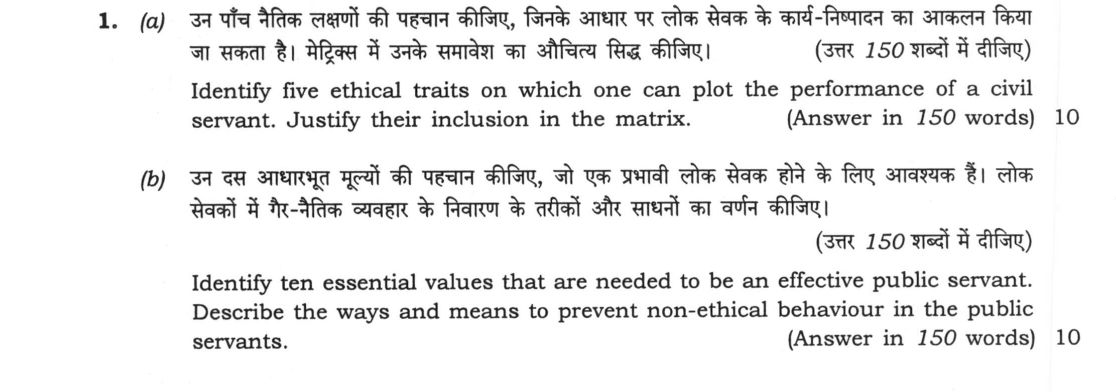
(a) Identify five ethical traits on which one can plot the performance of a civil servant. Justify their inclusion in the matrix…
Identify five ethical traits on which one can plot the performance of a civil servant. Justify their inclusion in the matrix. (Answer in 150 words) 10 marks
Identify ten essential values that are needed to be an effective public servant. Describe the ways and means to prevent non-ethical behaviour in the public servants. (Answer in 150 words) 10 marks
हिंदी में प्रश्न पढ़ें
उन पाँच नैतिक लक्षणों की पहचान कीजिए, जिनके आधार पर लोक सेवक के कार्य-निष्पादन का आकलन किया जा सकता है। मैट्रिक्स में उनके समावेश का औचित्य सिद्ध कीजिए। (उत्तर 150 शब्दों में दीजिए)
उन दस आधारभूत मूल्यों की पहचान कीजिए, जो एक प्रभावी लोक सेवक होने के लिए आवश्यक हैं। लोक सेवकों में गैर-नैतिक व्यवहार के निवारण के तरीकों और साधनों का वर्णन कीजिए। (उत्तर 150 शब्दों में दीजिए)
Model answer
Written by UPSC Answer Check against this question's marking rubric, to the 150-word length. UPSC does not publish answers for Mains — this is one way to score well, not an official key.
(a) Performance Matrix Traits and Justification
Five plottable ethical traits:
- Integrity: Assessed via annual asset declarations and zero conflict of interest; indispensable for eliminating corruption.
- Objectivity: Evaluated through evidence-based file notings and merit-driven decisions; insulates administration from political or personal bias.
- Accountability: Measured through audit compliance, RTI adherence, and timely administrative delivery; guarantees answerability to citizens.
- Empathy: Gauged by proactive interventions for vulnerable sections under schemes like Antyodaya; ensures inclusive welfare.
- Responsiveness: Tracked via citizen charter timelines and public grievance redressal rates; sustains administrative efficiency.
(b) Essential Values and Prevention of Non-Ethical Behaviour
Ten essential values: Integrity, Impartiality, Objectivity, Dedication, Compassion, Transparency, Courage of Conviction, Responsiveness, Honesty, and Accountability.
To prevent unethical behaviour and value erosion:
- Institutional & Legal: Strengthen anti-corruption bodies (Lokpal, CVC) and strictly enforce the RTI Act and Whistle Blowers Protection Act.
- Procedural & Technological: Deploy e-governance (GeM, faceless taxation) to reduce arbitrary discretion, alongside mandatory periodic staff rotations to disrupt corrupt nexuses.
- Personal & Pedagogical: Impart continuous ethics training through Mission Karmayogi, institutionalise mentorship, and adopt 360-degree ethical performance evaluations (SPARROW).
What "Justify" is asking you to do
Defend a position with reasons that carry evidence, and show why the contrary view does not hold. Where the stem runs as a question and asks you to justify your answer, the position is yours to choose and the marks lie wholly in the defence.
Structure that answers it
Position stated plainly → reason 1 with evidence → reason 2 with evidence → strongest objection, met → position restated as qualified
Where marks are lost
Reasons stated and none of them evidenced. The other standard loss is fence-sitting — an answer that finds merit on both sides and commits to neither has justified nothing.
How this answer will be evaluated
Approach
Framework: GS4 Ethical Dilemmas & Values Framework. (a) justify: claim > 3-4 reasons > evidence > conclusion | (b) describe: define > structure or process in order > labelled diagram > significance Full marks: Precise identification of traits/values with strong administrative justification and specific institutional mechanisms.
Key points expected
- Names exactly five distinct ethical traits
- Links each trait to a specific performance metric
- Justifies why the trait is essential for civil service
- Connects traits to public trust or accountability
- Identifies ten distinct essential values
- Describes specific institutional mechanisms for prevention
- Mentions legal or regulatory safeguards (e.g., CVC, RTI)
- Links prevention methods to the identified values
Evaluation rubric
Each sub-part is marked on its own, against the marks and word limit printed on the paper.
- (a) Identify 5 traits and justify their inclusion in a performance matrix. 10 marks · 150 words
justify— claim → 3-4 reasons → evidence → conclusion
Must cover
- Names exactly five distinct ethical traits
- Links each trait to a specific performance metric
- Justifies why the trait is essential for civil service
- Connects traits to public trust or accountability
Loses marks
- Listing more than five traits without prioritization
- Defining traits without linking to performance metrics
- Preaching moral values without administrative application
Earns more
- Mentions specific administrative contexts (e.g., disaster relief)
- References the 2nd ARC report on ethics
- Distinguishes between personal virtue and professional duty
Extra mark
- Cites a specific Supreme Court judgment on ethics
- References the Lokpal and Lokayuktas Act
- (b) List 10 values and describe ways to prevent non-ethical behavior. 10 marks · 150 words
describe— define → structure or process in order → labelled diagram → significance
Must cover
- Identifies ten distinct essential values
- Describes specific institutional mechanisms for prevention
- Mentions legal or regulatory safeguards (e.g., CVC, RTI)
- Links prevention methods to the identified values
Loses marks
- Listing values without describing prevention methods
- Vague generalities like 'strict action' without mechanism
- Ignoring the 'ten values' constraint by listing fewer
Earns more
- Distinguishes between internal (training) and external (audit) controls
- Mentions the role of social media or transparency portals
- References the Prevention of Corruption Act
Extra mark
- Cites the 2nd ARC recommendations on ethics
- Mentions specific whistleblower protection mechanisms
Practice this exact question
Write your answer and it is marked point by point against the model answer above — what you covered, what you missed, what you got wrong.
Evaluate my answer →More from General Studies 2021 GS Paper IV
- Q1 (a) Identify five ethical traits on which one can plot the performance of a civil servant…
- Q2 (a) Impact of digital technology as reliable source of input for rational decision making…
- Q3 What does each of the following quotations mean to you? (a) "Every work has got to pass t…
- Q4 (a) Attitude is an important component that goes as input in the development of human bei…