GS Paper IV — Q4
(a) Attitude is an important component that goes as input in the development of human being. How to build a suitable attitude…
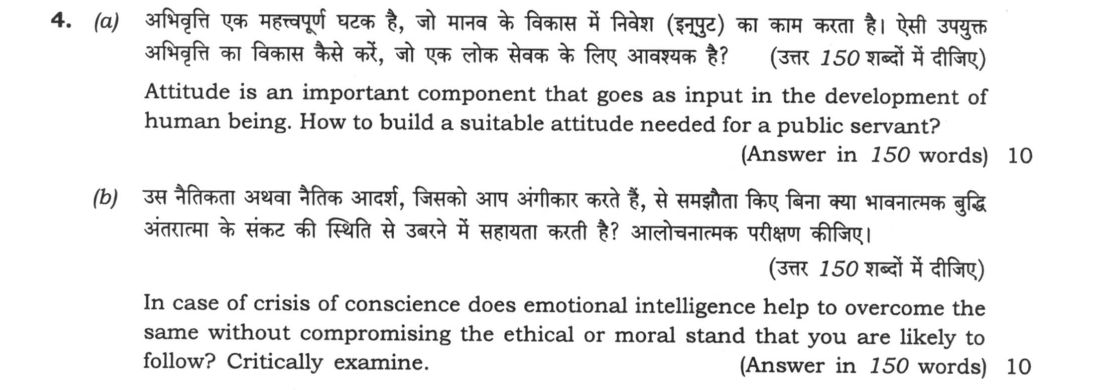
Attitude is an important component that goes as input in the development of human being. How to build a suitable attitude needed for a public servant?
In case of crisis of conscience does emotional intelligence help to overcome the same without compromising the ethical or moral stand that you are likely to follow? Critically examine.
हिंदी में प्रश्न पढ़ें
अभिवृत्ति एक महत्वपूर्ण घटक है, जो मानव के विकास में निवेश (इनपुट) का काम करता है। ऐसी उपयुक्त अभिवृत्ति का विकास कैसे करें, जो एक लोक सेवक के लिए आवश्यक है?
उस नैतिकता अथवा नैतिक आदर्श, जिसको आप अंगीकार करते हैं, से समझौता किए बिना क्या भावनात्मक बुद्धि अंतरात्मा के संकट की स्थिति से उबरने में सहायता करती है? आलोचनात्मक परीक्षण कीजिए।
Model answer
Written by UPSC Answer Check against this question's marking rubric, to the 150-word length. UPSC does not publish answers for Mains — this is one way to score well, not an official key.
Attitude is a learned psychological predisposition that drives action through cognitive (constitutional knowledge), affective (empathy and compassion), and behavioural (integrity and objectivity) components. For a public servant, a pro-public attitude is built through structured value inculcation (as under Mission Karmayogi), experiential field exposure to marginalized realities, institutional mentorship, and regular ethical self-reflection.
EI and Crisis of Conscience
A crisis of conscience arises when personal moral convictions clash with situational demands or official directives. Emotional intelligence (EI)—specifically self-awareness and self-regulation—enables an officer to manage acute moral distress, resist panic, and evaluate dilemmas objectively. Moreover, empathy and social skills facilitate the diplomatic communication of principled dissent without insubordination.
However, EI is inherently an amoral competency. High EI can be misused to rationalize unethical compromises, suppress moral guilt, or manipulate outcomes to maintain situational harmony and appease superiors.
What "Critically examine" is asking you to do
Test the proposition the question puts to you and return a finding on how far it holds. Examine stems carry a claim, or ask whether something has happened, and expect evidence weighed both ways before the extent is stated — often with remedial measures attached. “Critically” is not a section added at the end: name the yardstick you are judging by — the evidence, the stated objective, a constitutional principle, a rival explanation — and let a verdict close each part of the body. Where the question quotes a claim, that verdict must land on the claim itself, accepted, qualified or rejected, and not on the theme in general.
Structure that answers it
Restate the claim as the question frames it → evidence that supports it → evidence that undercuts it → the conditions under which it holds → verdict on how far it stands
Where marks are lost
Merits in one paragraph, demerits in the next, and a conclusion calling for a balanced and holistic approach. That is a survey with the judgement left out and it holds the answer in the middle band. The opposite error is reading “critically” as permission to attack — and with the odd pairings, critically describe or critically explain, the exposition still carries most of the marks, the judgement being a layer on it rather than a substitute for it.
How this answer will be evaluated
Approach
Framework: GS4 Ethical Dilemma & Public Service Values. (a) explain: definition/context > points in order > small example > short close | (b) critically evaluate: positives > negatives/limits > conditions/safeguards > conclusion Full marks: Clear, balanced, and actionable; uses specific examples and references; addresses all parts of the question.
Key points expected
- Define attitude as a component of human development
- Identify specific attitudes needed for public service (e.g., empathy, integrity)
- Provide a method or steps to build these attitudes
- Link the attitude to the role of a public servant
- Define crisis of conscience in the context of public service
- Explain how emotional intelligence (EI) helps in managing such a crisis
- Critically examine if EI can be used without compromising ethical/moral stand
- Provide a balanced judgment on the role of EI
Evaluation rubric
Each sub-part is marked on its own, against the marks and word limit printed on the paper.
- (a) Define attitude and outline a method to build a suitable attitude for a public servant. 10 marks · 150 words
explain— definition/context → points in order → small example → short close
Must cover
- Define attitude as a component of human development
- Identify specific attitudes needed for public service (e.g., empathy, integrity)
- Provide a method or steps to build these attitudes
- Link the attitude to the role of a public servant
Loses marks
- Preaching values without explaining how to build them
- Listing values without connecting them to public service
- Ignoring the 'input' aspect of human development
Earns more
- Mention specific values like empathy, integrity, or service orientation
- Reference the role of training or education in attitude building
- Connect attitude to public trust or service delivery
Extra mark
- Cite a specific value-based example or case study
- Reference a relevant quote on public service attitude
- (b) Critically examine if emotional intelligence helps overcome a crisis of conscience without compromising ethical/moral stand. 10 marks · 150 words
critically evaluate— positives → negatives/limits → conditions/safeguards → conclusion
Must cover
- Define crisis of conscience in the context of public service
- Explain how emotional intelligence (EI) helps in managing such a crisis
- Critically examine if EI can be used without compromising ethical/moral stand
- Provide a balanced judgment on the role of EI
Loses marks
- Treating EI as a panacea for all ethical dilemmas
- Ignoring the 'without compromising' constraint
- Failing to critically examine the role of EI
Earns more
- Distinguish between emotional intelligence and ethical reasoning
- Provide an example of a crisis of conscience and how EI helps
- Discuss the limits of EI in ethical decision-making
Extra mark
- Reference a specific ethical framework or thinker
- Cite a relevant case study or example
Practice this exact question
Write your answer and it is marked point by point against the model answer above — what you covered, what you missed, what you got wrong.
Evaluate my answer →More from General Studies 2021 GS Paper IV
- Q1 (a) Identify five ethical traits on which one can plot the performance of a civil servant…
- Q2 (a) Impact of digital technology as reliable source of input for rational decision making…
- Q3 What does each of the following quotations mean to you? (a) "Every work has got to pass t…
- Q4 (a) Attitude is an important component that goes as input in the development of human bei…
- Q5 (a) "Refugees should not be turned back to the country where they would face persecution…
- Q6 (a) An independent and empowered social audit mechanism is an absolute must in every sphe…
- Q7 Sunil is a young civil servant and has a reputation for his competence, integrity, dedica…