GS Paper IV — Q11
A reputed food product company based in India developed a food product for the international market and started exporting the…
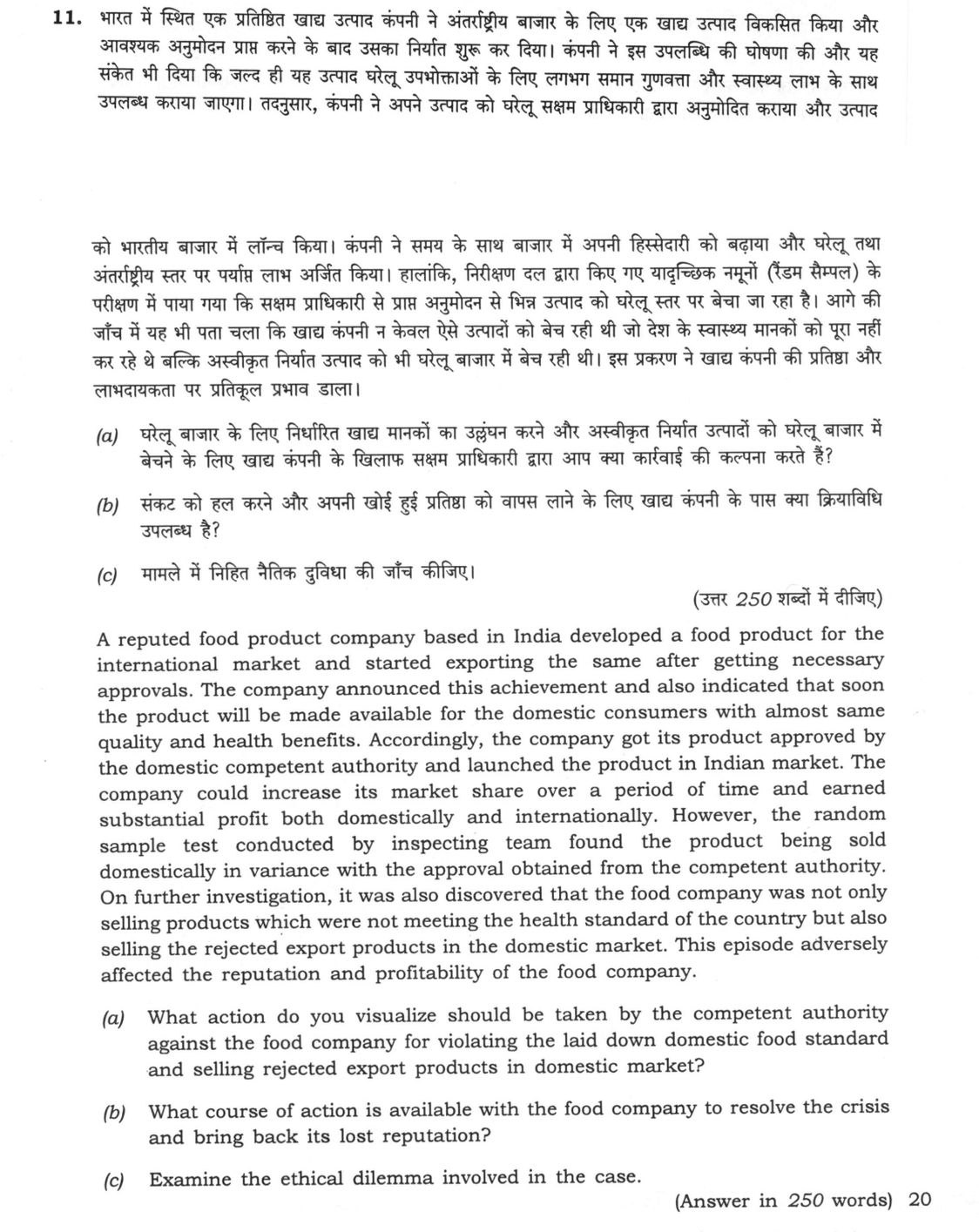
A reputed food product company based in India developed a food product for the international market and started exporting the same after getting necessary approvals. The company announced this achievement and also indicated that soon the product will be made available for the domestic consumers with almost same quality and health benefits. Accordingly, the company got its product approved by the domestic competent authority and launched the product in Indian market. The company could increase its market share over a period of time and earned substantial profit both domestically and internationally. However, the random sample test conducted by inspecting team found the product being sold domestically in variance with the approval obtained from the competent authority. On further investigation, it was also discovered that the food company was not only selling products which were not meeting the health standard of the country but also selling the rejected export products in the domestic market. This episode adversely affected the reputation and profitability of the food company.
What action do you visualize should be taken by the competent authority against the food company for violating the laid down domestic food standard and selling rejected export products in domestic market?
What course of action is available with the food company to resolve the crisis and bring back its lost reputation?
Examine the ethical dilemma involved in the case.
(Answer in 250 words)
हिंदी में प्रश्न पढ़ें
भारत में स्थित एक प्रतिष्ठित खाद्य उत्पाद कंपनी ने अंतर्राष्ट्रीय बाजार के लिए एक खाद्य उत्पाद विकसित किया और आवश्यक अनुमोदन प्राप्त करने के बाद उसका निर्यात शुरू कर दिया। कंपनी ने इस उपलब्धि की घोषणा की और यह संकेत भी दिया कि जल्द ही यह उत्पाद घरेलू उपभोक्ताओं के लिए लगभग समान गुणवत्ता और स्वास्थ्य लाभ के साथ उपलब्ध कराया जाएगा। तदनुसार, कंपनी ने अपने उत्पाद को घरेलू सक्षम प्राधिकारी द्वारा अनुमोदित कराया और उत्पाद को भारतीय बाजार में लॉन्च किया। कंपनी ने समय के साथ बाजार में अपनी हिस्सेदारी को बढ़ाया और घरेलू तथा अंतर्राष्ट्रीय स्तर पर पर्याप्त लाभ अर्जित किया। हालांकि, निरीक्षण दल द्वारा किए गए यादृच्छिक नमूनों (रैंडम सैम्पल) के परीक्षण में पाया गया कि सक्षम प्राधिकारी से प्राप्त अनुमोदन से भिन्न उत्पाद को घरेलू स्तर पर बेचा जा रहा है। आगे की जाँच में यह भी पता चला कि खाद्य कंपनी न केवल ऐसे उत्पादों को बेच रही थी जो देश के स्वास्थ्य मानकों को पूरा नहीं कर रहे थे बल्कि अस्वीकृत निर्यात उत्पाद को भी घरेलू बाजार में बेच रही थी। इस प्रकरण ने खाद्य कंपनी की प्रतिष्ठा और लाभदायकता पर प्रतिकूल प्रभाव डाला।
घरेलू बाजार के लिए निर्धारित खाद्य मानकों का उल्लंघन करने और अस्वीकृत निर्यात उत्पादों को घरेलू बाजार में बेचने के लिए खाद्य कंपनी के खिलाफ सक्षम प्राधिकारी द्वारा आप क्या कार्रवाई की कल्पना करते हैं?
संकट को हल करने और अपनी खोई हुई प्रतिष्ठा को वापस लाने के लिए खाद्य कंपनी के पास क्या क्रियाविधि उपलब्ध है?
मामले में निहित नैतिक दुविधा की जाँच कीजिए।
(उत्तर 250 शब्दों में दीजिए)
Model answer
Written by UPSC Answer Check against this question's marking rubric, to the 250-word length. UPSC does not publish answers for Mains — this is one way to score well, not an official key.
The case highlights a systemic breach where information asymmetry and corporate malfeasance endanger public health. The key stakeholders are domestic consumers (entitled to safe food under Article 21), the regulator (FSSAI), corporate leadership, and market institutions dependent on public trust.
Actions by the Competent Authority Exercising statutory powers under the Food Safety and Standards (FSS) Act, 2006, the authority must:
- Issue an immediate nationwide product recall and suspend manufacturing and export licenses.
- Initiate prosecution and levy deterrent financial penalties under Sections 50–59 for selling unsafe, misbranded, and sub-standard food.
- Conduct comprehensive supply-chain audits and publicly disclose testing data to dispel regulatory arbitrage and restore market transparency.
Course of Action for the Food Company Applying virtue ethics and restorative governance, the management must:
- Make a transparent, unconditional public admission of failure and execute a voluntary recall.
- Fix internal accountability by penalising erring executives and overhauling quality-assurance boards.
- Implement third-party batch certification, open traceability protocols, and establish a consumer compensation fund, accepting short-term financial distress to rebuild long-term social capital.
Ethical Dilemmas Involved
- Profit Maximisation vs Public Health: A classic deontological violation where citizens were treated merely as a means to clear sub-standard inventory.
- Dual Standards vs Equity: Dumping rejected exports domestically breaches distributive justice, treating domestic citizens with lesser dignity than foreign consumers.
- Short-term Shareholder Value vs Long-term Institutional Integrity: Prioritising quarterly margins over corporate social responsibility eroded foundational consumer trust.
Administrative wisdom requires deterring corporate impunity through stringent post-market surveillance while embedding verifiable compliance mechanisms that hold commercial profit strictly subservient to public safety.
What "Analyse" is asking you to do
Break the subject into its working parts and show how they act on each other. The marks are in the interconnections — which factor drives which, and what the resulting structure explains — not in the inventory of factors.
Structure that answers it
Define the whole → separate it into its parts → show which part drives which → what that interaction produces → what the structure implies
Where marks are lost
A flat list of causes with no account of which drives which. An answer of neatly separated headings, each self-contained, scores as description.
How this answer will be evaluated
Approach
Framework: GS4 Case Study: Crux, Stakeholders, Dilemmas, Options, Course of Action (Immediate/Short/Long-term). (a) suggest: the problem in one line > implementable measures > who acts > conclusion | (b) suggest: the problem in one line > implementable measures > who acts > conclusion | (c) examine: intro > how/why with reasoning > evidence > conclusion Full marks: Identifies specific legal/ethical frameworks, provides actionable 3-horizon solutions, and clearly articulates the core dilemma.
Key points expected
- Immediate recall and seizure of non-compliant stock
- Financial penalties and revocation of FSSAI license
- Criminal prosecution for fraud and public health risk
- Mandatory public disclosure of the violation
- Unconditional apology and full transparency
- Compensation to affected consumers
- Independent third-party quality audit
- Long-term: Institutionalizing ethical compliance culture
Evaluation rubric
Each sub-part is marked on its own, against the marks and word limit printed on the paper.
- (a) Regulatory actions by competent authority for standard violation and dumping rejected exports.
suggest— the problem in one line → implementable measures → who acts → conclusion
Must cover
- Immediate recall and seizure of non-compliant stock
- Financial penalties and revocation of FSSAI license
- Criminal prosecution for fraud and public health risk
- Mandatory public disclosure of the violation
Loses marks
- Suggesting only warnings or verbal advice
- Ignoring the 'rejected export' aspect
- Focusing on company profit over public safety
Earns more
- Reference to FSSAI Act 2006 provisions
- Mention of 'strict liability' for food safety
- Action against specific officers involved
Extra mark
- Citing specific FSSAI penalty amounts
- Reference to 'Food Safety Officer' powers
- (b) Strategic steps for the company to resolve crisis and restore reputation.
suggest— the problem in one line → implementable measures → who acts → conclusion
Must cover
- Unconditional apology and full transparency
- Compensation to affected consumers
- Independent third-party quality audit
- Long-term: Institutionalizing ethical compliance culture
Loses marks
- Suggesting PR spin without action
- Blaming employees or 'systemic failure'
- Ignoring the need for structural change
Earns more
- CEO taking personal responsibility
- Whistleblower protection policy
- CSR initiatives for health awareness
Extra mark
- Reference to 'Crisis Management' protocols
- Specific PR strategy for trust building
- (c) Analysis of the ethical conflict between profit and public health.
examine— intro → how/why with reasoning → evidence → conclusion
Must cover
- Conflict: Profit motive vs. Public Health
- Deception: Hiding rejected exports from consumers
- Breach of Trust: Violating social contract
- Utilitarian vs. Deontological perspective
Loses marks
- Preaching generic values without application
- Ignoring the 'rejected export' ethical breach
- Failing to identify the core dilemma
Earns more
- Mention of 'Corporate Social Responsibility'
- Reference to 'Stakeholder Theory'
- Discussion of 'Moral Hazard'
Extra mark
- Citing a specific ethical framework (e.g., Kant)
- Reference to 'Business Ethics' codes
Practice this exact question
Write your answer and it is marked point by point against the model answer above — what you covered, what you missed, what you got wrong.
Evaluate my answer →More from General Studies 2021 GS Paper IV
- Q8 You are Vice Principal of a degree college in one of the middle-class towns. Principal ha…
- Q9 An elevated corridor is being constructed to reduce traffic congestion in the capital of…
- Q10 The coronavirus disease (COVID-19) pandemic has quickly spread to various countries. As o…
- Q11 A reputed food product company based in India developed a food product for the internatio…
- Q12 Pawan is working as an officer in the State Government for the last ten years. As a part…