GS Paper IV — Q3
What does each of the following quotations mean to you? (a) "Every work has got to pass through hundreds of difficulties before…
What does each of the following quotations mean to you?
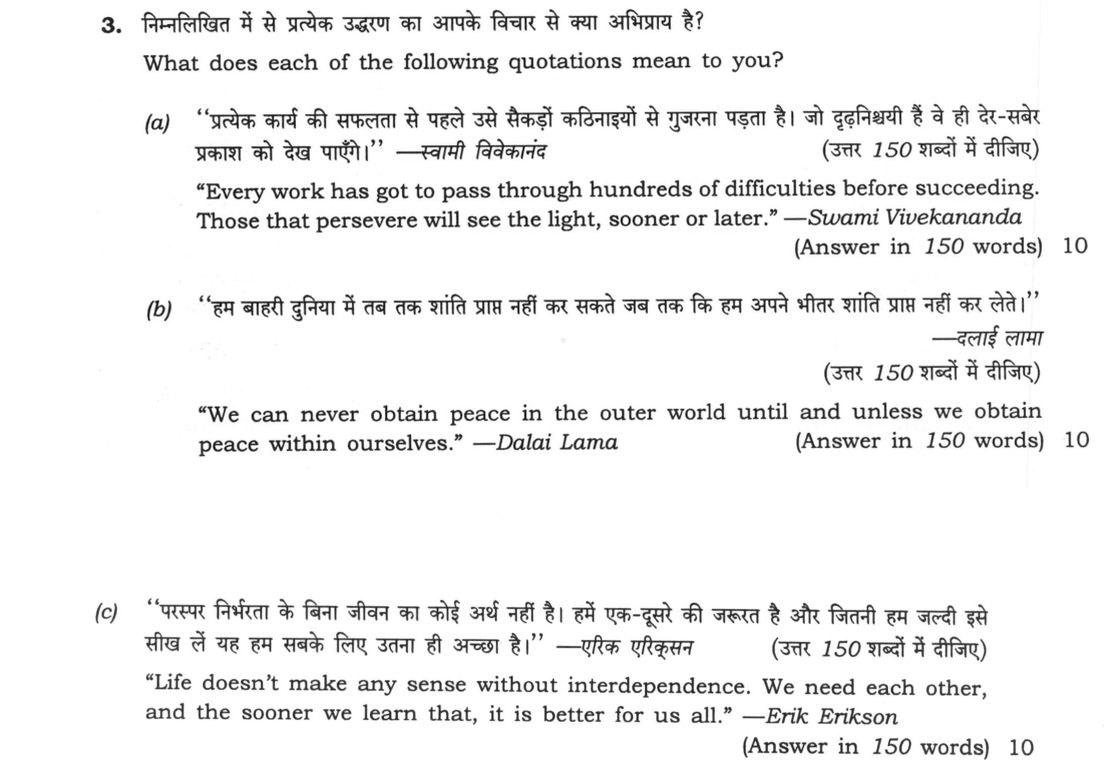
"Every work has got to pass through hundreds of difficulties before succeeding. Those that persevere will see the light, sooner or later." —Swami Vivekananda
"We can never obtain peace in the outer world until and unless we obtain peace within ourselves." —Dalai Lama
"Life doesn't make any sense without interdependence. We need each other, and the sooner we learn that, it is better for us all." —Erik Erikson
हिंदी में प्रश्न पढ़ें
निम्नलिखित में से प्रत्येक उद्धरण का आपके विचार से क्या अभिप्राय है?
"प्रत्येक कार्य की सफलता से पहले उसे सैकड़ों कठिनाइयों से गुजरना पड़ता है। जो दृढ़निश्चयी हैं वे ही देर-सबेर प्रकाश को देख पाएँगे।" —स्वामी विवेकानंद
"हम बाहरी दुनिया में तब तक शांति प्राप्त नहीं कर सकते जब तक कि हम अपने भीतर शांति प्राप्त नहीं कर लेते।" —दलाई लामा
"परस्पर निर्भरता के बिना जीवन का कोई अर्थ नहीं है। हमें एक-दूसरे की जरूरत है और जितनी हम जल्दी इसे सीख लें यह हम सबके लिए उतना ही अच्छा है।" —एरिक एरिक्सन
Model answer
Written by UPSC Answer Check against this question's marking rubric, to the 150-word length. UPSC does not publish answers for Mains — this is one way to score well, not an official key.
These three maxims collectively formulate a blueprint for public life, linking personal fortitude, psychological equanimity, and institutional synergy to achieve ethical and effective governance.
Perseverance and Resilience in Governance
Swami Vivekananda emphasizes that transformative change inevitably encounters institutional inertia, resource constraints, and systemic resistance. In public administration, policy execution is often fraught with procedural delays, public skepticism, and political pressures. When a civil servant perseveres with unwavering dedication, friction is overcome and initial failures convert into durable administrative outcomes. For instance, ISRO’s persistent pursuit after the setback of Chandrayaan-2 culminated in the triumphant landing of Chandrayaan-3, exemplifying how resilience converts technical difficulties into historic breakthroughs. Similarly, the relentless ground-level resolve of ASHA workers during the COVID-19 pandemic and the decades-long grassroots struggles to institutionalize the Right to Information (RTI) Act demonstrate that public success demands persistent commitment against all odds.
Inner Equanimity and External Harmony
The Dalai Lama articulates the causal linkage between personal psychological balance and societal peace. An administrator who lacks emotional regulation or harbours internal ethical dissonance cannot effectively resolve complex social discords or uphold justice impartially. Inner tranquility fosters ethical clarity, insulating decision-makers from corruption, impulse, and external pressure during high-stakes crises while preventing administrative burnout. Institutionalizing stress-management and meditation practices cultivates emotional intelligence, enabling civil servants to approach communal tensions, law-and-order situations, and public grievances with empathy and dispassionate wisdom. Outer social harmony is thus an outward projection of an administrator's internal moral and emotional stability.
Interdependence and Collaborative Governance
Erik Erikson highlights human interconnectedness as the foundational reality of shared survival and collective welfare. In administration, isolated bureaucratic silos inevitably fail to resolve multidimensional socio-economic challenges. Sustainable progress demands collaborative frameworks, as seen in India's cooperative federalism, synchronized multi-agency responses under the National Disaster Management Authority (NDMA), and robust public-private partnerships. This is vividly reflected in the Jan-Bhagidari (people's participation) model of the Swachh Bharat Mission, where state machinery and citizen action coalesced to achieve community-wide sanitation. Public value is created only when society, state, and institutions act on the understanding of their mutual reliance.
Synthesized Administrative Philosophy
Ethical and impactful administration emerges at the convergence of these three truths: it requires resilient individuals with the fortitude to endure administrative difficulties, anchored in deep inner peace and emotional balance, working through empathetic, interdependent institutional structures. In public service, I aspire to embody this triad—cultivating unyielding perseverance in policy execution, maintaining internal moral equanimity under pressure, and championing collaborative, participatory governance for the collective good.
What "Explain" is asking you to do
Make the working of something clear — what sets it off, what follows from what, and what it produces. Explain is the Commission's mechanism word: it dominates the technical papers and the “explain why” stems, where the marks sit in the causal chain and not in the label.
Structure that answers it
State what it is → the initiating condition → the chain of cause, step by step → an instance where it plays out → what the chain produces
Where marks are lost
Describing what something looks like instead of why it works that way. Naming the stages without linking them reads as description too.
How this answer will be evaluated
Approach
Framework: GS4 Ethical Reasoning & Value Application. (a) comment: context > arguments both sides > judgment > close | (b) comment: context > arguments both sides > judgment > close | (c) comment: context > arguments both sides > judgment > close Full marks: Clear interpretation, strong administrative link, specific example, balanced judgment.
Key points expected
- Contextualize the quote's meaning
- Link perseverance to administrative challenges
- Provide a specific example of overcoming difficulty
- Conclude with a balanced judgment on the value
- Define the relationship between inner/outer peace
- Explain how personal bias affects public policy
- Discuss the role of emotional intelligence in leadership
- Offer a judgment on the quote's validity
Evaluation rubric
Each sub-part is marked on its own, against the marks and word limit printed on the paper.
- (a) Interpret Vivekananda's quote on perseverance and its relevance to public service. 10 marks · 150 words
comment— context → arguments both sides → judgment → close
Must cover
- Contextualize the quote's meaning
- Link perseverance to administrative challenges
- Provide a specific example of overcoming difficulty
- Conclude with a balanced judgment on the value
Loses marks
- Preaching without reasoning
- Ignoring the 'difficulties' aspect
- Conclusion merely repeating the intro
Earns more
- Mentioning a specific historical figure
- Connecting to modern bureaucratic hurdles
- Discussing the psychological aspect of resilience
- Balancing optimism with realistic constraints
Extra mark
- Citing a specific administrative reform
- Referencing a relevant Supreme Court judgment
- (b) Analyze the link between inner peace and outer peace in governance. 10 marks · 150 words
comment— context → arguments both sides → judgment → close
Must cover
- Define the relationship between inner/outer peace
- Explain how personal bias affects public policy
- Discuss the role of emotional intelligence in leadership
- Offer a judgment on the quote's validity
Loses marks
- Being overly abstract or philosophical
- Ignoring the 'outer world' (public) aspect
- Failing to connect to administrative ethics
Earns more
- Linking to conflict resolution
- Mentioning stress management in high-pressure roles
- Discussing the impact on stakeholder trust
- Balancing personal well-being with duty
Extra mark
- Citing a specific psychological study
- Referencing a specific ethical code of conduct
- (c) Discuss the importance of interdependence in life and society. 10 marks · 150 words
comment— context → arguments both sides → judgment → close
Must cover
- Explain the concept of interdependence
- Link to social cohesion and community welfare
- Provide an example of collective action
- Conclude with the benefits of this realization
Loses marks
- Focusing only on individualism
- Ignoring the 'sooner we learn' urgency
- Vague generalities without specific examples
Earns more
- Mentioning specific social schemes
- Discussing the role of NGOs
- Linking to sustainable development goals
- Balancing individual rights with collective needs
Extra mark
- Citing a specific community development project
- Referencing a relevant sociological theory
Practice this exact question
Write your answer and it is marked point by point against the model answer above — what you covered, what you missed, what you got wrong.
Evaluate my answer →More from General Studies 2021 GS Paper IV
- Q1 (a) Identify five ethical traits on which one can plot the performance of a civil servant…
- Q2 (a) Impact of digital technology as reliable source of input for rational decision making…
- Q3 What does each of the following quotations mean to you? (a) "Every work has got to pass t…
- Q4 (a) Attitude is an important component that goes as input in the development of human bei…
- Q5 (a) "Refugees should not be turned back to the country where they would face persecution…
- Q6 (a) An independent and empowered social audit mechanism is an absolute must in every sphe…