GS Paper IV — Q9
An elevated corridor is being constructed to reduce traffic congestion in the capital of a particular state. You have been…
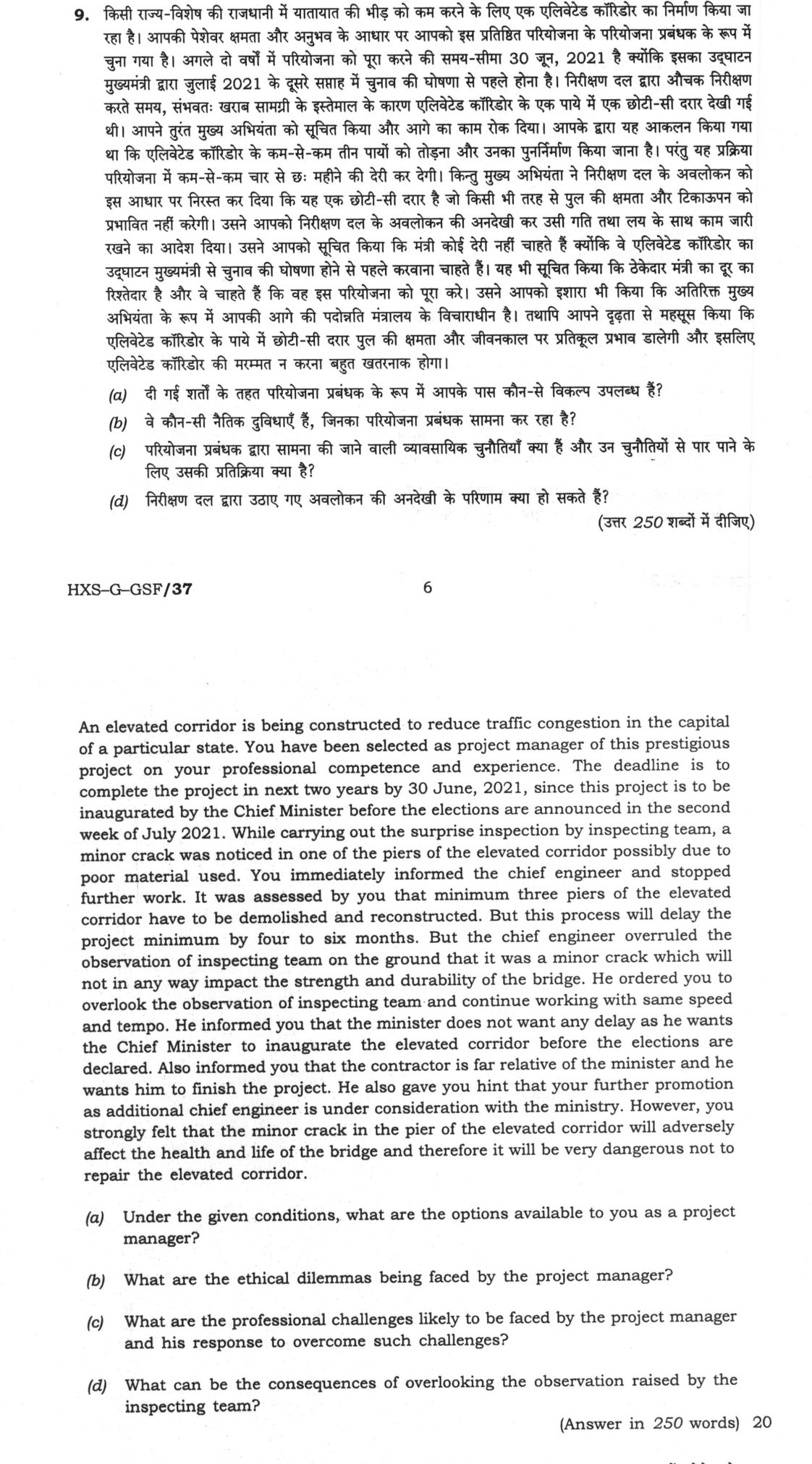
An elevated corridor is being constructed to reduce traffic congestion in the capital of a particular state. You have been selected as project manager of this prestigious project on your professional competence and experience. The deadline is to complete the project in next two years by 30 June, 2021, since this project is to be inaugurated by the Chief Minister before the elections are announced in the second week of July 2021. While carrying out the surprise inspection by inspecting team, a minor crack was noticed in one of the piers of the elevated corridor possibly due to poor material used. You immediately informed the chief engineer and stopped further work. It was assessed by you that minimum three piers of the elevated corridor have to be demolished and reconstructed. But this process will delay the project minimum by four to six months. But the chief engineer overruled the observation of inspecting team on the ground that it was a minor crack which will not in any way impact the strength and durability of the bridge. He ordered you to overlook the observation of inspecting team and continue working with same speed and tempo. He informed you that the minister does not want any delay as he wants the Chief Minister to inaugurate the elevated corridor before the elections are declared. Also informed you that the contractor is far relative of the minister and he wants him to finish the project. He also gave you hint that your further promotion as additional chief engineer is under consideration with the ministry. However, you strongly felt that the minor crack in the pier of the elevated corridor will adversely affect the health and life of the bridge and therefore it will be very dangerous not to repair the elevated corridor.
Under the given conditions, what are the options available to you as a project manager?
What are the ethical dilemmas being faced by the project manager?
What are the professional challenges likely to be faced by the project manager and his response to overcome such challenges?
What can be the consequences of overlooking the observation raised by the inspecting team?
(Answer in 250 words)
हिंदी में प्रश्न पढ़ें
किसी राज्य-विशेष की राजधानी में यातायात की भीड़ को कम करने के लिए एक एलिवेटेड कॉरिडोर का निर्माण किया जा रहा है। आपकी पेशेवर क्षमता और अनुभव के आधार पर आपको इस प्रतिष्ठित परियोजना के परियोजना प्रबंधक के रूप में चुना गया है। अगले दो वर्षों में परियोजना को पूरा करने की समय-सीमा 30 जून, 2021 है क्योंकि इसका उद्घाटन मुख्यमंत्री द्वारा जुलाई 2021 के दूसरे सप्ताह में चुनाव की घोषणा से पहले होना है। निरीक्षण दल द्वारा औचक निरीक्षण करते समय, संभवतः खराब सामग्री के इस्तेमाल के कारण एलिवेटेड कॉरिडोर के एक पाये में एक छोटी-सी दरार देखी गई थी। आपने तुरंत मुख्य अभियंता को सूचित किया और आगे का काम रोक दिया। आपके द्वारा यह आकलन किया गया था कि एलिवेटेड कॉरिडोर के कम-से-कम तीन पायों को तोड़ना और उनका पुनर्निर्माण किया जाना है। परंतु यह प्रक्रिया परियोजना में कम-से-कम चार से छः महीने की देरी कर देगी। किन्तु मुख्य अभियंता ने निरीक्षण दल के अवलोकन को इस आधार पर निरस्त कर दिया कि यह एक छोटी-सी दरार है जो किसी भी तरह से पुल की क्षमता और टिकाऊपन को प्रभावित नहीं करेगी। उसने आपको निरीक्षण दल के अवलोकन की अनदेखी कर उसी गति तथा लय के साथ काम जारी रखने का आदेश दिया। उसने आपको सूचित किया कि मंत्री कोई देरी नहीं चाहते हैं क्योंकि वे एलिवेटेड कॉरिडोर का उद्घाटन मुख्यमंत्री से चुनाव की घोषणा होने से पहले करवाना चाहते हैं। यह भी सूचित किया कि ठेकेदार मंत्री का दूर का रिश्तेदार है और वे चाहते हैं कि वह इस परियोजना को पूरा करे। उसने आपको इशारा भी किया कि अतिरिक्त मुख्य अभियंता के रूप में आपकी आगे की पदोन्नति मंत्रालय के विचाराधीन है। तथापि आपने दृढ़ता से महसूस किया कि एलिवेटेड कॉरिडोर के पाये में छोटी-सी दरार पुल की क्षमता और जीवनकाल पर प्रतिकूल प्रभाव डालेगी और इसलिए एलिवेटेड कॉरिडोर की मरम्मत न करना बहुत खतरनाक होगा।
दी गई शर्तों के तहत परियोजना प्रबंधक के रूप में आपके पास कौन-से विकल्प उपलब्ध हैं?
वे कौन-सी नैतिक दुविधाएँ हैं, जिनका परियोजना प्रबंधक सामना कर रहा है?
परियोजना प्रबंधक द्वारा सामना की जाने वाली व्यावसायिक चुनौतियाँ क्या हैं और उन चुनौतियों से पार पाने के लिए उसकी प्रतिक्रिया क्या है?
निरीक्षण दल द्वारा उठाए गए अवलोकन की अनदेखी के परिणाम क्या हो सकते हैं?
(उत्तर 250 शब्दों में दीजिए)
Model answer
Written by UPSC Answer Check against this question's marking rubric, to the 250-word length. UPSC does not publish answers for Mains — this is one way to score well, not an official key.
This case presents a fundamental conflict between uncompromising public safety and corrupt political expediency, demanding steadfast administrative morality.
Options Available The project manager can formally document dissent in official files and escalate the safety report to higher technical bodies like the DG (Roads & Highways). He can mandate an independent structural audit through an IIT/NIT technical panel. If coercion persists, he should seek statutory safeguards under the Whistle Blowers Protection Act, using principled resignation only as an ethical last resort.
Ethical Dilemmas The primary dilemmas involve deontological duty toward engineering standards versus consequentialist political pressure for pre-election inauguration; public safety versus personal career advancement (promised promotion); and unquestioning loyalty to departmental hierarchy versus constitutional accountability to citizen welfare.
Professional Challenges and Response The manager faces isolation, punitive transfers, tampered performance appraisals (ACRs), and evidence destruction by the minister-contractor nexus. To overcome this, he must mandate written directives for all instructions, preserve tamper-proof inspection logs, mobilize peer solidarity through professional engineering bodies, and invoke provisions under the Disaster Management Act to halt hazardous public construction.
Consequences of Overlooking Overlooking the defect risks catastrophic bridge collapse causing mass casualties, as seen in the 2022 Morbi bridge tragedy. It invites severe criminal liability under IPC Sections 304A and 409, permanent loss of professional accreditation, and complete destruction of public trust in state infrastructure.
Way Forward The project manager must prioritize the sanctity of life under Article 21, adhering strictly to Rule 3 of the Central Civil Services (Conduct) Rules, 1964, which mandates absolute integrity and devotion to duty over personal career gains.
What "Analyse" is asking you to do
Break the subject into its working parts and show how they act on each other. The marks are in the interconnections — which factor drives which, and what the resulting structure explains — not in the inventory of factors.
Structure that answers it
Define the whole → separate it into its parts → show which part drives which → what that interaction produces → what the structure implies
Where marks are lost
A flat list of causes with no account of which drives which. An answer of neatly separated headings, each self-contained, scores as description.
How this answer will be evaluated
Approach
Framework: GS4 Ethical Dilemma Framework. (a) enumerate: list the items in order > one line each > no commentary | (b) highlight: name the salient points > one line of substance each > close | (c) challenges: 3-4 challenges > solutions mapped to them > conclusion | (d) analyse: intro > causes > effects > stakeholders/linkages > way forward Full marks: Balanced analysis of all 4 parts with specific actions and legal/ethical references.
Key points expected
- Option to comply with Chief Engineer's order
- Option to escalate to higher authority (Ministry/CM)
- Option to resign from the post
- Option to seek independent technical re-assessment
- Conflict between public safety and political pressure
- Conflict between personal career and professional duty
- Conflict between loyalty to boss and integrity
- Conflict between political expediency and structural safety
Evaluation rubric
Each sub-part is marked on its own, against the marks and word limit printed on the paper.
- (a) List the specific courses of action available to the PM.
enumerate— list the items in order → one line each → no commentary
Must cover
- Option to comply with Chief Engineer's order
- Option to escalate to higher authority (Ministry/CM)
- Option to resign from the post
- Option to seek independent technical re-assessment
Loses marks
- Listing only one option
- Vague options like 'do the right thing'
Earns more
- Mentioning option to report to media (last resort)
- Option to seek legal advice
Extra mark
- Reference to Whistle Blower Protection Act
- (b) Identify the specific ethical conflicts in the scenario.
highlight— name the salient points → one line of substance each → close
Must cover
- Conflict between public safety and political pressure
- Conflict between personal career and professional duty
- Conflict between loyalty to boss and integrity
- Conflict between political expediency and structural safety
Loses marks
- Generic ethical statements without context
- Ignoring the specific political/career pressure
Earns more
- Mentioning conflict of interest (contractor is relative)
- Conflict between short-term gain and long-term liability
Extra mark
- Reference to 'Public Trust' theory
- (c) Detail professional hurdles and the specific response to each.
challenges— 3-4 challenges → solutions mapped to them → conclusion
Must cover
- Challenge: Political pressure; Response: Firm refusal
- Challenge: Career threat; Response: Integrity over promotion
- Challenge: Peer/Contractor pressure; Response: Technical evidence
- Challenge: Institutional inertia; Response: Written record
Loses marks
- Listing challenges without specific responses
- Passive responses like 'waiting and watching'
Earns more
- Response: Seeking independent expert opinion
- Response: Documenting all instructions in writing
Extra mark
- Reference to 'Code of Ethics' for engineers
- (d) Explain the consequences of ignoring the structural defect.
analyse— intro → causes → effects → stakeholders/linkages → way forward
Must cover
- Structural failure leading to loss of life
- Legal liability for negligence
- Damage to public trust in government
- Financial loss due to eventual collapse
Loses marks
- Focusing only on financial loss
- Ignoring the human cost (loss of life)
Earns more
- Reputational damage to the state
- Criminal charges against officials
Extra mark
- Reference to a specific bridge collapse case study
Practice this exact question
Write your answer and it is marked point by point against the model answer above — what you covered, what you missed, what you got wrong.
Evaluate my answer →More from General Studies 2021 GS Paper IV
- Q6 (a) An independent and empowered social audit mechanism is an absolute must in every sphe…
- Q7 Sunil is a young civil servant and has a reputation for his competence, integrity, dedica…
- Q8 You are Vice Principal of a degree college in one of the middle-class towns. Principal ha…
- Q9 An elevated corridor is being constructed to reduce traffic congestion in the capital of…
- Q10 The coronavirus disease (COVID-19) pandemic has quickly spread to various countries. As o…
- Q11 A reputed food product company based in India developed a food product for the internatio…
- Q12 Pawan is working as an officer in the State Government for the last ten years. As a part…