GS Paper IV — Q8
You are Vice Principal of a degree college in one of the middle-class towns. Principal has recently retired and management is…
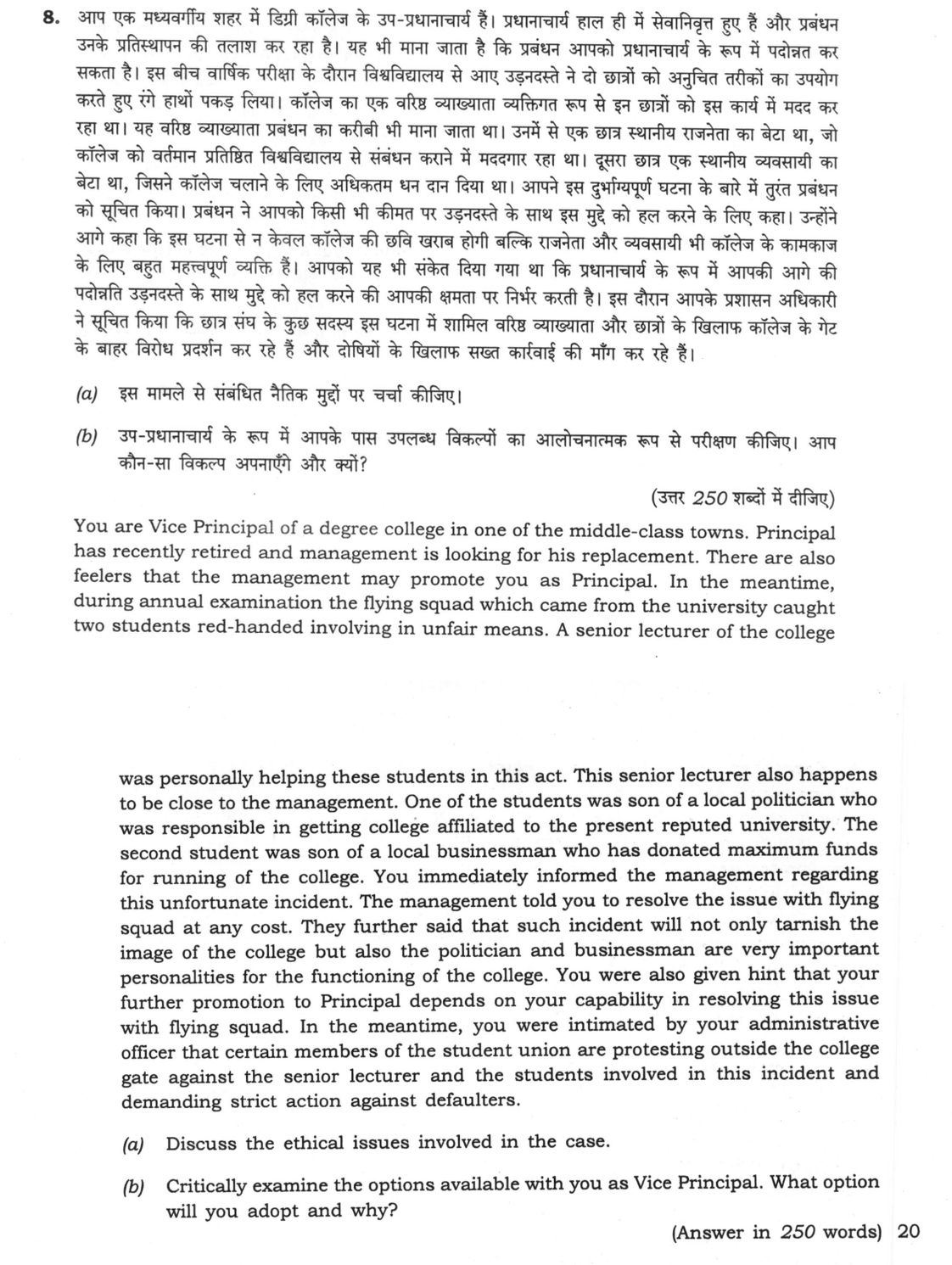
You are Vice Principal of a degree college in one of the middle-class towns. Principal has recently retired and management is looking for his replacement. There are also feelers that the management may promote you as Principal. In the meantime, during annual examination the flying squad which came from the university caught two students red-handed involving in unfair means. A senior lecturer of the college was personally helping these students in this act. This senior lecturer also happens to be close to the management. One of the students was son of a local politician who was responsible in getting college affiliated to the present reputed university. The second student was son of a local businessman who has donated maximum funds for running of the college. You immediately informed the management regarding this unfortunate incident. The management told you to resolve the issue with flying squad at any cost. They further said that such incident will not only tarnish the image of the college but also the politician and businessman are very important personalities for the functioning of the college. You were also given hint that your further promotion to Principal depends on your capability in resolving this issue with flying squad. In the meantime, you were intimated by your administrative officer that certain members of the student union are protesting outside the college gate against the senior lecturer and the students involved in this incident and demanding strict action against defaulters.
Discuss the ethical issues involved in the case.
Critically examine the options available with you as Vice Principal. What option will you adopt and why?
(Answer in 250 words)
हिंदी में प्रश्न पढ़ें
आप एक मध्यवर्गीय शहर में डिग्री कॉलेज के उप-प्रधानाचार्य हैं। प्रधानाचार्य हाल ही में सेवानिवृत्त हुए हैं और प्रबंधन उनके प्रतिस्थापन की तलाश कर रहा है। यह भी माना जाता है कि प्रबंधन आपको प्रधानाचार्य के रूप में पदोन्नत कर सकता है। इस बीच वार्षिक परीक्षा के दौरान विश्वविद्यालय से आए उड़नदस्ते ने दो छात्रों को अनुचित तरीकों का उपयोग करते हुए रंगे हाथों पकड़ लिया। कॉलेज का एक वरिष्ठ व्याख्याता व्यक्तिगत रूप से इन छात्रों को इस कार्य में मदद कर रहा था। यह वरिष्ठ व्याख्याता प्रबंधन का करीबी भी माना जाता था। उनमें से एक छात्र स्थानीय राजनेता का बेटा था, जो कॉलेज को वर्तमान प्रतिष्ठित विश्वविद्यालय से संबंध कराने में मददगार रहा था। दूसरा छात्र एक स्थानीय व्यवसायी का बेटा था, जिसने कॉलेज चलाने के लिए अधिकतम धन दान दिया था। आपने इस दुर्भाग्यपूर्ण घटना के बारे में तुरंत प्रबंधन को सूचित किया। प्रबंधन ने आपको किसी भी कीमत पर उड़नदस्ते के साथ इस मुद्दे को हल करने के लिए कहा। उन्होंने आगे कहा कि इस घटना से न केवल कॉलेज की छवि खराब होगी बल्कि राजनेता और व्यवसायी भी कॉलेज के कामकाज के लिए बहुत महत्वपूर्ण व्यक्ति हैं। आपको यह भी संकेत दिया गया था कि प्रधानाचार्य के रूप में आपकी आगे की पदोन्नति उड़नदस्ते के साथ मुद्दे को हल करने की आपकी क्षमता पर निर्भर करती है। इस दौरान आपके प्रशासन अधिकारी ने सूचित किया कि छात्र संघ के कुछ सदस्य इस घटना में शामिल वरिष्ठ व्याख्याता और छात्रों के खिलाफ कॉलेज के गेट के बाहर विरोध प्रदर्शन कर रहे हैं और दोषियों के खिलाफ सख्त कार्रवाई की मांग कर रहे हैं।
इस मामले से संबंधित नैतिक मुद्दों पर चर्चा कीजिए।
उप-प्रधानाचार्य के रूप में आपके पास उपलब्ध विकल्पों का आलोचनात्मक रूप से परीक्षण कीजिए। आप कौन-सा विकल्प अपनाएंगे और क्यों?
(उत्तर 250 शब्दों में दीजिए)
Model answer
Written by UPSC Answer Check against this question's marking rubric, to the 250-word length. UPSC does not publish answers for Mains — this is one way to score well, not an official key.
Ethical Issues Involved
- Conflict of Interest: Trading institutional duty and moral uprightness for personal career advancement (promotion as Principal).
- Academic Dishonesty and Nepotism: Faculty-aided malpractice favoring political and economic elites, subverting meritocracy and examination fairness.
- Institutional Corruption: Management’s pressure to collude undermines regulatory autonomy and violates UGC Regulations on Examination Malpractices.
- Crisis of Public Trust: Breach of fiduciary duty towards honest students, fueling student unrest and eroding institutional credibility.
Critical Examination of Options
Option 1: Comply with management directives to hush up the matter. Critique: It secures personal promotion and retains financial/political patronage. However, it constitutes gross professional misconduct, invites university derecognition, and permanently erodes moral authority.
Option 2: Broker a compromise by penalizing students internally while sparing the senior lecturer. Critique: It avoids immediate friction with the management and pacifies protests temporarily. However, it violates objective justice, compromises statutory norms, and sets a precedent of faculty impunity.
Option 3: Support the flying squad fully, enforce university regulations, and initiate an inquiry against the lecturer. Critique: It risks personal promotion, financial friction with the donor, and political hostility. However, it aligns with statutory AICTE/UGC guidelines, restores examination sanctity, and addresses the legitimate grievances of the student union.
Adopted Course of Action
I will adopt Option 3. Leadership demands courage of conviction, objectivity, and upholding the public interest over private gain. I will allow the flying squad to submit its independent report, suspend the errant lecturer pending an internal inquiry, and address the protesting students transparently. Academic institutions survive on credibility, which cannot be compromised for administrative expediency or personal ambition.
What "Critically examine" is asking you to do
Test the proposition the question puts to you and return a finding on how far it holds. Examine stems carry a claim, or ask whether something has happened, and expect evidence weighed both ways before the extent is stated — often with remedial measures attached. “Critically” is not a section added at the end: name the yardstick you are judging by — the evidence, the stated objective, a constitutional principle, a rival explanation — and let a verdict close each part of the body. Where the question quotes a claim, that verdict must land on the claim itself, accepted, qualified or rejected, and not on the theme in general.
Structure that answers it
Restate the claim as the question frames it → evidence that supports it → evidence that undercuts it → the conditions under which it holds → verdict on how far it stands
Where marks are lost
Merits in one paragraph, demerits in the next, and a conclusion calling for a balanced and holistic approach. That is a survey with the judgement left out and it holds the answer in the middle band. The opposite error is reading “critically” as permission to attack — and with the odd pairings, critically describe or critically explain, the exposition still carries most of the marks, the judgement being a layer on it rather than a substitute for it.
How this answer will be evaluated
Approach
Framework: GS4 Ethical Dilemma Framework. (a) discuss: intro > 3-4 dimensions > example > balanced close | (b) examine: intro > how/why with reasoning > evidence > conclusion Full marks: Balanced analysis of all stakeholders with a clear, actionable, and ethically sound course of action.
Key points expected
- Conflict between institutional integrity and personal career
- Pressure from influential stakeholders (politician/businessman)
- Duty to university regulations vs. management's 'any cost' order
- Responsibility to student union and public trust
- Critical examination of at least two distinct options
- Justification of chosen option based on higher right
- Immediate action plan (handling flying squad/protest)
- Long-term institutional reform or transparency measure
Evaluation rubric
Each sub-part is marked on its own, against the marks and word limit printed on the paper.
- (a) Identify and analyze the ethical conflicts and stakeholder pressures.
discuss— intro → 3-4 dimensions → example → balanced close
Must cover
- Conflict between institutional integrity and personal career
- Pressure from influential stakeholders (politician/businessman)
- Duty to university regulations vs. management's 'any cost' order
- Responsibility to student union and public trust
Loses marks
- Listing values without linking to specific case facts
- Ignoring the management's explicit threat to promotion
Earns more
- Mention of 'easy-but-wrong' option (covering up)
- Identification of senior lecturer's dual role (staff/management ally)
- Reference to 'silent stakeholders' (other students/university)
Extra mark
- Citing specific ethical values (Integrity, Courage, Accountability)
- (b) Critically evaluate options and justify the chosen course of action.
examine— intro → how/why with reasoning → evidence → conclusion
Must cover
- Critical examination of at least two distinct options
- Justification of chosen option based on higher right
- Immediate action plan (handling flying squad/protest)
- Long-term institutional reform or transparency measure
Loses marks
- Preaching instead of reasoning through the dilemma
- Vague course of action without immediate/long-term distinction
Earns more
- Balanced view of career risk vs. ethical duty
- Specific steps to resolve the 'flying squad' issue
- Addressing the student union's demand for strict action
Extra mark
- Reference to specific administrative rules or university statutes
Practice this exact question
Write your answer and it is marked point by point against the model answer above — what you covered, what you missed, what you got wrong.
Evaluate my answer →More from General Studies 2021 GS Paper IV
- Q5 (a) "Refugees should not be turned back to the country where they would face persecution…
- Q6 (a) An independent and empowered social audit mechanism is an absolute must in every sphe…
- Q7 Sunil is a young civil servant and has a reputation for his competence, integrity, dedica…
- Q8 You are Vice Principal of a degree college in one of the middle-class towns. Principal ha…
- Q9 An elevated corridor is being constructed to reduce traffic congestion in the capital of…
- Q10 The coronavirus disease (COVID-19) pandemic has quickly spread to various countries. As o…
- Q11 A reputed food product company based in India developed a food product for the internatio…