GS Paper IV — Q2
(a) Impact of digital technology as reliable source of input for rational decision making is a debatable issue. Critically…
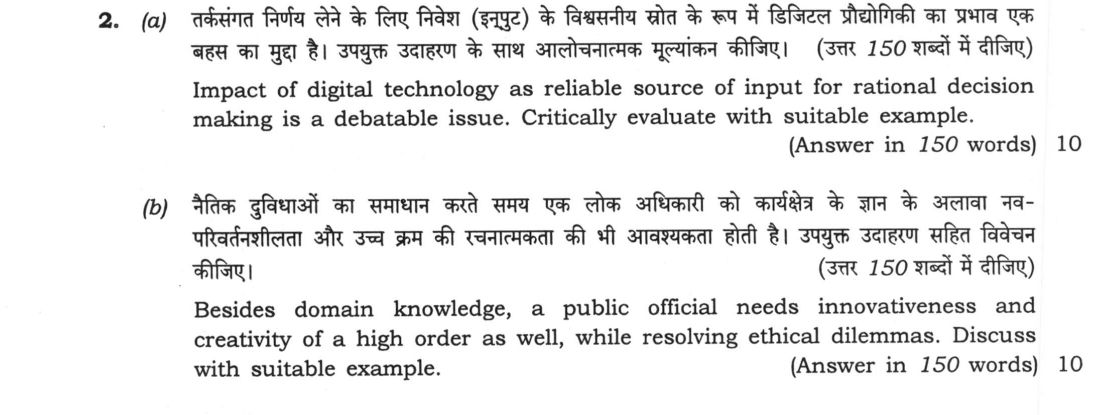
Impact of digital technology as reliable source of input for rational decision making is a debatable issue. Critically evaluate with suitable example. (Answer in 150 words) 10 marks
Besides domain knowledge, a public official needs innovativeness and creativity of a high order as well, while resolving ethical dilemmas. Discuss with suitable example. (Answer in 150 words) 10 marks
हिंदी में प्रश्न पढ़ें
तर्कसंगत निर्णय लेने के लिए निवेश (इनपुट) के विश्वसनीय स्रोत के रूप में डिजिटल प्रौद्योगिकी का प्रभाव एक बहस का मुद्दा है। उपयुक्त उदाहरण के साथ आलोचनात्मक मूल्यांकन कीजिए। (उत्तर 150 शब्दों में दीजिए)
नैतिक दुविधाओं का समाधान करते समय एक लोक अधिकारी को कार्यक्षेत्र के ज्ञान के अलावा नव-परिवर्तनशीलता और उच्च क्रम की रचनात्मकता की भी आवश्यकता होती है। उपयुक्त उदाहरण सहित विवेचन कीजिए। (उत्तर 150 शब्दों में दीजिए)
Model answer
Written by UPSC Answer Check against this question's marking rubric, to the 150-word length. UPSC does not publish answers for Mains — this is one way to score well, not an official key.
Digital Technology in Rational Decision-Making Digital technology enhances rational decision-making through predictive analytics, big data, and evidence-based policy, exemplified by Aadhaar-linked DBT curbing fiscal leakages. However, its reliability is constrained by "garbage-in, garbage-out" data quality, algorithmic bias, surveillance risks, and context-blindness—seen in welfare exclusions of genuine beneficiaries due to biometric failures. Therefore, while digital technology reliably informs computational rationality, it cannot substitute for contextual human sensitivity.
Creativity in Resolving Ethical Dilemmas Domain knowledge and rule-books alone cannot resolve novel ethical dilemmas involving competing values like procedural compliance versus urgent equity. High-order innovativeness enables administrators to reframe zero-sum dilemmas into stakeholder-inclusive, third-way solutions. For instance, IAS officer Armstrong Pame creatively mobilized community crowdfunding to build Manipur’s 100-km "People’s Road," overcoming severe administrative fund crunches without compromising integrity.
Verdict Technology provides critical data inputs, but creative moral discernment remains indispensable for ethical, public-centric governance.
What "Critically evaluate" is asking you to do
Judge how well something has performed against the standard it set for itself — its stated aim, mandate or promise — and commit to a verdict. Name the yardstick before you judge; an unanchored judgement reads as opinion. “Critically” is not a section added at the end: name the yardstick you are judging by — the evidence, the stated objective, a constitutional principle, a rival explanation — and let a verdict close each part of the body. Where the question quotes a claim, that verdict must land on the claim itself, accepted, qualified or rejected, and not on the theme in general.
Structure that answers it
Name the yardstick — stated aim, mandate or benchmark → performance against it → shortfall against it → why the gap exists → verdict
Where marks are lost
Merits in one paragraph, demerits in the next, and a conclusion calling for a balanced and holistic approach. That is a survey with the judgement left out and it holds the answer in the middle band. The opposite error is reading “critically” as permission to attack — and with the odd pairings, critically describe or critically explain, the exposition still carries most of the marks, the judgement being a layer on it rather than a substitute for it.
How this answer will be evaluated
Approach
Framework: GS4 Ethical Dilemma & Decision Making Framework. (a) critically evaluate: positives > negatives/limits > conditions/safeguards > conclusion | (b) discuss: intro > 3-4 dimensions > example > balanced close Full marks: Nuanced analysis with specific examples and clear link to public trust.
Key points expected
- Positives: data-driven precision, speed, transparency
- Negatives: algorithmic bias, data privacy, echo chambers
- Conditions: human oversight, data integrity, digital literacy
- Suitable example: e.g., AI in healthcare or e-governance
- Define the ethical dilemma (crux)
- Show how standard domain knowledge is insufficient
- Demonstrate the innovative/creative solution
- Suitable example: e.g., disaster management or policy reform
Evaluation rubric
Each sub-part is marked on its own, against the marks and word limit printed on the paper.
- (a) Assess digital tech as a reliable input for rational decisions, weighing benefits against risks. 10 marks · 150 words
critically evaluate— positives → negatives/limits → conditions/safeguards → conclusion
Must cover
- Positives: data-driven precision, speed, transparency
- Negatives: algorithmic bias, data privacy, echo chambers
- Conditions: human oversight, data integrity, digital literacy
- Suitable example: e.g., AI in healthcare or e-governance
Loses marks
- Utopian view ignoring data bias
- Luddite view ignoring efficiency gains
- Generic points without specific digital context
Earns more
- Mention of specific digital tool (e.g., GIS, Big Data)
- Reference to 'rationality' vs 'intuition' trade-off
- Balanced view on 'reliability' vs 'fallibility'
Extra mark
- Citing a specific case of algorithmic failure (e.g., COMPAS)
- Reference to a specific government digital initiative
- (b) Explain how innovation and creativity help resolve ethical dilemmas beyond standard domain knowledge. 10 marks · 150 words
discuss— intro → 3-4 dimensions → example → balanced close
Must cover
- Define the ethical dilemma (crux)
- Show how standard domain knowledge is insufficient
- Demonstrate the innovative/creative solution
- Suitable example: e.g., disaster management or policy reform
Loses marks
- Confusing creativity with mere rule-breaking
- Ignoring the 'ethical' aspect of the dilemma
- Vague examples without clear dilemma resolution
Earns more
- Mention of 'out-of-the-box' thinking
- Linking creativity to stakeholder satisfaction
- Balancing legal constraints with innovative outcomes
Extra mark
- Citing a specific 'first-of-its-kind' administrative move
- Reference to a specific ethical framework (e.g., Utilitarianism)
Practice this exact question
Write your answer and it is marked point by point against the model answer above — what you covered, what you missed, what you got wrong.
Evaluate my answer →More from General Studies 2021 GS Paper IV
- Q1 (a) Identify five ethical traits on which one can plot the performance of a civil servant…
- Q2 (a) Impact of digital technology as reliable source of input for rational decision making…
- Q3 What does each of the following quotations mean to you? (a) "Every work has got to pass t…
- Q4 (a) Attitude is an important component that goes as input in the development of human bei…
- Q5 (a) "Refugees should not be turned back to the country where they would face persecution…