GS Paper IV — Q10
The coronavirus disease (COVID-19) pandemic has quickly spread to various countries. As on May 8th, 2020, in India 56342 positive…
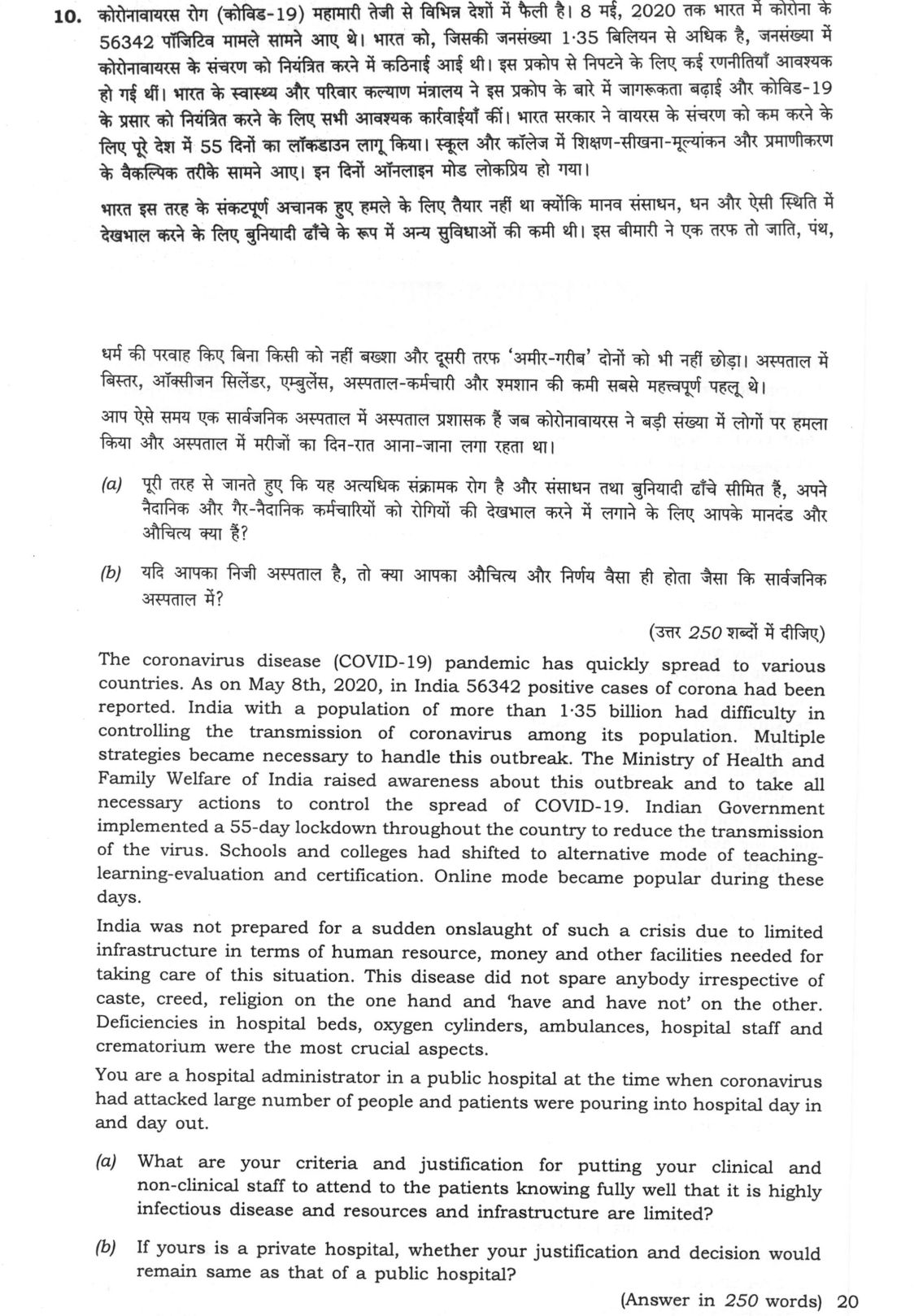
The coronavirus disease (COVID-19) pandemic has quickly spread to various countries. As on May 8th, 2020, in India 56342 positive cases of corona had been reported. India with a population of more than 1.35 billion had difficulty in controlling the transmission of coronavirus among its population. Multiple strategies became necessary to handle this outbreak. The Ministry of Health and Family Welfare of India raised awareness about this outbreak and to take all necessary actions to control the spread of COVID-19. Indian Government implemented a 55-day lockdown throughout the country to reduce the transmission of the virus. Schools and colleges had shifted to alternative mode of teaching-learning-evaluation and certification. Online mode became popular during these days.
India was not prepared for a sudden onslaught of such a crisis due to limited infrastructure in terms of human resource, money and other facilities needed for taking care of this situation. This disease did not spare anybody irrespective of caste, creed, religion on the one hand and 'have and have not' on the other. Deficiencies in hospital beds, oxygen cylinders, ambulances, hospital staff and crematorium were the most crucial aspects.
You are a hospital administrator in a public hospital at the time when coronavirus had attacked large number of people and patients were pouring into hospital day in and day out.
What are your criteria and justification for putting your clinical and non-clinical staff to attend to the patients knowing fully well that it is highly infectious disease and resources and infrastructure are limited?
If yours is a private hospital, whether your justification and decision would remain same as that of a public hospital?
(Answer in 250 words)
हिंदी में प्रश्न पढ़ें
कोरोनावायरस रोग (कोविड-19) महामारी तेजी से विभिन्न देशों में फैली है। 8 मई, 2020 तक भारत में कोरोना के 56342 पॉजिटिव मामले सामने आए थे। भारत को, जिसकी जनसंख्या 1.35 बिलियन से अधिक है, जनसंख्या में कोरोनावायरस के संचरण को नियंत्रित करने में कठिनाई आई थी। इस प्रकोप से निपटने के लिए कई रणनीतियाँ आवश्यक हो गई थीं। भारत के स्वास्थ्य और परिवार कल्याण मंत्रालय ने इस प्रकोप के बारे में जागरूकता बढ़ाई और कोविड-19 के प्रसार को नियंत्रित करने के लिए सभी आवश्यक कार्रवाईयाँ कीं। भारत सरकार ने वायरस के संचरण को कम करने के लिए पूरे देश में 55 दिनों का लॉकडाउन लागू किया। स्कूल और कॉलेज में शिक्षण-सीखना-मूल्यांकन और प्रमाणीकरण के वैकल्पिक तरीके सामने आए। इन दिनों ऑनलाइन मोड लोकप्रिय हो गया।
भारत इस तरह के संकटपूर्ण अचानक हुए हमले के लिए तैयार नहीं था क्योंकि मानव संसाधन, धन और ऐसी स्थिति में देखभाल करने के लिए बुनियादी ढाँचे के रूप में अन्य सुविधाओं की कमी थी। इस बीमारी ने एक तरफ तो जाति, पंथ, धर्म की परवाह किए बिना किसी को नहीं बख्शा और दूसरी तरफ 'अमीर-गरीब' दोनों को भी नहीं छोड़ा। अस्पताल में बिस्तर, ऑक्सीजन सिलेंडर, एम्बुलेंस, अस्पताल-कर्मचारी और श्मशान की कमी सबसे महत्त्वपूर्ण पहलू थे।
आप ऐसे समय एक सार्वजनिक अस्पताल में अस्पताल प्रशासक हैं जब कोरोनावायरस ने बड़ी संख्या में लोगों पर हमला किया और अस्पताल में मरीजों का दिन-रात आना-जाना लगा रहता था।
पूरी तरह से जानते हुए कि यह अत्यधिक संक्रामक रोग है और संसाधन तथा बुनियादी ढाँचे सीमित हैं, अपने नैदानिक और गैर-नैदानिक कर्मचारियों को रोगियों की देखभाल करने में लगाने के लिए आपके मानदंड और औचित्य क्या हैं?
यदि आपका निजी अस्पताल है, तो क्या आपका औचित्य और निर्णय वैसा ही होता जैसा कि सार्वजनिक अस्पताल में?
(उत्तर 250 शब्दों में दीजिए)
Model answer
Written by UPSC Answer Check against this question's marking rubric, to the 250-word length. UPSC does not publish answers for Mains — this is one way to score well, not an official key.
The pandemic presents a sharp conflict between the Right to Health of citizens (Article 21) and the Right to Life and occupational safety of healthcare workers. Key stakeholders include critical patients, clinical/non-clinical staff, their families, and hospital administrators.
Criteria and Justification in a Public Hospital
Criteria for Deployment: Staff allocation must follow a risk-stratified matrix:
- Clinical Staff: Deployed based on specialization and vulnerability; younger, low-risk personnel in high-viral-load zones (ICUs/COVID wards), while shielding elderly, pregnant, or co-morbid staff for tele-triage.
- Non-Clinical Staff: Assigned strictly to logistics, sanitation, and supply chains after rapid training in infection control and donning/doffing PPE.
- Operational Safeguards: Implementing rotational rosters (e.g., 7 days duty, 7 days quarantine) to prevent burnout.
Ethical Justification:
- Deontological Duty: Healthcare professionals are bound by vocational ethics (Hippocratic Oath) and public service rules to serve during emergencies.
- Utilitarian Calculus: Mobilizing all personnel maximizes aggregate survival in a catastrophic health crisis.
- Harm Mitigation: To uphold compassion and accountability, the administration must provide prioritized testing, institutional beds for infected staff, and social security via the Pradhan Mantri Garib Kalyan Package.
Comparison with a Private Hospital
The ethical justification remains identical. Under medical ethics (beneficence and non-maleficence) and statutory directions under the Disaster Management Act, 2005, private entities share the collective duty to preserve life during national emergencies; commercial motives cannot override basic human rights. However, operational decisions differ: private hospitals possess greater fiscal leeway to provide higher hazard pay, private insurance, and rapid market procurement of safety equipment.
An ethical administration must thus balance utilitarian triage with a deontological duty of protection, treating frontline workers as valued moral agents rather than expendable resources.
What "Analyse" is asking you to do
Break the subject into its working parts and show how they act on each other. The marks are in the interconnections — which factor drives which, and what the resulting structure explains — not in the inventory of factors.
Structure that answers it
Define the whole → separate it into its parts → show which part drives which → what that interaction produces → what the structure implies
Where marks are lost
A flat list of causes with no account of which drives which. An answer of neatly separated headings, each self-contained, scores as description.
How this answer will be evaluated
Approach
Framework: GS4 Ethical Dilemma & Administrative Decision-Making. (a) justify: claim > 3-4 reasons > evidence > conclusion | (b) compare: paired headings or table > key differences > significance > conclusion Full marks: Clear triage criteria for (a); nuanced distinction of profit vs. duty in (b); actionable administrative steps.
Key points expected
- Prioritization based on clinical acuity and survival probability
- Duty of care vs. staff safety (PPE/rotation)
- Utilitarian calculus: saving maximum lives
- Transparency in triage protocols
- Contrast profit motive vs. public duty
- Liability and legal risk in private sector
- Resource allocation: paying staff vs. free public service
- Conclusion on whether core ethical duty changes
Evaluation rubric
Each sub-part is marked on its own, against the marks and word limit printed on the paper.
- (a) Criteria and justification for deploying staff in a public hospital during a resource crisis.
justify— claim → 3-4 reasons → evidence → conclusion
Must cover
- Prioritization based on clinical acuity and survival probability
- Duty of care vs. staff safety (PPE/rotation)
- Utilitarian calculus: saving maximum lives
- Transparency in triage protocols
Loses marks
- Ignoring staff safety entirely
- Vague moralizing without administrative criteria
- Failing to address the 'limited resources' constraint
Earns more
- Reference to 'Triage' or 'Ethical Committee' guidelines
- Mention of non-clinical staff roles (logistics/support)
- Balancing individual rights with public health emergency
Extra mark
- Citing specific WHO or ICM triage guidelines
- Mentioning 'Duty to Rescue' legal/ethical principle
- (b) Whether justification/decision remains same in a private hospital context.
compare— paired headings or table → key differences → significance → conclusion
Must cover
- Contrast profit motive vs. public duty
- Liability and legal risk in private sector
- Resource allocation: paying staff vs. free public service
- Conclusion on whether core ethical duty changes
Loses marks
- Saying 'yes, exactly the same' without nuance
- Ignoring the financial constraints of private entities
- Failing to link back to the public hospital context
Earns more
- Mentioning 'Corporate Social Responsibility' (CSR)
- Discussion of 'fiduciary duty' to shareholders vs. patients
- Reference to private hospital capacity constraints
Extra mark
- Citing specific private hospital crisis management protocols
- Reference to 'Business Ethics' frameworks
Practice this exact question
Write your answer and it is marked point by point against the model answer above — what you covered, what you missed, what you got wrong.
Evaluate my answer →More from General Studies 2021 GS Paper IV
- Q7 Sunil is a young civil servant and has a reputation for his competence, integrity, dedica…
- Q8 You are Vice Principal of a degree college in one of the middle-class towns. Principal ha…
- Q9 An elevated corridor is being constructed to reduce traffic congestion in the capital of…
- Q10 The coronavirus disease (COVID-19) pandemic has quickly spread to various countries. As o…
- Q11 A reputed food product company based in India developed a food product for the internatio…
- Q12 Pawan is working as an officer in the State Government for the last ten years. As a part…