GS Paper IV — Q6
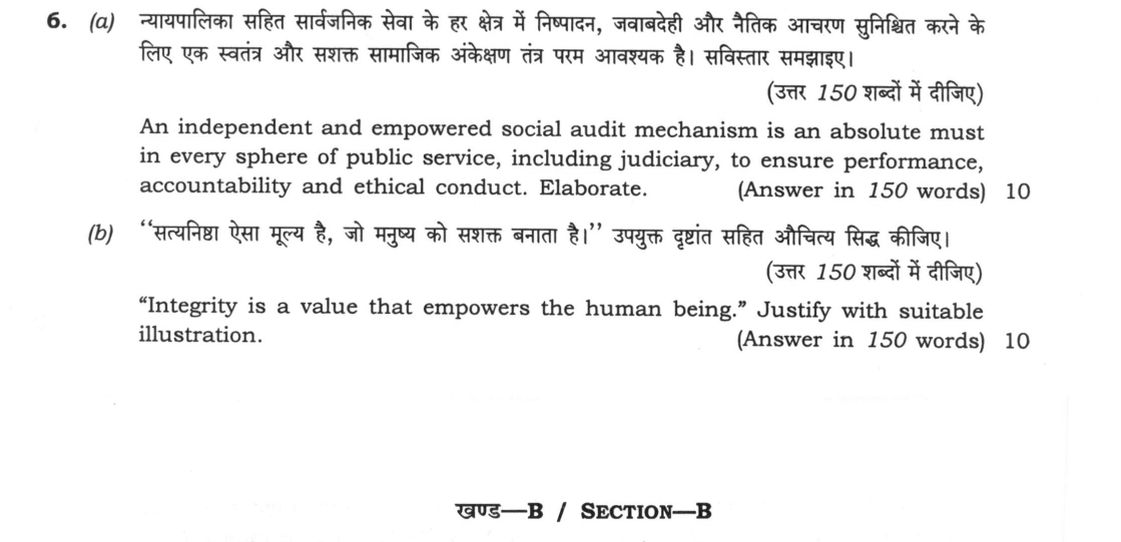
(a) An independent and empowered social audit mechanism is an absolute must in every sphere of public service, including…
An independent and empowered social audit mechanism is an absolute must in every sphere of public service, including judiciary, to ensure performance, accountability and ethical conduct. Elaborate. (Answer in 150 words) 10 marks
"Integrity is a value that empowers the human being." Justify with suitable illustration. (Answer in 150 words) 10 marks
हिंदी में प्रश्न पढ़ें
न्यायपालिका सहित सार्वजनिक सेवा के हर क्षेत्र में निष्पादन, जवाबदेही और नैतिक आचरण सुनिश्चित करने के लिए एक स्वतंत्र और सशक्त सामाजिक अंकेक्षण तंत्र परम आवश्यक है। सविस्तार समझाइए। (उत्तर 150 शब्दों में दीजिए) 10 marks
"सत्यनिष्ठा ऐसा मूल्य है, जो मनुष्य को सशक्त बनाता है।" उपयुक्त दृष्टांत सहित औचित्य सिद्ध कीजिए। (उत्तर 150 शब्दों में दीजिए) 10 marks
Model answer
Written by UPSC Answer Check against this question's marking rubric, to the 150-word length. UPSC does not publish answers for Mains — this is one way to score well, not an official key.
Social Audit in Public Services and Judiciary Social audit institutionalises citizen participation and transparency, preventing elite capture of welfare delivery. Legal backing through the 73rd Constitutional Amendment and MGNREGA Social Audit Units, supported by autonomous institutions like the CAG and Lokpal, enforces executive accountability. Extending independent social audits to the judiciary—utilising National Judicial Data Grid (NJDG) metrics, RTI compliance, and citizen-inclusive court monitoring committees—systematically tackles case pendency, deters corruption, and broadens access to justice.
Integrity as an Empowering Value Integrity acts as an internal moral compass, empowering individuals to take principled decisions autonomously despite coercion or inducements, transcending mechanical rule-following. For instance, civil servants like S.R. Sankaran and whistleblower Sanjiv Chaturvedi derived their authority and resilience against systemic corruption and administrative intimidation from uncompromising personal integrity.
Ultimately, independent social audit (external institutional oversight) and individual integrity (internal ethical strength) constitute complementary pillars essential for securing ethical conduct across public services.
What "Elaborate" is asking you to do
Give the full detailed account the question has compressed into a line — every dimension of it, with specifics. Elaborate rewards completeness and detail rather than clarification or argument: the examiner is checking whether you can fill out a topic without being told what its parts are.
Structure that answers it
State the proposition → first dimension in detail → second dimension in detail → the part the statement leaves implicit → the consolidated picture
Where marks are lost
Repeating the statement at greater length instead of adding substance. Elaborate also punishes narrowness: omitting a whole dimension costs more here than anywhere else in this family.
How this answer will be evaluated
Approach
Framework: GS4 Ethical Dilemma & Governance Framework. (a) explain: definition/context > points in order > small example > short close | (b) justify: claim > 3-4 reasons > evidence > conclusion Full marks: Precise definitions, specific examples, and clear logical flow.
Key points expected
- Define social audit as independent performance check
- Link to accountability and ethical conduct
- Specific application to judiciary (judicial accountability)
- Mention empowerment of the mechanism
- Define integrity as a value
- Explain the mechanism of 'empowerment' (trust/confidence)
- Provide a specific, suitable illustration
- Link integrity to human dignity or capability
Evaluation rubric
Each sub-part is marked on its own, against the marks and word limit printed on the paper.
- (a) Define social audit and justify its necessity in public service and judiciary. 10 marks · 150 words
explain— definition/context → points in order → small example → short close
Must cover
- Define social audit as independent performance check
- Link to accountability and ethical conduct
- Specific application to judiciary (judicial accountability)
- Mention empowerment of the mechanism
Loses marks
- Generic definition without public service context
- Ignoring the specific mention of judiciary
- Preaching values without administrative mechanism
Earns more
- Reference to RTI or CAG as audit tools
- Mention of 'silent stakeholders' (citizens)
- Distinction between financial and social audit
- Reference to 2nd ARC recommendations
Extra mark
- Cite specific judicial audit committee
- Reference to specific social audit act
- (b) Justify the claim that integrity empowers humans with a suitable illustration. 10 marks · 150 words
justify— claim → 3-4 reasons → evidence → conclusion
Must cover
- Define integrity as a value
- Explain the mechanism of 'empowerment' (trust/confidence)
- Provide a specific, suitable illustration
- Link integrity to human dignity or capability
Loses marks
- Listing other values without focusing on integrity
- Illustration is vague or generic
- Conclusion repeats the introduction
Earns more
- Use of a public servant example (e.g., IPS officer)
- Contrast with corruption's disempowerment
- Reference to 'inner voice' or conscience
- Mention of long-term vs short-term gain
Extra mark
- Cite a specific historical figure (e.g., Gandhi, Tagore)
- Reference to a specific ethical theory (e.g., Kant)
Practice this exact question
Write your answer and it is marked point by point against the model answer above — what you covered, what you missed, what you got wrong.
Evaluate my answer →More from General Studies 2021 GS Paper IV
- Q3 What does each of the following quotations mean to you? (a) "Every work has got to pass t…
- Q4 (a) Attitude is an important component that goes as input in the development of human bei…
- Q5 (a) "Refugees should not be turned back to the country where they would face persecution…
- Q6 (a) An independent and empowered social audit mechanism is an absolute must in every sphe…
- Q7 Sunil is a young civil servant and has a reputation for his competence, integrity, dedica…
- Q8 You are Vice Principal of a degree college in one of the middle-class towns. Principal ha…
- Q9 An elevated corridor is being constructed to reduce traffic congestion in the capital of…