GS Paper IV — Q7
Sunil is a young civil servant and has a reputation for his competence, integrity, dedication and relentness pursuit of difficult…
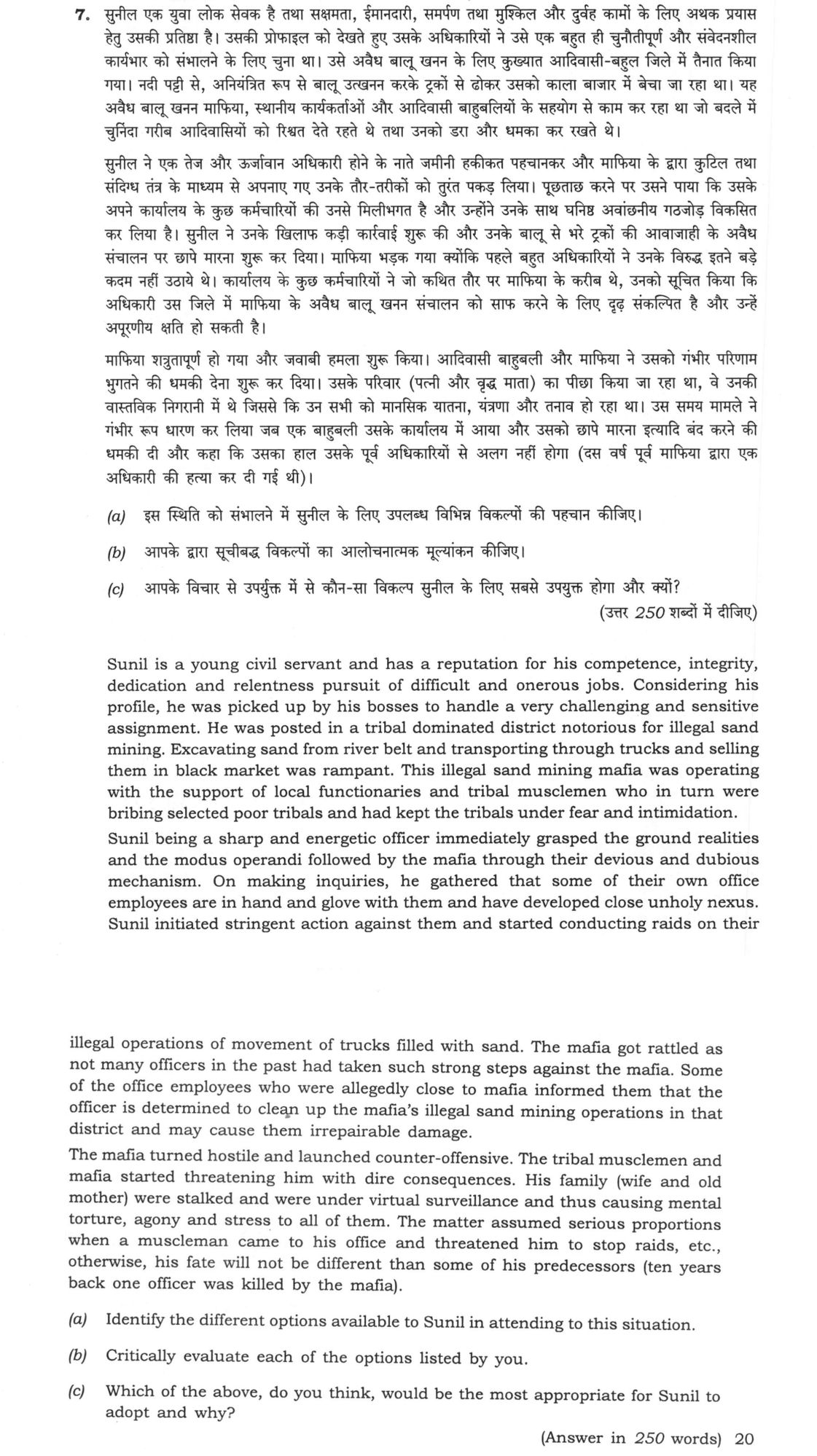
Sunil is a young civil servant and has a reputation for his competence, integrity, dedication and relentness pursuit of difficult and onerous jobs. Considering his profile, he was picked up by his bosses to handle a very challenging and sensitive assignment. He was posted in a tribal dominated district notorious for illegal sand mining. Excavating sand from river belt and transporting through trucks and selling them in black market was rampant. This illegal sand mining mafia was operating with the support of local functionaries and tribal musclemen who in turn were bribing selected poor tribals and had kept the tribals under fear and intimidation.
Sunil being a sharp and energetic officer immediately grasped the ground realities and the modus operandi followed by the mafia through their devious and dubious mechanism. On making inquiries, he gathered that some of their own office employees are in hand and glove with them and have developed close unholy nexus. Sunil initiated stringent action against them and started conducting raids on their illegal operations of movement of trucks filled with sand. The mafia got rattled as not many officers in the past had taken such strong steps against the mafia. Some of the office employees who were allegedly close to mafia informed them that the officer is determined to clean up the mafia's illegal sand mining operations in that district and may cause them irreparable damage.
The mafia turned hostile and launched counter-offensive. The tribal musclemen and mafia started threatening him with dire consequences. His family (wife and old mother) were stalked and were under virtual surveillance and thus causing mental torture, agony and stress to all of them. The matter assumed serious proportions when a muscleman came to his office and threatened him to stop raids, etc., otherwise, his fate will not be different than some of his predecessors (ten years back one officer was killed by the mafia).
Identify the different options available to Sunil in attending to this situation.
Critically evaluate each of the options listed by you.
Which of the above, do you think, would be the most appropriate for Sunil to adopt and why?
(Answer in 250 words)
हिंदी में प्रश्न पढ़ें
सुनील एक युवा लोक सेवक है तथा सक्षमता, ईमानदारी, समर्पण तथा मुश्किल और दुर्वह कामों के लिए अथक प्रयास हेतु उसकी प्रतिष्ठा है। उसकी प्रोफाइल को देखते हुए उसके अधिकारियों ने उसे एक बहुत ही चुनौतीपूर्ण और संवेदनशील कार्यभार को संभालने के लिए चुना था। उसे अवैध बालू खनन के लिए कुक्षात आदिवासी-बहुल जिले में तैनात किया गया। नदी पट्टी से, अनियंत्रित रूप से बालू उत्खनन करके ट्रकों से ढोकर उसको काला बाजार में बेचा जा रहा था। यह अवैध बालू खनन माफिया, स्थानीय कार्यकर्ताओं और आदिवासी बाहुबलियों के सहयोग से काम कर रहा था जो बदले में चुनिंदा गरीब आदिवासियों को रिश्वत देते रहते थे तथा उनको डरा और धमका कर रखते थे।
सुनील ने एक तेज और ऊर्जावान अधिकारी होने के नाते जमीनी हकीकत पहचानकर और माफिया के द्वारा कुटिल तथा संविधि तंत्र के माध्यम से अपनाए गए उनके तौर-तरीकों को तुरंत पकड़ लिया। पूछताछ करने पर उसने पाया कि उसके अपने कार्यालय के कुछ कर्मचारियों की उनसे मिलीभगत है और उन्होंने उनके साथ घनिष्ठ अवांछनीय गठजोड़ विकसित कर लिया है। सुनील ने उनके खिलाफ कड़ी कार्रवाई शुरू की और उनके बालू से भरे ट्रकों की आवाजाही के अवैध संचालन पर छापे मारना शुरू कर दिया। माफिया भड़क गया क्योंकि पहले बहुत अधिकारियों ने उनके विरुद्ध इतने बड़े कदम नहीं उठाए थे। कार्यालय के कुछ कर्मचारियों ने जो कथित तौर पर माफिया के करीब थे, उनको सूचित किया कि अधिकारी उस जिले में माफिया के अवैध बालू खनन संचालन को साफ करने के लिए दृढ़ संकल्पित है और उन्हें अपूर्णीय क्षति हो सकती है।
माफिया शत्रुतापूर्ण हो गया और जवाबी हमला शुरू किया। आदिवासी बाहुबली और माफिया ने उसको गंभीर परिणाम भुगतने की धमकी देना शुरू कर दिया। उसके परिवार (पत्नी और वृद्ध माता) का पीछा किया जा रहा था, वे उनकी वास्तविक निगरानी में थे जिससे कि उन सभी को मानसिक यातना, यंत्रणा और तनाव हो रहा था। उस समय मामले ने गंभीर रूप धारण कर लिया जब एक बाहुबली उसके कार्यालय में आया और उसको छापे मारना इत्यादि बंद करने की धमकी दी और कहा कि उसका हाल उसके पूर्व अधिकारियों से अलग नहीं होगा (दस वर्ष पूर्व माफिया द्वारा एक अधिकारी की हत्या कर दी गई थी)।
इस स्थिति को संभालने में सुनील के लिए उपलब्ध विभिन्न विकल्पों की पहचान कीजिए।
आपके द्वारा सूचीबद्ध विकल्पों का आलोचनात्मक मूल्यांकन कीजिए।
आपके विचार से उपर्युक्त में से कौन-सा विकल्प सुनील के लिए सबसे उपयुक्त होगा और क्यों?
(उत्तर 250 शब्दों में दीजिए)
Model answer
Written by UPSC Answer Check against this question's marking rubric, to the 250-word length. UPSC does not publish answers for Mains — this is one way to score well, not an official key.
Sunil faces an acute administrative and moral dilemma involving a direct conflict between his categorical public duty to uphold the rule of law and his fundamental obligation to protect his family’s life and mental well-being. The situation tests his fortitude, institutional acumen, and professional integrity against a nexus of organized crime, local corruption, and marginalized community vulnerability.
Options Available to Sunil
Option 1: Continue unilateral aggressive raids with personal security cover for himself and his family.
Option 2: Seek institutional escalation and administrative reinforcement by apprising senior authorities, demanding dedicated armed police or central forces, and taking formal legal cognizance of the death threat.
Option 3: Request an immediate transfer to another post or district citing grave threats to the life and mental well-being of his aged mother and wife.
Option 4: Adopt a tactical pause to de-escalate immediate hostility, initiate back-channel negotiations, and quietly gather actionable intelligence before resuming enforcement.
Option 5: Deploy technology-driven, depersonalized surveillance mechanisms (such as satellite imagery, drone monitoring, and RFID/e-transit permits) alongside departmental vigilance against compromised insiders.
Option 6: Pursue a comprehensive institutional-cum-community strategy combining state-backed enforcement, administrative purging of colluding staff, depersonalized technology, and socio-economic mobilization of local tribals through Gram Sabhas and alternative livelihoods.
Critical Evaluation of the Options
Option 1 upholds deontological duty and personal integrity, demonstrating raw courage. However, evaluated through a utilitarian lens, unilateral confrontation without systemic backup carries severe risks of physical harm or martyrdom, akin to the tragic death of his predecessor. It leaves his vulnerable family exposed to extreme trauma and fails to structurally dismantle the mafia’s deep nexus, risking institutional setback if he is incapacitated.
Option 2 leverages institutional backing, neutralizing the power imbalance between a lone officer and an armed cartel. Deontologically, it transforms an individual dispute into an institutional enforcement of state sovereignty. While it enhances family protection and operational safety, procedural delays in bureaucratic approvals may leave a temporary window of vulnerability that requires immediate interim security arrangements.
Option 3 prioritizes the immediate safety and emotional security of his family, fulfilling his private moral obligations. However, critically, it amounts to an abandonment of public trust and professional duty. It sets a damaging precedent that institutional intimidation succeeds against honest governance, demoralizes the civil services, and leaves the exploited tribal population entirely at the mercy of criminal syndicates.
Option 4 may provide short-term relief to his family and create space to rebuild intelligence networks. Yet, ethically and pragmatically, negotiating or pausing under duress compromises administrative integrity, signals institutional weakness, and validates criminal intimidation. It risks giving the mafia time to entrench their operations further and compromise evidence.
Option 5 substitutes vulnerable human confrontation with objective technological oversight, significantly reducing personal physical exposure. While highly effective in curtailing illicit sand transport, technology alone is insufficient to address ground-level muscle intimidation or the structural economic desperation of the local tribals who are bribed into complicity.
Option 6 balances deontological rectitude, utilitarian welfare maximization, and virtue ethics. By invoking state authority, purging insider moles under Article 311/departmental inquiry, and organizing local tribals through the Provisions of the Panchayats (Extension to Scheduled Areas) Act (PESA), 1996, it addresses root causes. It safeguards his family via formal state protection while structurally dismantling the mafia. Its challenge lies in managing multiple complex fronts simultaneously.
Most Appropriate Course of Action and Justification
Sunil should adopt a multi-pronged institutional and community-centric strategy (Option 6 incorporating Options 2 and 5), reflecting "smart courage" rather than reckless heroism or cowardly retreat.
First, he must officially report the direct intimidation and file an FIR under relevant sections of the Bharatiya Nyaya Sanhita (criminal intimidation and obstruction of public servant) against the named muscleman and syndicates. He must formally apprise the District Magistrate, Superintendent of Police, and Home Department, securing immediate round-the-clock armed protection for his residence and family, and requisitioning specialized armed units (like the State Armed Police or Central Armed Police Forces) for mining enforcement.
Second, he must neutralize the internal sabotage by placing compromised staff under immediate suspension and initiating departmental vigilance inquiries.
Third, he should institutionalize technology-based enforcement—deploying drone surveillance along river basins, satellite imagery for volumetric estimation, CCTV monitoring at check-posts, and e-invoicing for mineral transport. Depersonalizing the enforcement process removes the target from his back.
Fourth, Sunil must drive tribal empowerment by leveraging the District Mineral Foundation (DMF) funds and minor forest produce schemes to generate sustainable livelihoods. Involving local tribal bodies and Gram Sabhas creates community ownership over riverine ecology and dissolves the mafia’s recruitment base.
This approach demonstrates the civil service virtues of fortitude, probity, empathy, and institutional resilience. By refusing to abandon his post, Sunil preserves public faith in the rule of law, ensures the safety of his family through institutional fortification, and provides sustainable justice to the exploited tribal community.
What "Critically evaluate" is asking you to do
Judge how well something has performed against the standard it set for itself — its stated aim, mandate or promise — and commit to a verdict. Name the yardstick before you judge; an unanchored judgement reads as opinion. “Critically” is not a section added at the end: name the yardstick you are judging by — the evidence, the stated objective, a constitutional principle, a rival explanation — and let a verdict close each part of the body. Where the question quotes a claim, that verdict must land on the claim itself, accepted, qualified or rejected, and not on the theme in general.
Structure that answers it
Name the yardstick — stated aim, mandate or benchmark → performance against it → shortfall against it → why the gap exists → verdict
Where marks are lost
Merits in one paragraph, demerits in the next, and a conclusion calling for a balanced and holistic approach. That is a survey with the judgement left out and it holds the answer in the middle band. The opposite error is reading “critically” as permission to attack — and with the odd pairings, critically describe or critically explain, the exposition still carries most of the marks, the judgement being a layer on it rather than a substitute for it.
How this answer will be evaluated
Approach
Framework: GS4 Ethical Dilemma & Course of Action. (a) highlight: name the salient points > one line of substance each > close | (b) critically evaluate: positives > negatives/limits > conditions/safeguards > conclusion | (c) justify: claim > 3-4 reasons > evidence > conclusion Full marks: Identifies nuanced options, critically weighs ethical/admin trade-offs, and provides a structured, actionable course of action.
Key points expected
- Option to continue raids with enhanced security
- Option to seek transfer or reassignment
- Option to negotiate or compromise with mafia
- Option to escalate to higher authorities
- Critique of 'transfer' as a failure of duty
- Critique of 'compromise' as ethical breach
- Analysis of risks in 'continuing raids'
- Evaluation of institutional support mechanisms
Evaluation rubric
Each sub-part is marked on its own, against the marks and word limit printed on the paper.
- (a) List distinct courses of action available to Sunil.
highlight— name the salient points → one line of substance each → close
Must cover
- Option to continue raids with enhanced security
- Option to seek transfer or reassignment
- Option to negotiate or compromise with mafia
- Option to escalate to higher authorities
Loses marks
- Listing vague or generic options
- Missing the 'compromise' option
Earns more
- Mentioning legal action against threats
- Mentioning media intervention
Extra mark
- Reference to specific police protection protocols
- (b) Assess merits and demerits of each option listed.
critically evaluate— positives → negatives/limits → conditions/safeguards → conclusion
Must cover
- Critique of 'transfer' as a failure of duty
- Critique of 'compromise' as ethical breach
- Analysis of risks in 'continuing raids'
- Evaluation of institutional support mechanisms
Loses marks
- Describing options without evaluating them
- Ignoring the 'easy-but-wrong' option
Earns more
- Linking options to public trust
- Considering impact on family safety
Extra mark
- Citing a specific precedent of officer safety
- (c) Select the best option and provide reasoned justification.
justify— claim → 3-4 reasons → evidence → conclusion
Must cover
- Clear selection of the most appropriate option
- Justification based on duty and integrity
- Action plan in immediate/short/long horizons
- Addressing the specific threat to family
Loses marks
- Preaching values without specific action
- Conclusion repeating the introduction
Earns more
- Balancing personal safety with public duty
- Mentioning specific legal safeguards
Extra mark
- Reference to specific government safety guidelines
Practice this exact question
Write your answer and it is marked point by point against the model answer above — what you covered, what you missed, what you got wrong.
Evaluate my answer →More from General Studies 2021 GS Paper IV
- Q4 (a) Attitude is an important component that goes as input in the development of human bei…
- Q5 (a) "Refugees should not be turned back to the country where they would face persecution…
- Q6 (a) An independent and empowered social audit mechanism is an absolute must in every sphe…
- Q7 Sunil is a young civil servant and has a reputation for his competence, integrity, dedica…
- Q8 You are Vice Principal of a degree college in one of the middle-class towns. Principal ha…
- Q9 An elevated corridor is being constructed to reduce traffic congestion in the capital of…
- Q10 The coronavirus disease (COVID-19) pandemic has quickly spread to various countries. As o…