GS Paper IV — Q12
Pawan is working as an officer in the State Government for the last ten years. As a part of routine transfer, he was posted to…
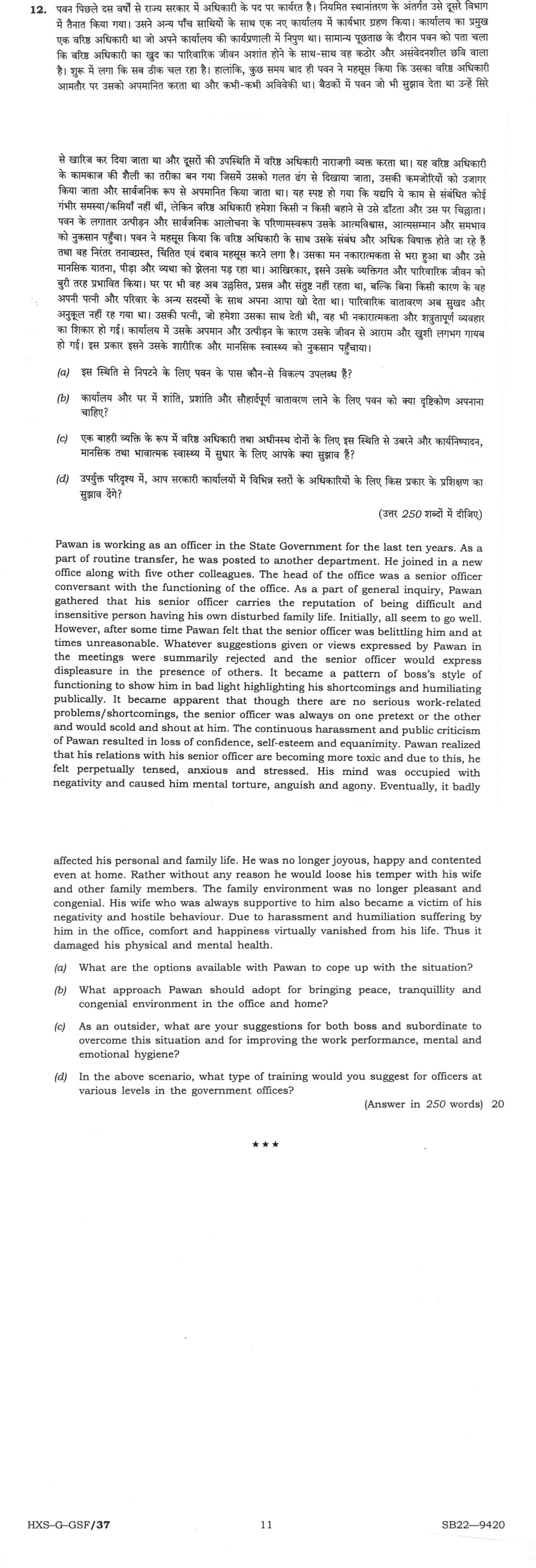
Pawan is working as an officer in the State Government for the last ten years. As a part of routine transfer, he was posted to another department. He joined in a new office along with five other colleagues. The head of the office was a senior officer conversant with the functioning of the office. As a part of general inquiry, Pawan gathered that his senior officer carries the reputation of being difficult and insensitive person having his own disturbed family life. Initially, all seem to go well. However, after some time Pawan felt that the senior officer was belittling him and at times unreasonable. Whatever suggestions given or views expressed by Pawan in the meetings were summarily rejected and the senior officer would express displeasure in the presence of others. It became a pattern of boss's style of functioning to show him in bad light highlighting his shortcomings and humiliating publically. It became apparent that though there are no serious work-related problems/shortcomings, the senior officer was always on one pretext or the other and would scold and shout at him. The continuous harassment and public criticism of Pawan resulted in loss of confidence, self-esteem and equanimity. Pawan realized that his relations with his senior officer are becoming more toxic and due to this, he felt perpetually tensed, anxious and stressed. His mind was occupied with negativity and caused him mental torture, anguish and agony. Eventually, it badly affected his personal and family life. He was no longer joyous, happy and contented even at home. Rather without any reason he would loose his temper with his wife and other family members. The family environment was no longer pleasant and congenial. His wife who was always supportive to him also became a victim of his negativity and hostile behaviour. Due to harassment and humiliation suffering by him in the office, comfort and happiness virtually vanished from his life. Thus it damaged his physical and mental health.
What are the options available with Pawan to cope up with the situation?
What approach Pawan should adopt for bringing peace, tranquillity and congenial environment in the office and home?
As an outsider, what are your suggestions for both boss and subordinate to overcome this situation and for improving the work performance, mental and emotional hygiene?
In the above scenario, what type of training would you suggest for officers at various levels in the government offices?
(Answer in 250 words)
हिंदी में प्रश्न पढ़ें
पवन पिछले दस वर्षों से राज्य सरकार में अधिकारी के पद पर कार्यरत है। नियमित स्थानांतरण के अंतर्गत उसे दूसरे विभाग में तैनात किया गया। उसने अन्य पांच साथियों के साथ एक नए कार्यालय में कार्यभार ग्रहण किया। कार्यालय का प्रमुख एक वरिष्ठ अधिकारी था जो अपने कार्यालय की कार्यप्रणाली में निपुण था। सामान्य पृच्छताछ के दौरान पवन को पता चला कि वरिष्ठ अधिकारी का खुद का पारिवारिक जीवन अशांत होने के साथ-साथ वह कठोर और असंवेदनशील छवि वाला है। शुरू में लगा कि सब ठीक चल रहा है। हालांकि, कुछ समय बाद ही पवन ने महसूस किया कि उसका वरिष्ठ अधिकारी आमतौर पर उसको अपमानित करता था और कभी-कभी अविवेकी था। बैठकों में पवन जो भी सुझाव देता था उन्हें तिरस्कार से खारिज कर दिया जाता था और दूसरों की उपस्थिति में वरिष्ठ अधिकारी नाराजगी व्यक्त करता था। यह वरिष्ठ अधिकारी के कामकाज की शैली का तरीका बन गया जिसमें उसको गलत ढंग से दिखाया जाता, उसकी कमजोरियों को उजागर किया जाता और सार्वजनिक रूप से अपमानित किया जाता था। यह स्पष्ट हो गया कि यद्यपि ये काम से संबंधित कोई गंभीर समस्या/कमियां नहीं थीं, लेकिन वरिष्ठ अधिकारी हमेशा किसी न किसी बहाने से उसे डांटता और उस पर चिल्लाता। पवन के लगातार उत्पीड़न और सार्वजनिक आलोचना के परिणामस्वरूप उसके आत्मविश्वास, आत्मसम्मान और समभाव को नुकसान पहुंचा। पवन ने महसूस किया कि वरिष्ठ अधिकारी के साथ उसके संबंध और अधिक विषाक्त होते जा रहे हैं तथा वह निरंतर तनावग्रस्त, चिंतित एवं दबाव महसूस करने लगा है। उसका मन नकारात्मकता से भरा हुआ था और उसे मानसिक यातना, पीड़ा और व्यथा को झेलना पड़ रहा था। अंततः, इसने उसके व्यक्तिगत और पारिवारिक जीवन को बुरी तरह प्रभावित किया। घर पर भी वह अब उत्साहित, प्रसन्न और संतुष्ट नहीं रहता था, बल्कि बिना किसी कारण के वह अपनी पत्नी और परिवार के अन्य सदस्यों के साथ अपना आपा खो देता था। पारिवारिक वातावरण अब सुखद और अनुकूल नहीं रह गया था। उसकी पत्नी, जो हमेशा उसका साथ देती थी, वह भी नकारात्मकता और शत्रुतापूर्ण व्यवहार का शिकार हो गई। कार्यालय में उसके अपमान और उत्पीड़न के कारण उसके जीवन से आराम और खुशी लगभग गायब हो गई। इस प्रकार इसने उसके शारीरिक और मानसिक स्वास्थ्य को नुकसान पहुंचाया।
इस स्थिति से निपटने के लिए पवन के पास कौन-से विकल्प उपलब्ध हैं?
कार्यालय और घर में शांति, प्रशांति और सौहार्दपूर्ण वातावरण लाने के लिए पवन को क्या दृष्टिकोण अपनाना चाहिए?
एक बाहरी व्यक्ति के रूप में वरिष्ठ अधिकारी तथा अधीनस्थ दोनों के लिए इस स्थिति से उबरने और कार्यनिष्पादन, मानसिक तथा भावात्मक स्वास्थ्य में सुधार के लिए आपके क्या सुझाव हैं?
उपर्युक्त परिदृश्य में, आप सरकारी कार्यालयों में विभिन्न स्तरों के अधिकारियों के लिए किस प्रकार के प्रशिक्षण का सुझाव देंगे?
(उत्तर 250 शब्दों में दीजिए)
Model answer
Written by UPSC Answer Check against this question's marking rubric, to the 250-word length. UPSC does not publish answers for Mains — this is one way to score well, not an official key.
Pawan’s options are administrative and personal. He should document incidents, dates and witnesses, maintain work quality, seek peer support and professional counselling. He may request a private meeting to express concern, then use the department’s grievance redressal mechanism, representation to the competent authority, service association, or administrative transfer if the pattern persists. He should not treat this as a personal failure. The aim is not retaliation but restoring dignity, productivity and a congenial atmosphere, while ensuring that service rules, public trust and institutional credibility are protected in governance.
For office-home harmony, Pawan needs emotional regulation: mindfulness, cognitive reframing, and scheduled disengagement from work stress. He must set boundaries, communicate transparently with his wife, explain the external pressure, and rebuild self-esteem through competence affirmation, small wins and family time.
As an outsider, I would advise the boss to undergo leadership coaching, receive 360-degree feedback, and consider family counselling if personal distress is evident; his conduct may reflect projection, but accountability is essential. Pawan should use assertive communication, seek mentorship, and understand triggers without excusing humiliation. Systemically, the office needs structured feedback, team-building, and clear performance metrics to reduce subjective evaluation.
Training should be level-specific: junior officers need stress management, emotional intelligence and grievance redressal procedures; senior officers need transformational leadership, conflict resolution and unconscious bias training; all need mental health first aid and work-life balance workshops, reviewed regularly.
Ultimately, administrative effectiveness depends on emotional hygiene; a humane, accountable office culture protects dignity, public trust and service.
What "Suggest" is asking you to do
Propose measures that attach to the causes the question has just had you identify. Each should name who acts, on what, and why it would work; a measure with no actor behind it is a wish rather than a suggestion.
Structure that answers it
The problem in one line → measure 1 with the cause it addresses → measure 2 → measure 3 → how it would be implemented and what it requires
Where marks are lost
Prescriptions that would fit any question on any subject — awareness campaigns, capacity building, better coordination. The examiner checks whether each measure is traceable to a cause the answer itself named.
How this answer will be evaluated
Approach
Framework: GS4 Ethical Dilemma & Workplace Conflict Resolution. (a) enumerate: list the items in order > one line each > no commentary | (b) suggest: the problem in one line > implementable measures > who acts > conclusion | (c) suggest: the problem in one line > implementable measures > who acts > conclusion | (d) suggest: the problem in one line > implementable measures > who acts > conclusion Full marks: Balanced, actionable, and specific; addresses both personal and institutional dimensions.
Key points expected
- Internal coping (meditation, counseling)
- External escalation (Lokayukta, HR)
- Administrative remedy (transfer request)
- Legal recourse (workplace harassment)
- Work-life boundary setting
- Emotional regulation techniques
- Communication strategy with spouse
- Professional help (psychologist)
Evaluation rubric
Each sub-part is marked on its own, against the marks and word limit printed on the paper.
- (a) List specific options available to Pawan to cope with the situation.
enumerate— list the items in order → one line each → no commentary
Must cover
- Internal coping (meditation, counseling)
- External escalation (Lokayukta, HR)
- Administrative remedy (transfer request)
- Legal recourse (workplace harassment)
Loses marks
- Suggesting resignation as primary option
- Vague generalities without specific mechanisms
Earns more
- Mentioning 'Internal Complaint Committee'
- Referring to 'Lokayukta' for senior misconduct
Extra mark
- Citing specific state Lokayukta Act
- (b) Suggest an approach for Pawan to restore peace in office and home.
suggest— the problem in one line → implementable measures → who acts → conclusion
Must cover
- Work-life boundary setting
- Emotional regulation techniques
- Communication strategy with spouse
- Professional help (psychologist)
Loses marks
- Ignoring the home/family aspect
- Preaching without actionable steps
Earns more
- Mentioning 'cognitive reframing'
- Suggesting 'family counseling'
Extra mark
- Reference to 'Stress Management' workshops
- (c) Provide suggestions for both boss and subordinate to improve hygiene.
suggest— the problem in one line → implementable measures → who acts → conclusion
Must cover
- Boss: Empathy and feedback training
- Subordinate: Assertiveness and conflict resolution
- Institutional: Mentoring or mediation
- Focus on 'emotional hygiene'
Loses marks
- One-sided advice (only boss or only sub)
- Ignoring the 'outsider' perspective
Earns more
- Suggesting '360-degree feedback'
- Mentioning 'emotional intelligence' (EQ)
Extra mark
- Citing 'Emotional Intelligence' by Goleman
- (d) Suggest types of training for officers at various levels.
suggest— the problem in one line → implementable measures → who acts → conclusion
Must cover
- Soft skills (communication)
- Leadership and management
- Stress management/mental health
- Ethics and code of conduct
Loses marks
- Generic 'training' without specific types
- Ignoring the 'various levels' aspect
Earns more
- Mentioning 'Lateral entry' training
- Suggesting 'Mentorship programs'
Extra mark
- Reference to 'Lokniti' or specific DoPT training
Practice this exact question
Write your answer and it is marked point by point against the model answer above — what you covered, what you missed, what you got wrong.
Evaluate my answer →More from General Studies 2021 GS Paper IV
- Q9 An elevated corridor is being constructed to reduce traffic congestion in the capital of…
- Q10 The coronavirus disease (COVID-19) pandemic has quickly spread to various countries. As o…
- Q11 A reputed food product company based in India developed a food product for the internatio…
- Q12 Pawan is working as an officer in the State Government for the last ten years. As a part…