GS Paper IV — Q5
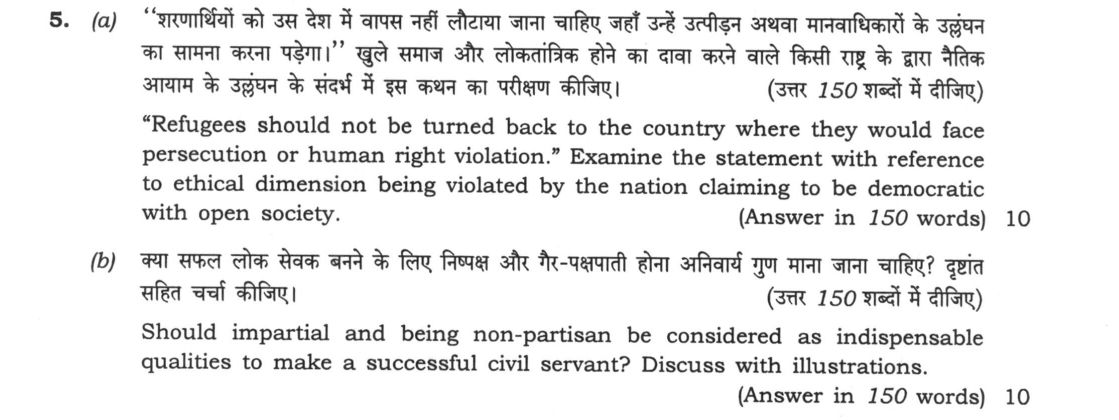
(a) "Refugees should not be turned back to the country where they would face persecution or human right violation." Examine the…
"Refugees should not be turned back to the country where they would face persecution or human right violation." Examine the statement with reference to ethical dimension being violated by the nation claiming to be democratic with open society. (Answer in 150 words) 10 marks
Should impartial and being non-partisan be considered as indispensable qualities to make a successful civil servant? Discuss with illustrations. (Answer in 150 words) 10 marks
हिंदी में प्रश्न पढ़ें
"शरणार्थियों को उस देश में वापस नहीं लौटाया जाना चाहिए जहाँ उन्हें उत्पीड़न अथवा मानवाधिकारों के उल्लंघन का सामना करना पड़ेगा।" खुले समाज और लोकतांत्रिक होने का दावा करने वाले किसी राष्ट्र के द्वारा नैतिक आयाम के उल्लंघन के संदर्भ में इस कथन का परीक्षण कीजिए। (उत्तर 150 शब्दों में दीजिए) 10 marks
क्या सफल लोक सेवक बनने के लिए निष्पक्ष और गैर-पक्षपाती होना अनिवार्य गुण माना जाना चाहिए? दृष्टांत सहित चर्चा कीजिए। (उत्तर 150 शब्दों में दीजिए) 10 marks
Model answer
Written by UPSC Answer Check against this question's marking rubric, to the 150-word length. UPSC does not publish answers for Mains — this is one way to score well, not an official key.
(a) Ethics of Non-Refoulement Turning back persecuted refugees breaches the customary international norm of non-refoulement and cosmopolitan ethics. It violates inalienable human dignity, compassion, and Rawlsian justice, which treats arbitrary borders as morally irrelevant behind the veil of ignorance. For a self-proclaimed democratic open society, this manifests an acute paradox: preaching universal human rights domestically while practicing exclusionary nationalism at its borders. Subordinating human survival to state sovereignty fundamentally erodes the ethical credibility and democratic ethos of an open society.
(b) Impartiality and Non-Partisanship in Civil Service Impartiality and non-partisanship are foundational to upholding the rule of law, public trust, and constitutional morality (Article 14). However, uncritical or passive neutrality can foster administrative inertia, impeding proactive social justice and responsive governance for marginalized sections. Therefore, functional indispensability lies in combining political detachment with constitutional commitment. As demonstrated by Sardar Patel’s civil servants during national integration and contemporary administrators in crisis and disaster management, a civil servant must remain politically non-partisan while being actively partisan toward constitutional values and public welfare.
What "Examine" is asking you to do
Test the proposition the question puts to you and return a finding on how far it holds. Examine stems carry a claim, or ask whether something has happened, and expect evidence weighed both ways before the extent is stated — often with remedial measures attached.
Structure that answers it
Restate the claim as the question frames it → evidence that supports it → evidence that undercuts it → the conditions under which it holds → verdict on how far it stands
Where marks are lost
Stopping at description. An examination has to reach a finding, and “examine with justification” means the extent must be stated, not implied.
How this answer will be evaluated
Approach
Framework: GS4 Ethical Dilemma & Administrative Values. (a) examine: intro > how/why with reasoning > evidence > conclusion | (b) discuss: intro > 3-4 dimensions > example > balanced close Full marks: Precise ethical reasoning with specific legal/administrative references and clear illustrations.
Key points expected
- Define the ethical dimension of 'open society' vs. exclusion
- Identify the specific human rights violation (persecution)
- Contrast democratic ideals with actual state behavior
- Conclude on the violation of public trust
- Define impartiality and non-partisanship in the civil service context
- Provide an illustration of a conflict of interest
- Explain the link to public trust and administrative efficiency
- Conclude on their indispensability for successful service
Evaluation rubric
Each sub-part is marked on its own, against the marks and word limit printed on the paper.
- (a) Analyze the ethical contradiction of democratic nations violating refugee rights. 10 marks · 150 words
examine— intro → how/why with reasoning → evidence → conclusion
Must cover
- Define the ethical dimension of 'open society' vs. exclusion
- Identify the specific human rights violation (persecution)
- Contrast democratic ideals with actual state behavior
- Conclude on the violation of public trust
Loses marks
- Preaching values without analyzing the state's role
- Ignoring the 'democratic' context of the question
- Vague generalities without specific ethical reasoning
Earns more
- Reference to non-refoulement principle
- Mention of specific ethical frameworks (utilitarianism/deontology)
- Link to international humanitarian law
Extra mark
- Cite a specific Supreme Court judgment on refugee rights
- Reference to the 1951 Refugee Convention
- (b) Evaluate the necessity of impartiality and non-partisanship for civil servants. 10 marks · 150 words
discuss— intro → 3-4 dimensions → example → balanced close
Must cover
- Define impartiality and non-partisanship in the civil service context
- Provide an illustration of a conflict of interest
- Explain the link to public trust and administrative efficiency
- Conclude on their indispensability for successful service
Loses marks
- Treating non-partisanship as absolute (ignoring political reality)
- Lack of concrete illustration or case study
- Focusing only on personal ethics, ignoring institutional impact
Earns more
- Mention of the 'Rule of Law' vs. 'Rule of Man'
- Reference to the 2nd Schedule of the Constitution
- Distinction between political neutrality and administrative bias
Extra mark
- Cite a specific case of political interference (e.g., transfer of officers)
- Reference to the Administrative Reforms Commission report
Practice this exact question
Write your answer and it is marked point by point against the model answer above — what you covered, what you missed, what you got wrong.
Evaluate my answer →More from General Studies 2021 GS Paper IV
- Q2 (a) Impact of digital technology as reliable source of input for rational decision making…
- Q3 What does each of the following quotations mean to you? (a) "Every work has got to pass t…
- Q4 (a) Attitude is an important component that goes as input in the development of human bei…
- Q5 (a) "Refugees should not be turned back to the country where they would face persecution…
- Q6 (a) An independent and empowered social audit mechanism is an absolute must in every sphe…
- Q7 Sunil is a young civil servant and has a reputation for his competence, integrity, dedica…
- Q8 You are Vice Principal of a degree college in one of the middle-class towns. Principal ha…