GS Paper IV — Q1
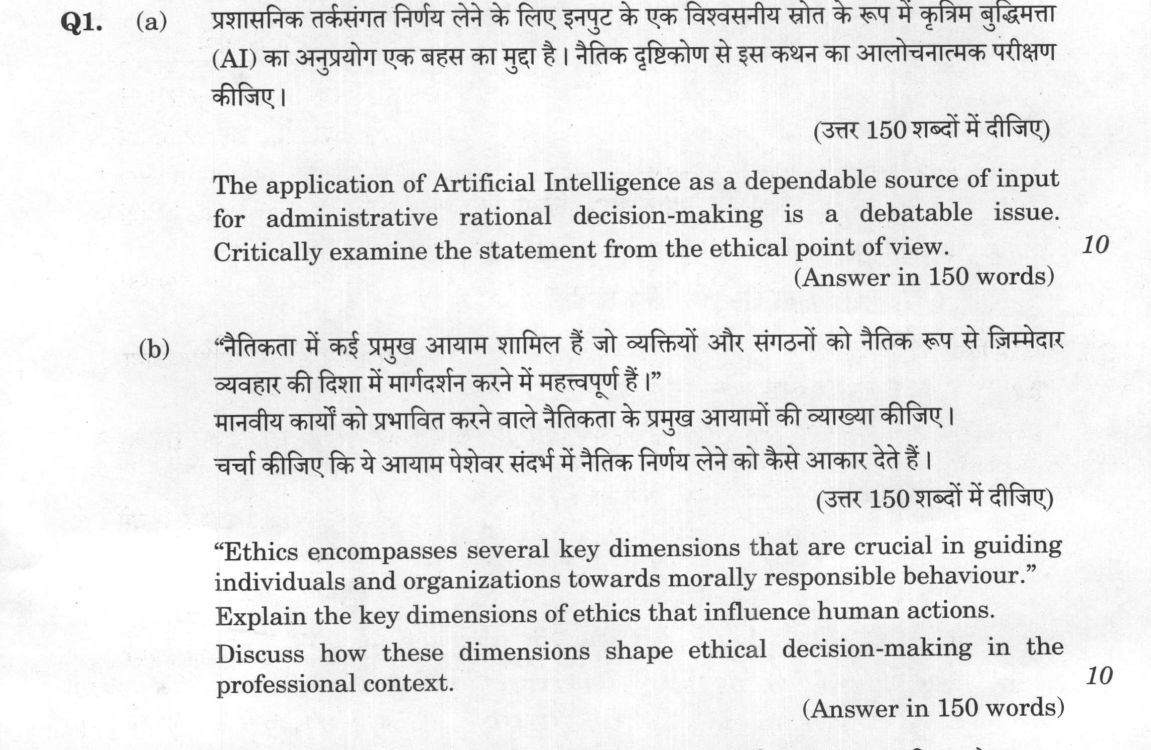
(a) The application of Artificial Intelligence as a dependable source of input for administrative rational decision-making is a…
The application of Artificial Intelligence as a dependable source of input for administrative rational decision-making is a debatable issue. Critically examine the statement from the ethical point of view. 10 (Answer in 150 words)
"Ethics encompasses several key dimensions that are crucial in guiding individuals and organizations towards morally responsible behaviour." Explain the key dimensions of ethics that influence human actions. Discuss how these dimensions shape ethical decision-making in the professional context. 10 (Answer in 150 words)
हिंदी में प्रश्न पढ़ें
प्रशासनिक तर्कसंगत निर्णय लेने के लिए इनपुट के एक विश्वसनीय स्रोत के रूप में कृत्रिम बुद्धिमत्ता (AI) का अनुप्रयोग एक बहस का मुद्दा है। नैतिक दृष्टिकोण से इस कथन का आलोचनात्मक परीक्षण कीजिए। (उत्तर 150 शब्दों में दीजिए)
"नैतिकता में कई प्रमुख आयाम शामिल हैं जो व्यक्तियों और संगठनों को नैतिक रूप से जिम्मेदार व्यवहार की दिशा में मार्गदर्शन करने में महत्वपूर्ण हैं।" मानवीय कार्यों को प्रभावित करने वाले नैतिकता के प्रमुख आयामों की व्याख्या कीजिए। चर्चा कीजिए कि ये आयाम पेशेवर संदर्भ में नैतिक निर्णय लेने को कैसे आकार देते हैं। (उत्तर 150 शब्दों में दीजिए)
Model answer
Written by UPSC Answer Check against this question's marking rubric, to the 150-word length. UPSC does not publish answers for Mains — this is one way to score well, not an official key.
AI in Administrative Decision-Making AI enhances administrative rationality through rapid data processing, pattern recognition, and objective welfare targeting. However, ethically, it poses risks of algorithmic bias from unrepresentative training data, "black-box" opacity violating procedural fairness, and the dehumanization of governance. Delegating decisions to automated systems erodes administrative discretion, empathy, and moral accountability, threatening distributive justice. Thus, AI can serve as a decision-support aid, but not an autonomous decision-maker.
Dimensions of Ethics in Professional Context Ethics operates across key dimensions that govern human conduct:
- Meta-ethics examines the nature and origins of moral judgments.
- Normative ethics sets standards of right and wrong, providing statutory rules and public-interest benchmarks (duty vs. utility).
- Applied ethics guides the practical resolution of real-world dilemmas, such as balancing transparency with confidentiality.
- Virtue ethics emphasizes character, cultivating foundational civil service values of integrity, empathy, and probity.
In governance, as envisaged by NITI Aayog’s Responsible AI and UNESCO frameworks, human-AI complementarity is essential: AI must augment analytical capacity while human moral agency retains ethical judgment and ultimate accountability.
What "Critically examine" is asking you to do
Test the proposition the question puts to you and return a finding on how far it holds. Examine stems carry a claim, or ask whether something has happened, and expect evidence weighed both ways before the extent is stated — often with remedial measures attached. “Critically” is not a section added at the end: name the yardstick you are judging by — the evidence, the stated objective, a constitutional principle, a rival explanation — and let a verdict close each part of the body. Where the question quotes a claim, that verdict must land on the claim itself, accepted, qualified or rejected, and not on the theme in general.
Structure that answers it
Restate the claim as the question frames it → evidence that supports it → evidence that undercuts it → the conditions under which it holds → verdict on how far it stands
Where marks are lost
Merits in one paragraph, demerits in the next, and a conclusion calling for a balanced and holistic approach. That is a survey with the judgement left out and it holds the answer in the middle band. The opposite error is reading “critically” as permission to attack — and with the odd pairings, critically describe or critically explain, the exposition still carries most of the marks, the judgement being a layer on it rather than a substitute for it.
How this answer will be evaluated
Approach
Framework: GS4 Ethical Dilemma & Decision-Making Framework. (a) critically evaluate: positives > negatives/limits > conditions/safeguards > conclusion | (b) explain: definition/context > points in order > small example > short close Full marks: Balanced, reasoned, context-specific; names mechanisms, stakeholders, and trade-offs; closes with actionable insight.
Key points expected
- Define 'administrative rational decision-making' in context
- Identify ethical risks: bias, opacity, accountability
- Acknowledge benefits: consistency, speed, data-driven
- Conclude with conditions for ethical deployment
- Define 3-4 key ethical dimensions (e.g., duty, virtue, consequence, justice)
- Link each dimension to professional context
- Show how dimensions shape actual decisions
- Conclude with integrated ethical framework
Evaluation rubric
Each sub-part is marked on its own, against the marks and word limit printed on the paper.
- (a) Assess AI as a decision input for administrative rationality from an ethical perspective. 10 marks · 150 words
critically evaluate— positives → negatives/limits → conditions/safeguards → conclusion
Must cover
- Define 'administrative rational decision-making' in context
- Identify ethical risks: bias, opacity, accountability
- Acknowledge benefits: consistency, speed, data-driven
- Conclude with conditions for ethical deployment
Loses marks
- Treating AI as fully autonomous decision-maker
- Ignoring human oversight or accountability
- Preaching without reasoning or evidence
Earns more
- Mention algorithmic bias or black-box problem
- Reference public trust or democratic legitimacy
- Distinguish between input vs. final decision
- Cite a real-world example (e.g., welfare targeting)
Extra mark
- Name a specific AI governance framework (e.g., EU AI Act)
- Quote a relevant ethical principle (e.g., Rawlsian fairness)
- (b) Explain key dimensions of ethics influencing human action and their role in professional decision-making. 10 marks · 150 words
explain— definition/context → points in order → small example → short close
Must cover
- Define 3-4 key ethical dimensions (e.g., duty, virtue, consequence, justice)
- Link each dimension to professional context
- Show how dimensions shape actual decisions
- Conclude with integrated ethical framework
Loses marks
- Listing values without explaining their function
- Ignoring professional context or application
- Conclusion repeating intro without synthesis
Earns more
- Use examples from public service or corporate ethics
- Mention stakeholder impact or silent stakeholders
- Reference ethical theories (Kant, Mill, Aristotle)
- Discuss trade-offs between dimensions
Extra mark
- Cite a specific code of conduct (e.g., UPSC Code of Ethics)
- Name a thinker or school (e.g., utilitarianism, deontology)
Practice this exact question
Write your answer and it is marked point by point against the model answer above — what you covered, what you missed, what you got wrong.
Evaluate my answer →More from General Studies 2024 GS Paper IV
- Q1 (a) The application of Artificial Intelligence as a dependable source of input for admini…
- Q2 (a) "It is not enough to talk about peace, one must believe in it; and it is not enough t…
- Q3 Given below are three quotations of great thinkers. What do each of these quotations conv…
- Q4 (a) "The concept of Just and Unjust is contextual. What was just a year back, may turn ou…