GS Paper IV — Q8
Raman is a senior IPS officer and has recently been posted as D.G. of a state. Among the various issues and problems/challenges…
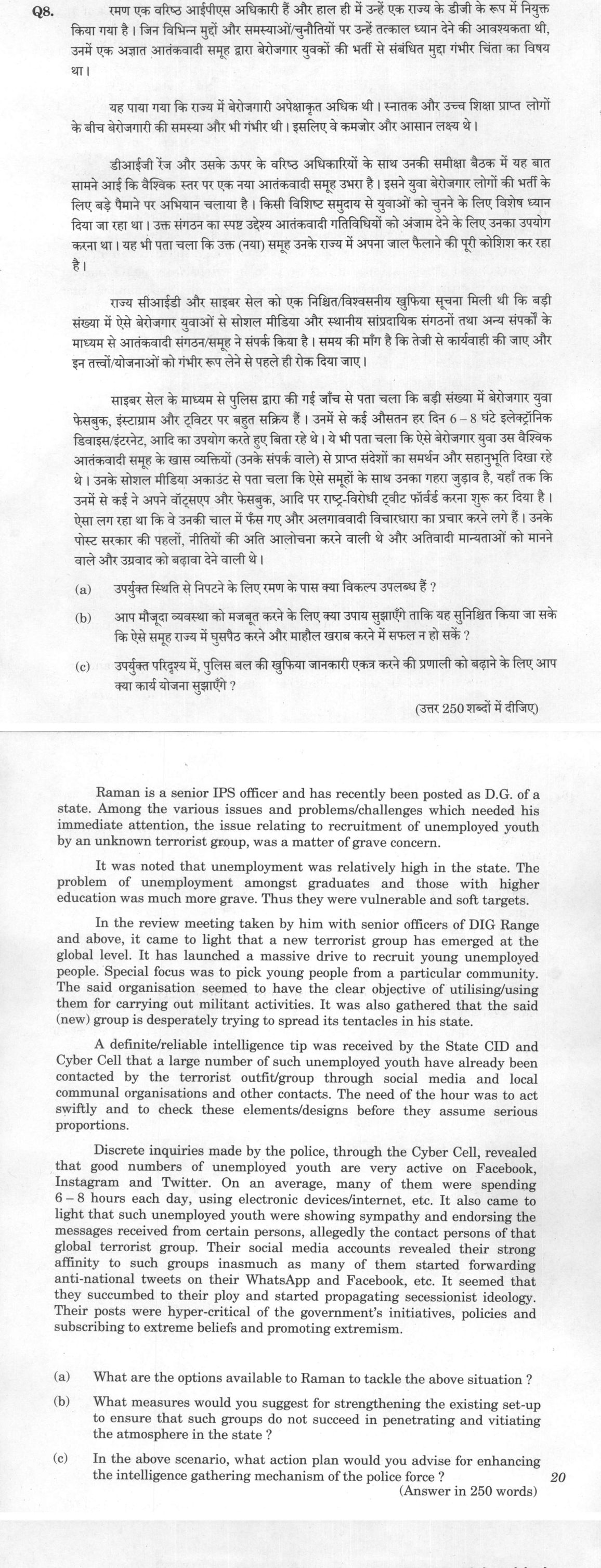
Raman is a senior IPS officer and has recently been posted as D.G. of a state. Among the various issues and problems/challenges which needed his immediate attention, the issue relating to recruitment of unemployed youth by an unknown terrorist group, was a matter of grave concern.
It was noted that unemployment was relatively high in the state. The problem of unemployment amongst graduates and those with higher education was much more grave. Thus they were vulnerable and soft targets.
In the review meeting taken by him with senior officers of DIG Range and above, it came to light that a new terrorist group has emerged at the global level. It has launched a massive drive to recruit young unemployed people. Special focus was to pick young people from a particular community. The said organisation seemed to have the clear objective of utilising/using them for carrying out militant activities. It was also gathered that the said (new) group is desperately trying to spread its tentacles in his state.
A definite/reliable intelligence tip was received by the State CID and Cyber Cell that a large number of such unemployed youth have already been contacted by the terrorist outfit/group through social media and local communal organisations and other contacts. The need of the hour was to act swiftly and to check these elements/designs before they assume serious proportions.
Discrete inquiries made by the police, through the Cyber Cell, revealed that good numbers of unemployed youth are very active on Facebook, Instagram and Twitter. On an average, many of them were spending 6-8 hours each day, using electronic devices/internet, etc. It also came to light that such unemployed youth were showing sympathy and endorsing the messages received from certain persons, allegedly the contact persons of that global terrorist group. Their social media accounts revealed their strong affinity to such groups inasmuch as many of them started forwarding anti-national tweets on their WhatsApp and Facebook, etc. It seemed that they succumbed to their ploy and started propagating secessionist ideology. Their posts were hyper-critical of the government's initiatives, policies and subscribing to extreme beliefs and promoting extremism.
What are the options available to Raman to tackle the above situation?
What measures would you suggest for strengthening the existing set-up to ensure that such groups do not succeed in penetrating and vitiating the atmosphere in the state?
In the above scenario, what action plan would you advise for enhancing the intelligence gathering mechanism of the police force?
हिंदी में प्रश्न पढ़ें
रमण एक वरिष्ठ आईपीएस अधिकारी हैं और हाल ही में उन्हें एक राज्य के डीजी के रूप में नियुक्त किया गया है। जिन विभिन्न मुद्दों और समस्याओं/चुनौतियों पर उन्हें तत्काल ध्यान देने की आवश्यकता थी, उनमें एक अज्ञात आतंकवादी समूह द्वारा बेरोजगार युवकों की भर्ती से संबंधित मुद्दा गंभीर चिंता का विषय था।
यह पाया गया कि राज्य में बेरोजगारी अपेक्षाकृत अधिक थी। स्नातक और उच्च शिक्षा प्राप्त लोगों के बीच बेरोजगारी की समस्या और भी गंभीर थी। इसलिए वे कमजोर और आसान लक्ष्य थे।
डीआईजी रैंज और उसके ऊपर के वरिष्ठ अधिकारियों के साथ उनकी समीक्षा बैठक में यह बात सामने आई कि वैश्विक स्तर पर एक नया आतंकवादी समूह उभरा है। इसने युवा बेरोजगार लोगों की भर्ती के लिए बड़े पैमाने पर अभियान चलाया है। किसी विशिष्ट समुदाय से युवाओं को चुनने के लिए विशेष ध्यान दिया जा रहा था। उक्त संगठन का स्पष्ट उद्देश्य आतंकवादी गतिविधियों को अंजाम देने के लिए उनका उपयोग करना था। यह भी पता चला कि उक्त (नया) समूह उनके राज्य में अपना जाल फैलाने की पूरी कोशिश कर रहा है।
राज्य सीआईडी और साइबर सेल को एक निश्चित/विश्वसनीय खुफिया सूचना मिली थी कि बड़ी संख्या में ऐसे बेरोजगार युवाओं से सोशल मीडिया और स्थानीय सांप्रदायिक संगठनों तथा अन्य संपर्कों के माध्यम से आतंकवादी संगठन/समूह ने संपर्क किया है। समय की मांग है कि तेजी से कार्यवाही की जाए और इन तत्वों/योजनाओं को गंभीर रूप लेने से पहले ही रोक दिया जाए।
साइबर सेल के माध्यम से पुलिस द्वारा की गई जांच से पता चला कि बड़ी संख्या में बेरोजगार युवा फेसबुक, इंस्टाग्राम और ट्विटर पर बहुत सक्रिय हैं। उनमें से कई औसतन हर दिन 6-8 घंटे इलेक्ट्रॉनिक डिवाइस/इंटरनेट, आदि का उपयोग करते हुए बिता रहे थे। ये भी पता चला कि ऐसे बेरोजगार युवा उस वैश्विक आतंकवादी समूह के खास व्यक्तियों (उनके संपर्क वालों) से प्राप्त संदेशों का समर्थन और सहानुभूति दिखा रहे थे। उनके सोशल मीडिया अकाउंट से पता चला कि ऐसे समूहों के साथ उनका गहरा जुड़ाव है, यहां तक कि उनमें से कई ने अपने वॉट्सऐप और फेसबुक, आदि पर राष्ट्र-विरोधी ट्वीट फॉरवर्ड करना शुरू कर दिया है। ऐसा लग रहा था कि वे उनकी चाल में फंस गए और अलगाववादी विचारधारा का प्रचार करने लगे हैं। उनके पोस्ट सरकार की पहलों, नीतियों की अति आलोचना करने वाली थीं और अतिवादी मान्यताओं को मानने वाले और उग्रवाद को बढ़ावा देने वाली थीं।
उपर्युक्त स्थिति से निपटने के लिए रमण के पास क्या विकल्प उपलब्ध हैं?
आप मौजूदा व्यवस्था को मजबूत करने के लिए क्या उपाय सुझाएंगे ताकि यह सुनिश्चित किया जा सके कि ऐसे समूह राज्य में घुसपैठ करने और माहौल खराब करने में सफल न हो सके?
उपर्युक्त परिदृश्य में, पुलिस बल की खुफिया जानकारी एकत्र करने की प्रणाली को बढ़ाने के लिए आप क्या कार्य योजना सुझाएंगे?
Model answer
Written by UPSC Answer Check against this question's marking rubric, to the 250-word length. UPSC does not publish answers for Mains — this is one way to score well, not an official key.
The situation presents a complex internal security challenge at the intersection of youth unemployment, cyber-radicalization, and proxy warfare by a global terrorist syndicate. Raman must adopt a constitutionally sound, multi-pronged approach that balances the imperatives of national security with the preservation of civil liberties and community trust.
Options Available to Raman
Raman has the following strategic options:
Raman can adopt an enforcement-heavy approach involving immediate detentions under the Unlawful Activities (Prevention) Act and the Bharatiya Nyaya Sanhita. However, purely punitive measures risk deepening alienation among educated youth and validating extremist propaganda.
Alternatively, Raman should pursue a graduated, balanced response combining targeted law enforcement with socio-psychological deradicalization:
Triage and Targeted Enforcement: The police must distinguish between hardcore recruiters/handlers and vulnerable, impressionable youth. Stringent legal action, financial tracking, and platform takedowns under Section 69A of the Information Technology Act should be directed at foreign and local handlers in close coordination with central agencies such as the Intelligence Bureau (IB) and the National Investigation Agency (NIA).
Community-Led Deradicalization: For youth who have merely consumed or forwarded secessionist content, punitive detention must be avoided. Raman should initiate a structured, non-custodial deradicalization program involving clinical psychologists, family members, and credible community and religious elders, drawing on successful models like Maharashtra’s Anti-Terrorism Squad deradicalization initiative.
Soft Interventions and Socio-Economic Linkages: Given that unemployment is the primary vulnerability, the district administration must link these youth to the State Skill Development Mission, Prime Minister’s Kaushal Vikas Yojana, and local employment exchanges, redirecting their energies productively.
Safeguards for Civil Liberties: All actions must strictly adhere to the proportionality principle laid down in the K.S. Puttaswamy judgment and follow the procedural safeguards for preventive detention and interrogation established in D.K. Basu v. State of West Bengal, preventing arbitrary harassment of the target community.
Strengthening the Existing Set-Up
To prevent extremist organizations from penetrating the social fabric, systemic institutional reforms are necessary:
Multi-Agency Coordination: Establish a State Counter-Radicalization Task Force integrating the State Police, Cyber Cell, Department of Higher Education, Labour Department, and Social Welfare Department. This ensures early detection of student distress and coordinated policy interventions.
Revival of Community Policing: Reinvigorate institutional community policing models, such as Kerala’s Janamaithri Suraksha, by setting up Mohalla and Village Defense Committees and youth sports clubs. These platforms bridge the trust deficit between law enforcement and minority communities, creating organic barriers against extremist penetration.
Counter-Narrative Campaigns: The state Cyber Cell must launch proactive digital campaigns across Instagram, X, and YouTube. By collaborating with youth influencers, educators, and moderate religious scholars, the police can systematically dismantle secessionist narratives and highlight constitutional values and civic opportunities.
Grievance Redressal Mechanisms: Establish transparent, decentralized grievance cells for educated unemployed youth to address issues related to competitive examination delays, recruitment transparency, and institutional credit access, neutralizing the socio-economic despair exploited by recruiters.
Action Plan for Enhancing Intelligence Gathering
A robust, modernized intelligence architecture must be instituted to preempt security threats:
Technical Intelligence (TECHINT) and Cyber Forensics: Upgrade the State Cyber Crime Cell into an advanced Cyber Command Centre equipped with Artificial Intelligence-driven Open Source Intelligence (OSINT) tools and sentiment analysis software. This allows real-time tracking of emerging radicalization trends, algorithmic bot networks, and suspicious communication clusters on social media while maintaining digital privacy protocols.
Revitalization of Human Intelligence (HUMINT): While digital surveillance is critical, traditional beat policing remains irreplaceable. Raman must build a discrete, deeply embedded HUMINT network within vulnerable neighborhoods, college campuses, and local organizations. Beat constables should be trained in community psychology to identify early behavioral indicators of radicalization.
Seamless Inter-Agency Grid Integration: Operationalize the State Multi-Agency Centre (SMAC) to ensure 24/7 real-time information exchange between state intelligence units, the National Crime Records Bureau’s CCTNS, the Indian Cyber Crime Coordination Centre (I4C), and the central Multi-Agency Centre (MAC). Integrating state feeds with the National Intelligence Grid (NATGRID) will facilitate rapid inter-state tracking of extremist financing and cross-border handlers.
Training and Specialized Units: Create a dedicated Counter-Ideology Intelligence Unit within the State Special Branch, staffed with personnel trained in behavioral forensics, linguistics, and counter-insurgency doctrine to anticipate recruitment patterns before they materialize on the ground.
By blending precise technical intelligence, constitutional policing, and compassionate socio-economic rehabilitation, Raman can dismantle the recruitment machinery of the global outfit while anchoring the state's educated youth firmly within the democratic and economic mainstream of the nation.
What "Suggest" is asking you to do
Propose measures that attach to the causes the question has just had you identify. Each should name who acts, on what, and why it would work; a measure with no actor behind it is a wish rather than a suggestion.
Structure that answers it
The problem in one line → measure 1 with the cause it addresses → measure 2 → measure 3 → how it would be implemented and what it requires
Where marks are lost
Prescriptions that would fit any question on any subject — awareness campaigns, capacity building, better coordination. The examiner checks whether each measure is traceable to a cause the answer itself named.
How this answer will be evaluated
Approach
Framework: GS4 Ethical Dilemma & Administrative Action. (a) enumerate: list the items in order > one line each > no commentary | (b) suggest: the problem in one line > implementable measures > who acts > conclusion | (c) suggest: the problem in one line > implementable measures > who acts > conclusion Full marks: Comprehensive, actionable, and legally sound plan addressing both immediate threat and root causes.
Key points expected
- Immediate containment of identified radicalized youth
- Coordination with State CID and Cyber Cell
- Intelligence-driven targeted action
- Community engagement to counter radicalization
- Strengthening Cyber Cell monitoring capabilities
- Integrating intelligence from local communal organizations
- Addressing root cause: unemployment/education
- Building community trust to prevent 'vitiating atmosphere'
Evaluation rubric
Each sub-part is marked on its own, against the marks and word limit printed on the paper.
- (a) List specific operational options for Raman to address the recruitment threat.
enumerate— list the items in order → one line each → no commentary
Must cover
- Immediate containment of identified radicalized youth
- Coordination with State CID and Cyber Cell
- Intelligence-driven targeted action
- Community engagement to counter radicalization
Loses marks
- Vague generalities without operational detail
- Ignoring the 'unemployed youth' vulnerability aspect
- Suggesting only punitive measures without prevention
Earns more
- Mention of specific legal powers (UAPA/IPC)
- Differentiation between 'soft' and 'hard' targets
- Reference to de-radicalization programs
Extra mark
- Citing a specific counter-insurgency doctrine
- Reference to NIA's role in such cases
- (b) Propose measures to strengthen the existing security setup against infiltration.
suggest— the problem in one line → implementable measures → who acts → conclusion
Must cover
- Strengthening Cyber Cell monitoring capabilities
- Integrating intelligence from local communal organizations
- Addressing root cause: unemployment/education
- Building community trust to prevent 'vitiating atmosphere'
Loses marks
- Focusing only on policing, ignoring social factors
- Suggesting measures that violate civil liberties
- Generic 'improve coordination' without specifics
Earns more
- Suggesting specific tech upgrades for surveillance
- Proposing inter-agency task forces
- Mentioning social media counter-narratives
Extra mark
- Reference to specific IT Act sections
- Mentioning specific state-level security committees
- (c) Advise an action plan to enhance police intelligence gathering.
suggest— the problem in one line → implementable measures → who acts → conclusion
Must cover
- Human Intelligence (HUMINT) in target communities
- Signal Intelligence (SIGINT) via Cyber Cell
- Open Source Intelligence (OSINT) from social media
- Feedback loop for actionable intelligence
Loses marks
- Confusing intelligence gathering with investigation
- Ignoring the 'social media' specific threat vector
- Lack of a structured 'action plan' format
Earns more
- Mentioning specific intelligence analysis techniques
- Proposing training for officers on digital forensics
- Suggesting reward systems for informants
Extra mark
- Reference to specific intelligence agencies (RAW/IB)
- Mentioning specific software tools for analysis
Practice this exact question
Write your answer and it is marked point by point against the model answer above — what you covered, what you missed, what you got wrong.
Evaluate my answer →More from General Studies 2024 GS Paper IV
- Q5 (a) "The 'Code of Conduct' and 'Code of Ethics' are the sources of guidance in public adm…
- Q6 (a) "In Indian culture and value system, an equal opportunity has been provided irrespect…
- Q7 There is a technological company named ABC Incorporated which is the second largest world…
- Q8 Raman is a senior IPS officer and has recently been posted as D.G. of a state. Among the…
- Q9 With multipronged strategy of the Central and State Governments specially in the last few…
- Q10 Sneha is a Senior Manager working for a big reputed hospital chain in a mid-sized city. S…
- Q11 With the summer heat being exceptionally severe this year, the district has been facing s…