GS Paper IV — Q6
(a) "In Indian culture and value system, an equal opportunity has been provided irrespective of gender identity. The number of…
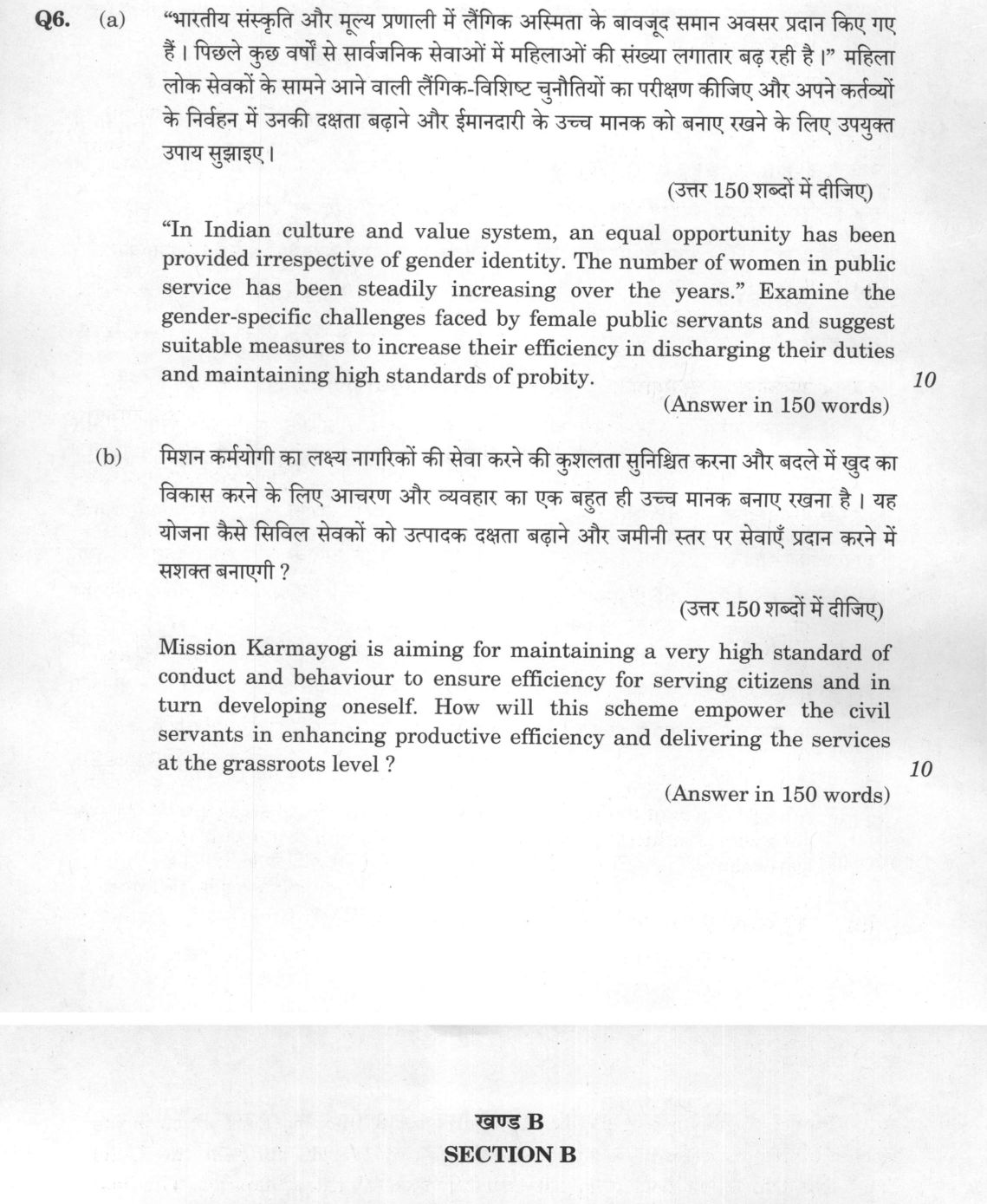
"In Indian culture and value system, an equal opportunity has been provided irrespective of gender identity. The number of women in public service has been steadily increasing over the years." Examine the gender-specific challenges faced by female public servants and suggest suitable measures to increase their efficiency in discharging their duties and maintaining high standards of probity. (Answer in 150 words) 10 marks
Mission Karmayogi is aiming for maintaining a very high standard of conduct and behaviour to ensure efficiency for serving citizens and in turn developing oneself. How will this scheme empower the civil servants in enhancing productive efficiency and delivering the services at the grassroots level ? (Answer in 150 words) 10 marks
हिंदी में प्रश्न पढ़ें
"भारतीय संस्कृति और मूल्य प्रणाली में लैंगिक अस्मिता के बावजूद समान अवसर प्रदान किए गए हैं। पिछले कुछ वर्षों से सार्वजनिक सेवाओं में महिलाओं की संख्या लगातार बढ़ रही है।" महिला लोक सेवकों के सामने आने वाली लैंगिक-विशिष्ट चुनौतियों का परीक्षण कीजिए और अपने कर्तव्यों के निर्वहन में उनकी दक्षता बढ़ाने और ईमानदारी के उच्च मानक को बनाए रखने के लिए उपयुक्त उपाय सुझाइए। (उत्तर 150 शब्दों में दीजिए)
मिशन कर्मयोगी का लक्ष्य नागरिकों की सेवा करने की कुशलता सुनिश्चित करना और बदले में खुद का विकास करने के लिए आचरण और व्यवहार का एक बहुत ही उच्च मानक बनाए रखना है। यह योजना कैसे सिविल सेवकों को उत्पादक दक्षता बढ़ाने और जमीनी स्तर पर सेवाएं प्रदान करने में सशक्त बनाएगी ? (उत्तर 150 शब्दों में दीजिए)
Model answer
Written by UPSC Answer Check against this question's marking rubric, to the 150-word length. UPSC does not publish answers for Mains — this is one way to score well, not an official key.
Gender-Specific Challenges and Measures in Public Service
Despite constitutional guarantees of equality, female public servants face systemic hurdles: deep-seated patriarchal work cultures, glass ceilings in premier postings, work-life balance strains due to unshared domestic burdens, lack of institutional mentorship networks, and personal safety challenges during remote field inspections.
To bolster their efficiency and probity, the state must:
- Institutionalize mandatory crèche facilities, flexible work arrangements, and secure field transit/housing.
- Enforce zero-tolerance anti-harassment mechanisms under the POSH Act, 2013.
- Establish structured women-leadership mentorship programmes and institutional gender-sensitization training across all tiers.
Empowerment via Mission Karmayogi at the Grassroots
Mission Karmayogi transitions the bureaucracy from 'rules-based' to 'roles-based' governance. Utilizing the iGOT Karmayogi digital platform, it empowers civil servants by democratizing competency-based training across functional, behavioural, and domain competencies.
Grassroots delivery is enhanced through:
- Decentralized, tailored capacity building for frontline functionaries to ensure empathetic, citizen-centric service delivery.
- Embedding ethical decision-making frameworks that fortify probity and responsiveness.
- Aligning performance-linked career progression with objective learning outcomes.
Integrating gender-inclusive working environments with Karmayogi's competency framework is vital to forging a high-performing, ethical, and representative administrative system.
What "Examine" is asking you to do
Test the proposition the question puts to you and return a finding on how far it holds. Examine stems carry a claim, or ask whether something has happened, and expect evidence weighed both ways before the extent is stated — often with remedial measures attached.
Structure that answers it
Restate the claim as the question frames it → evidence that supports it → evidence that undercuts it → the conditions under which it holds → verdict on how far it stands
Where marks are lost
Stopping at description. An examination has to reach a finding, and “examine with justification” means the extent must be stated, not implied.
How this answer will be evaluated
Approach
Framework: GS4 Ethical Dilemma & Governance Framework. (a) examine: intro > how/why with reasoning > evidence > conclusion | (b) explain: definition/context > points in order > small example > short close Full marks: Precise identification of challenges/measures with specific institutional references and clear linkage to probity/efficiency.
Key points expected
- Identify specific challenges (e.g., safety, harassment, work-life balance).
- Suggest measures to enhance duty efficiency.
- Suggest measures to maintain high standards of probity.
- Link measures to the Indian value system context.
- Define the core objective of Mission Karmayogi.
- Explain the mechanism for enhancing productive efficiency.
- Explain the impact on grassroots service delivery.
- Connect the scheme to self-development of civil servants.
Evaluation rubric
Each sub-part is marked on its own, against the marks and word limit printed on the paper.
- (a) Analyze gender-specific challenges and suggest measures for efficiency and probity. 10 marks · 150 words
examine— intro → how/why with reasoning → evidence → conclusion
Must cover
- Identify specific challenges (e.g., safety, harassment, work-life balance).
- Suggest measures to enhance duty efficiency.
- Suggest measures to maintain high standards of probity.
- Link measures to the Indian value system context.
Loses marks
- Generic statements without specific administrative measures.
- Ignoring the 'probity' aspect of the question.
Earns more
- Mention specific institutional mechanisms (e.g., Internal Complaints Committee).
- Reference specific policies (e.g., Maternity Benefit Act).
Extra mark
- Cite a specific Supreme Court judgment on workplace harassment.
- Reference a specific government scheme for women in service.
- (b) Explain how Mission Karmayogi enhances efficiency and grassroots service delivery. 10 marks · 150 words
explain— definition/context → points in order → small example → short close
Must cover
- Define the core objective of Mission Karmayogi.
- Explain the mechanism for enhancing productive efficiency.
- Explain the impact on grassroots service delivery.
- Connect the scheme to self-development of civil servants.
Loses marks
- Vague description of the scheme without specific mechanisms.
- Failing to link the scheme to grassroots impact.
Earns more
- Mention the 'Learn, Practice, Transform' framework.
- Reference the e-Office or digital training platforms.
Extra mark
- Cite a specific module or training program under the scheme.
- Reference the 'Karmayogi' portal or specific digital infrastructure.
Practice this exact question
Write your answer and it is marked point by point against the model answer above — what you covered, what you missed, what you got wrong.
Evaluate my answer →More from General Studies 2024 GS Paper IV
- Q3 Given below are three quotations of great thinkers. What do each of these quotations conv…
- Q4 (a) "The concept of Just and Unjust is contextual. What was just a year back, may turn ou…
- Q5 (a) "The 'Code of Conduct' and 'Code of Ethics' are the sources of guidance in public adm…
- Q6 (a) "In Indian culture and value system, an equal opportunity has been provided irrespect…
- Q7 There is a technological company named ABC Incorporated which is the second largest world…
- Q8 Raman is a senior IPS officer and has recently been posted as D.G. of a state. Among the…
- Q9 With multipronged strategy of the Central and State Governments specially in the last few…