GS Paper IV — Q2
(a) "It is not enough to talk about peace, one must believe in it; and it is not enough to believe in it, one must act upon it."…
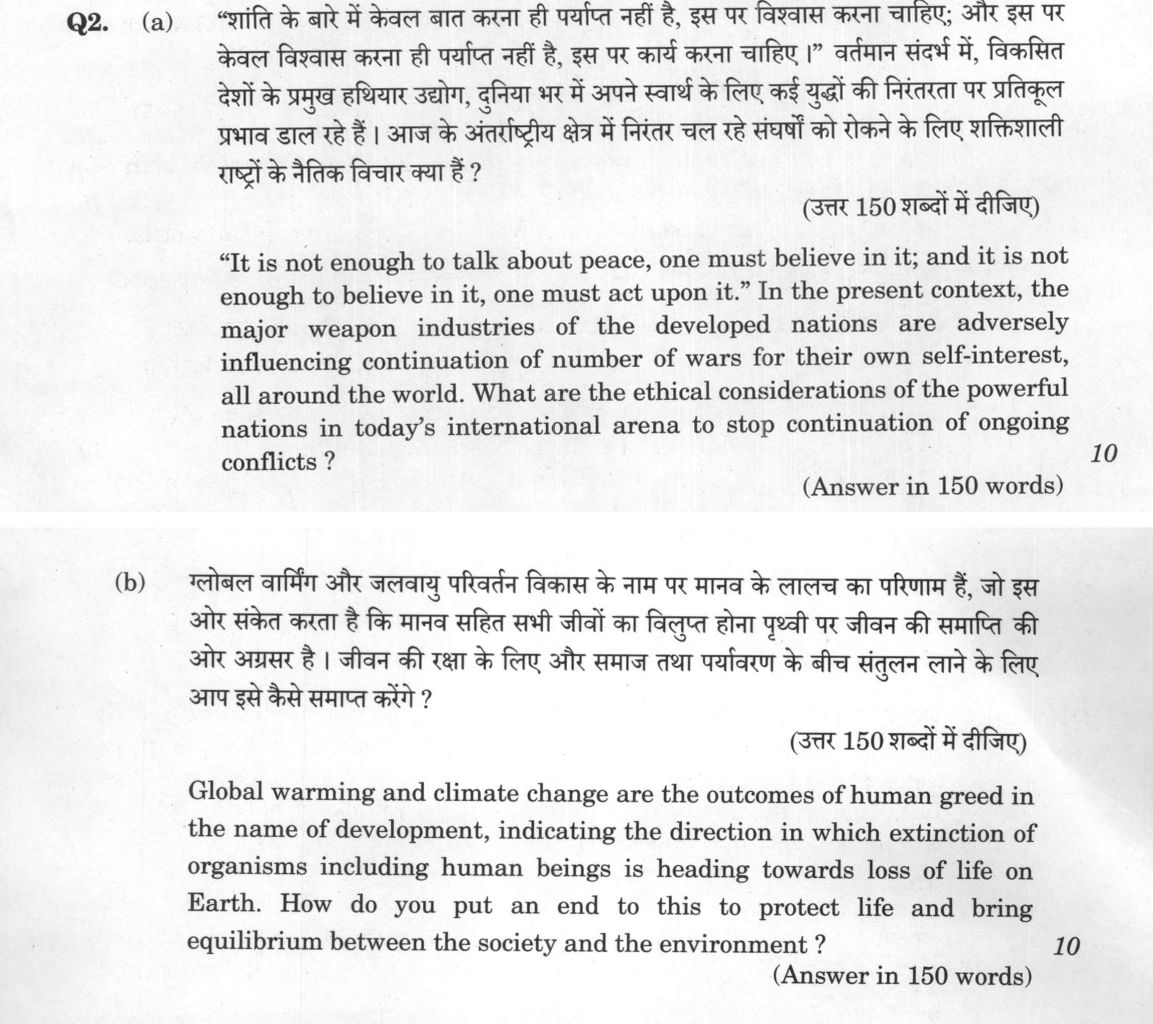
"It is not enough to talk about peace, one must believe in it; and it is not enough to believe in it, one must act upon it." In the present context, the major weapon industries of the developed nations are adversely influencing continuation of number of wars for their own self-interest, all around the world. What are the ethical considerations of the powerful nations in today's international arena to stop continuation of ongoing conflicts? 10 (Answer in 150 words)
Global warming and climate change are the outcomes of human greed in the name of development, indicating the direction in which extinction of organisms including human beings is heading towards loss of life on Earth. How do you put an end to this to protect life and bring equilibrium between the society and the environment? 10 (Answer in 150 words)
हिंदी में प्रश्न पढ़ें
"शांति के बारे में केवल बात करना ही पर्याप्त नहीं है, इस पर विश्वास करना चाहिए; और इस पर केवल विश्वास करना ही पर्याप्त नहीं है, इस पर कार्य करना चाहिए।" वर्तमान संदर्भ में, विकसित देशों के प्रमुख हथियार उद्योग, दुनिया भर में अपने स्वार्थ के लिए कई युद्धों की निरंतरता पर प्रतिकूल प्रभाव डाल रहे हैं। आज के अंतर्राष्ट्रीय क्षेत्र में निरंतर चल रहे संघर्षों को रोकने के लिए शक्तिशाली राष्ट्रों के नैतिक विचार क्या हैं? (उत्तर 150 शब्दों में दीजिए)
ग्लोबल वार्मिंग और जलवायु परिवर्तन विकास के नाम पर मानव के लालच का परिणाम है, जो इस और संकेत करता है कि मानव सहित सभी जीवों का विलुप्त होना पृथ्वी पर जीवन की समाप्ति की ओर अग्रसर है। जीवन की रक्षा के लिए और समाज तथा पर्यावरण के बीच संतुलन लाने के लिए आप इसे कैसे समाप्त करेंगे? (उत्तर 150 शब्दों में दीजिए)
Model answer
Written by UPSC Answer Check against this question's marking rubric, to the 150-word length. UPSC does not publish answers for Mains — this is one way to score well, not an official key.
(a) Ethical Obligations in Global Conflicts The military-industrial complex perpetuates conflicts for economic gain, creating a moral hazard that treats human lives as mere means rather than ends. Evaluated against the ethical standards of non-maleficence, jus ad bellum, and the Responsibility to Protect (R2P), powerful nations have a duty to curb weapon proliferation. Genuine commitment to peace requires enforcing robust arms export controls, ending proxy wars, and actively prioritizing multilateral mediation and disarmament over geopolitical mercantilism.
(b) Restoring Ecological Equilibrium Anthropogenic degradation stems from anthropocentric greed, presenting a collective action failure that breaches intergenerational justice. To restore equilibrium, society must cultivate ecological citizenship through frameworks like India’s Mission LiFE. Putting an end to ecological loss requires transitioning to a circular economy, adopting nature-based solutions, fast-tracking Sustainable Development Goals (SDGs), and operationalizing climate reparations based on Common But Differentiated Responsibilities (CBDR-RC).
Verdict Both crises reveal a conflict between narrow state sovereignty and universal moral duty. Resolving them necessitates shifting to cosmopolitan ethics (Vasudhaiva Kutumbakam), subordinating national self-interest to planetary survival and human security.
What "Evaluate" is asking you to do
Judge how well something has performed against the standard it set for itself — its stated aim, mandate or promise — and commit to a verdict. Name the yardstick before you judge; an unanchored judgement reads as opinion.
Structure that answers it
Name the yardstick — stated aim, mandate or benchmark → performance against it → shortfall against it → why the gap exists → verdict
Where marks are lost
Presenting both sides and then declining to decide, or delivering a verdict against a standard you never stated, which makes it look arbitrary.
How this answer will be evaluated
Approach
Framework: GS4 Ethical Dilemma & Governance Framework. (a) discuss: intro > 3-4 dimensions > example > balanced close | (b) suggest: the problem in one line > implementable measures > who acts > conclusion Full marks: Identifies structural conflicts and offers specific, actionable policy solutions.
Key points expected
- Identify conflict of interest: profit vs. peace
- Discuss duty of care to global citizens
- Mention role of international institutions (UN)
- Propose action: regulation of arms trade
- Address 'human greed' as the root cause
- Suggest policy: carbon pricing or cap-and-trade
- Suggest social: sustainable development goals
- Balance economic growth with ecological limits
Evaluation rubric
Each sub-part is marked on its own, against the marks and word limit printed on the paper.
- (a) Ethical considerations of powerful nations to stop ongoing conflicts. 10 marks · 150 words
discuss— intro → 3-4 dimensions → example → balanced close
Must cover
- Identify conflict of interest: profit vs. peace
- Discuss duty of care to global citizens
- Mention role of international institutions (UN)
- Propose action: regulation of arms trade
Loses marks
- Preaching without structural analysis
- Ignoring the 'self-interest' aspect of the prompt
- Vague generalities about 'world peace'
Earns more
- Reference to 'Just War' theory
- Mention of 'Human Security' concept
- Critique of 'Realpolitik' in foreign policy
- Reference to specific arms control treaties
Extra mark
- Citing specific UN Security Council resolutions
- Reference to specific arms trade agreements
- (b) Measures to end climate change and restore socio-environmental equilibrium. 10 marks · 150 words
suggest— the problem in one line → implementable measures → who acts → conclusion
Must cover
- Address 'human greed' as the root cause
- Suggest policy: carbon pricing or cap-and-trade
- Suggest social: sustainable development goals
- Balance economic growth with ecological limits
Loses marks
- Ignoring the 'greed' aspect of the prompt
- Focusing only on technology, ignoring policy
- Preaching 'save the earth' without actionable steps
Earns more
- Mention of 'Circular Economy' model
- Reference to 'Paris Agreement' targets
- Discussion of 'Intergenerational Equity'
- Specific examples of green technology adoption
Extra mark
- Citing specific IPCC report findings
- Reference to specific national climate action plans
Practice this exact question
Write your answer and it is marked point by point against the model answer above — what you covered, what you missed, what you got wrong.
Evaluate my answer →More from General Studies 2024 GS Paper IV
- Q1 (a) The application of Artificial Intelligence as a dependable source of input for admini…
- Q2 (a) "It is not enough to talk about peace, one must believe in it; and it is not enough t…
- Q3 Given below are three quotations of great thinkers. What do each of these quotations conv…
- Q4 (a) "The concept of Just and Unjust is contextual. What was just a year back, may turn ou…
- Q5 (a) "The 'Code of Conduct' and 'Code of Ethics' are the sources of guidance in public adm…