GS Paper IV — Q10
Sneha is a Senior Manager working for a big reputed hospital chain in a mid-sized city. She has been made in-charge of the new…
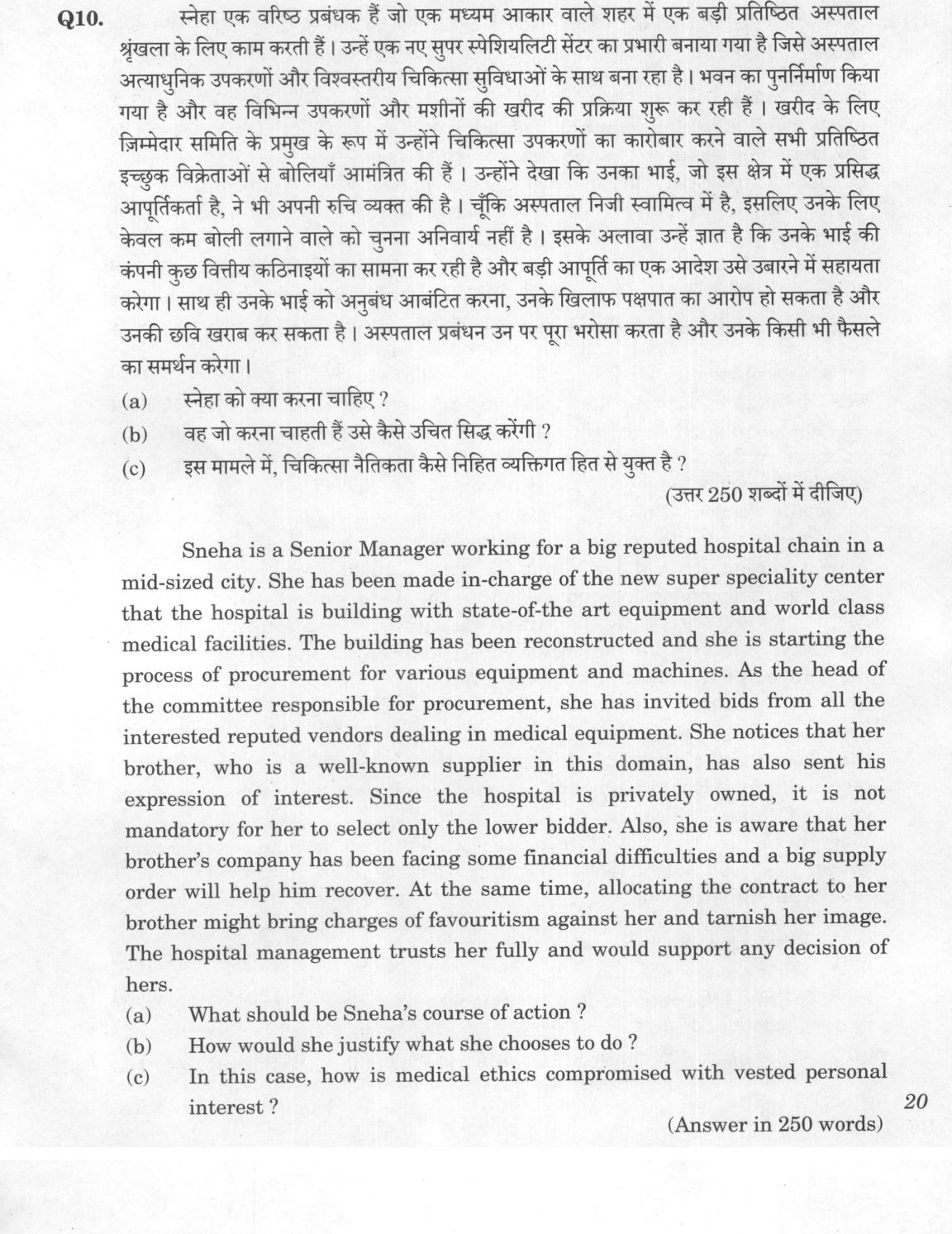
Sneha is a Senior Manager working for a big reputed hospital chain in a mid-sized city. She has been made in-charge of the new super speciality center that the hospital is building with state-of-the art equipment and world class medical facilities. The building has been reconstructed and she is starting the process of procurement for various equipment and machines. As the head of the committee responsible for procurement, she has invited bids from all the interested reputed vendors dealing in medical equipment. She notices that her brother, who is a well-known supplier in this domain, has also sent his expression of interest. Since the hospital is privately owned, it is not mandatory for her to select only the lower bidder. Also, she is aware that her brother's company has been facing some financial difficulties and a big supply order will help him recover. At the same time, allocating the contract to her brother might bring charges of favouritism against her and tarnish her image. The hospital management trusts her fully and would support any decision of hers.
What should be Sneha's course of action?
How would she justify what she chooses to do?
In this case, how is medical ethics compromised with vested personal interest?
(Answer in 250 words)
हिंदी में प्रश्न पढ़ें
स्नेहा एक वरिष्ठ प्रबंधक है जो एक मध्यम आकार वाले शहर में एक बड़ी प्रतिष्ठित अस्पताल श्रृंखला के लिए काम करती है। उन्हें एक नए सुपर स्पेशियलिटी सेंटर का प्रभारी बनाया गया है जिसे अस्पताल अत्याधुनिक उपकरणों और विश्वस्तरीय चिकित्सा सुविधाओं के साथ बना रहा है। भवन का पुनर्निर्माण किया गया है और वह विभिन्न उपकरणों और मशीनों की खरीद की प्रक्रिया शुरू कर रही है। खरीद के लिए जिम्मेदार समिति के प्रमुख के रूप में उन्होंने चिकित्सा उपकरणों का कारोबार करने वाले सभी प्रतिष्ठित इच्छुक विक्रेताओं से बोलियाँ आमंत्रित की हैं। उन्होंने देखा कि उनका भाई, जो इस क्षेत्र में एक प्रसिद्ध आपूर्तिकर्ता है, ने भी अपनी रुचि व्यक्त की है। चूँकि अस्पताल निजी स्वामित्व में है, इसलिए उनके लिए केवल कम बोली लगाने वाले को चुनना अनिवार्य नहीं है। इसके अलावा उन्हें ज्ञात है कि उनके भाई की कंपनी कुछ वित्तीय कठिनाइयों का सामना कर रही है और बड़ी आपूर्ति का एक आदेश उसे उबारने में सहायता करेगा। साथ ही उनके भाई को अनुबंध आबंटित करना, उनके खिलाफ पक्षपात का आरोप हो सकता है और उनकी छवि खराब कर सकता है। अस्पताल प्रबंधन उन पर पूरा भरोसा करता है और उनके किसी भी फैसले का समर्थन करेगा।
स्नेहा को क्या करना चाहिए?
वह जो करना चाहती है उसे कैसे उचित सिद्ध करेंगी?
इस मामले में, चिकित्सा नैतिकता कैसे निहित व्यक्तिगत हित से युक्त है?
(उत्तर 250 शब्दों में दीजिए)
Model answer
Written by UPSC Answer Check against this question's marking rubric, to the 250-word length. UPSC does not publish answers for Mains — this is one way to score well, not an official key.
Sneha faces a conflict of interest pitting familial obligation against professional integrity, fiduciary accountability, and patient welfare.
Course of Action Sneha must formally disclose her relationship with the vendor to the hospital board in writing and immediately recuse herself from the procurement committee evaluating this tender. Direct allocation of the contract to her brother is unethical and unacceptable. The hospital must establish an independent, third-party technical evaluation committee to assess all bids through an open, transparent, and competitive process. Bids must be appraised strictly on merit, technical specifications, cost-effectiveness, and reliability through a documented, arm’s-length mechanism.
Justification of Action Her actions are justified through the Nolan Committee principles of integrity, objectivity, and openness. Under John Rawls’s veil of ignorance, procurement standards must remain blind to personal identities to ensure fairness for all stakeholders. A utilitarian harm-benefit analysis demonstrates that compromising institutional procurement to relieve one individual's financial stress risks the health outcomes of thousands of future patients. Sneha's paramount fiduciary duty lies with the hospital and its patients, overriding private familial interests.
Compromise of Medical Ethics Vested personal interests directly compromise bioethical principles of beneficence and non-maleficence by risking substandard equipment quality, which jeopardizes clinical accuracy and patient safety. Furthermore, favoritism distorts economic fairness, inflating healthcare delivery costs and undermining distributive justice. Such conflicts of interest violate the ICMR Ethical Guidelines (2017) and WHO guidelines on health technology procurement, eroding public trust in medical institutions and subordinating sacred patient care to private pecuniary gain.
What "Suggest" is asking you to do
Propose measures that attach to the causes the question has just had you identify. Each should name who acts, on what, and why it would work; a measure with no actor behind it is a wish rather than a suggestion.
Structure that answers it
The problem in one line → measure 1 with the cause it addresses → measure 2 → measure 3 → how it would be implemented and what it requires
Where marks are lost
Prescriptions that would fit any question on any subject — awareness campaigns, capacity building, better coordination. The examiner checks whether each measure is traceable to a cause the answer itself named.
How this answer will be evaluated
Approach
Framework: GS4 Ethical Dilemma Framework. (a) suggest: the problem in one line > implementable measures > who acts > conclusion | (b) justify: claim > 3-4 reasons > evidence > conclusion | (c) analyse: intro > causes > effects > stakeholders/linkages > way forward Full marks: Clear, logical, and well-justified response addressing all parts with specific actions and ethical reasoning.
Key points expected
- Recusal from the specific procurement decision
- Transparent evaluation of all bids
- Prioritizing institutional integrity over personal gain
- Ensuring fair competition among vendors
- Upholding public trust and institutional reputation
- Demonstrating impartiality and fairness
- Protecting personal professional image
- Ensuring long-term sustainability of the hospital
Evaluation rubric
Each sub-part is marked on its own, against the marks and word limit printed on the paper.
- (a) Specific course of action to resolve the conflict of interest.
suggest— the problem in one line → implementable measures → who acts → conclusion
Must cover
- Recusal from the specific procurement decision
- Transparent evaluation of all bids
- Prioritizing institutional integrity over personal gain
- Ensuring fair competition among vendors
Loses marks
- Suggesting direct award to brother
- Ignoring the conflict of interest
- Vague or generic ethical statements
Earns more
- Mentioning conflict of interest policy
- Referring to independent committee review
- Balancing brother's financial need with duty
Extra mark
- Citing specific hospital procurement guidelines
- Mentioning legal provisions on conflict of interest
- (b) Reasoning to support the chosen course of action.
justify— claim → 3-4 reasons → evidence → conclusion
Must cover
- Upholding public trust and institutional reputation
- Demonstrating impartiality and fairness
- Protecting personal professional image
- Ensuring long-term sustainability of the hospital
Loses marks
- Justifying based solely on personal gain
- Ignoring the potential for reputational damage
- Lack of logical connection to the action
Earns more
- Referencing ethical principles of transparency
- Highlighting the risk of favouritism charges
- Emphasizing the duty to the hospital management
Extra mark
- Citing a relevant ethical code or case study
- Mentioning the impact on future procurement processes
- (c) Analysis of how personal interest compromises medical ethics.
analyse— intro → causes → effects → stakeholders/linkages → way forward
Must cover
- Identifying the conflict between personal and professional duty
- Explaining the erosion of trust in medical institutions
- Discussing the impact on patient care quality
- Highlighting the violation of ethical procurement standards
Loses marks
- Failing to connect personal interest to medical ethics
- Superficial analysis without depth
- Ignoring the specific context of the case
Earns more
- Linking to the concept of 'vested interest'
- Discussing the broader implications for the healthcare sector
- Mentioning the role of ethics in medical administration
Extra mark
- Referencing specific medical ethics codes (e.g., WMA)
- Providing a real-world example of procurement fraud
Practice this exact question
Write your answer and it is marked point by point against the model answer above — what you covered, what you missed, what you got wrong.
Evaluate my answer →More from General Studies 2024 GS Paper IV
- Q7 There is a technological company named ABC Incorporated which is the second largest world…
- Q8 Raman is a senior IPS officer and has recently been posted as D.G. of a state. Among the…
- Q9 With multipronged strategy of the Central and State Governments specially in the last few…
- Q10 Sneha is a Senior Manager working for a big reputed hospital chain in a mid-sized city. S…
- Q11 With the summer heat being exceptionally severe this year, the district has been facing s…
- Q12 Dr. Srinivasan is a senior scientist working for a reputed biotechnology company known fo…