GS Paper IV — Q12
Dr. Srinivasan is a senior scientist working for a reputed biotechnology company known for its cutting-edge research in…
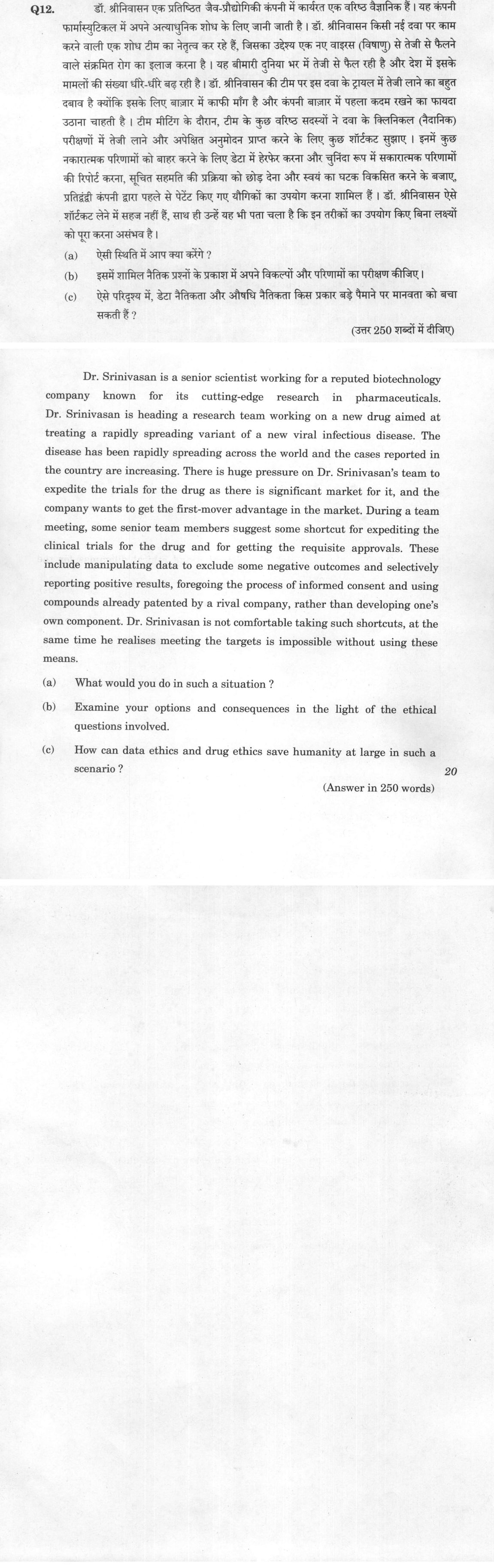
Dr. Srinivasan is a senior scientist working for a reputed biotechnology company known for its cutting-edge research in pharmaceuticals. Dr. Srinivasan is heading a research team working on a new drug aimed at treating a rapidly spreading variant of a new viral infectious disease. The disease has been rapidly spreading across the world and the cases reported in the country are increasing. There is huge pressure on Dr. Srinivasan's team to expedite the trials for the drug as there is significant market for it, and the company wants to get the first-mover advantage in the market. During a team meeting, some senior team members suggest some shortcut for expediting the clinical trials for the drug and for getting the requisite approvals. These include manipulating data to exclude some negative outcomes and selectively reporting positive results, foregoing the process of informed consent and using compounds already patented by a rival company, rather than developing one's own component. Dr. Srinivasan is not comfortable taking such shortcuts, at the same time he realises meeting the targets is impossible without using these means.
What would you do in such a situation?
Examine your options and consequences in the light of the ethical questions involved.
How can data ethics and drug ethics save humanity at large in such a scenario?
हिंदी में प्रश्न पढ़ें
डॉ. श्रीनिवासन एक प्रतिष्ठित जैव-प्रौद्योगिकी कंपनी में कार्यरत एक वरिष्ठ वैज्ञानिक हैं। यह कंपनी फार्मास्युटिकल में अपने अत्याधुनिक शोध के लिए जानी जाती है। डॉ. श्रीनिवासन किसी नई दवा पर काम करने वाली एक शोध टीम का नेतृत्व कर रहे हैं, जिसका उद्देश्य एक नए वाइरस (विषाणु) से तेजी से फैलने वाले संक्रमित रोग का इलाज करना है। यह बीमारी दुनिया भर में तेजी से फैल रही है और देश में इसके मामलों की संख्या धीरे-धीरे बढ़ रही है। डॉ. श्रीनिवासन की टीम पर इस दवा के ट्रायल में तेजी लाने का बहुत दबाव है क्योंकि इसके लिए बाजार में काफी मांग है और कंपनी बाजार में पहला कदम रखने का फायदा उठाना चाहती है। टीम मीटिंग के दौरान, टीम के कुछ वरिष्ठ सदस्यों ने दवा के क्लिनिकल (नैदानिक) परीक्षणों में तेजी लाने और अपेक्षित अनुमोदन प्राप्त करने के लिए कुछ शॉर्टकट सुझाए। इनमें कुछ नकारात्मक परिणामों को बाहर करने के लिए डेटा में हेरफेर करना और चुनिंदा रूप में सकारात्मक परिणामों की रिपोर्ट करना, सूचित सहमति की प्रक्रिया को छोड़ देना और स्वयं का घटक विकसित करने के बजाए, प्रतिद्वंद्वी कंपनी द्वारा पहले से पेटेंट किए गए यौगिकों का उपयोग करना शामिल है। डॉ. श्रीनिवासन ऐसे शॉर्टकट लेने में सहज नहीं हैं, साथ ही उन्हें यह भी पता चला है कि इन तरीकों का उपयोग किए बिना लक्ष्यों को पूरा करना असंभव है।
ऐसी स्थिति में आप क्या करेंगे?
इसमें शामिल नैतिक प्रश्नों के प्रकाश में अपने विकल्पों और परिणामों का परीक्षण कीजिए।
ऐसे परिदृश्य में, डेटा नैतिकता और औषधि नैतिकता किस प्रकार बड़े पैमाने पर मानवता को बचा सकती हैं?
Model answer
Written by UPSC Answer Check against this question's marking rubric, to the 250-word length. UPSC does not publish answers for Mains — this is one way to score well, not an official key.
This scenario presents a conflict between commercial urgency and foundational bioethics.
My Course of Action I would categorically refuse all proposed shortcuts—data manipulation, patent infringement, and bypassing informed consent. Upholding my duty as a scientist and citizen, I will prioritize patient safety over commercial profits. I will instruct the team to follow standard clinical trial protocols, explore legitimate scientific accelerations like adaptive trial designs, and apprise top management of the legal and moral risks.
Examination of Options and Ethical Frameworks Option 1: Complying with shortcuts. This secures first-mover advantage but violates Deontology (Kant’s Categorical Imperative against treating humans as mere means) by denying informed consent. It invites severe penal liabilities under the Drugs and Cosmetics Act, 1940, and patent laws. Utilitarian analysis confirms that the potential long-term harm to public health vastly outweighs short-term corporate gains.
Option 2: Refusing and escalating internally. Rejecting shortcuts and reporting misconduct to the Institutional Ethics Committee (IEC) upholds Virtue Ethics (scientific integrity). If pressured further, utilizing whistleblower protections to alert regulators (CDSCO) preserves professional duty despite career risks.
Option 3: Negotiating modified fast-track timelines. Engaging management to allocate additional resources and seek regulatory fast-tracking safely balances innovation, public urgency, and trial rigor.
Data and Drug Ethics for Humanity Data ethics enforces transparency, reproducibility, and FAIR principles, preventing fatal misinformation. Drug ethics, governed by the Declaration of Helsinki and ICMR Guidelines, sustains public trust in healthcare. As seen during COVID-19, rushed, flawed trials (e.g., Hydroxychloroquine controversies) eroded global trust, whereas transparent trials (e.g., Oxford-AstraZeneca) saved millions.
Bypassing bioethics turns a potential cure into a public hazard; steadfast scientific integrity is non-negotiable for human survival.
What "Examine" is asking you to do
Test the proposition the question puts to you and return a finding on how far it holds. Examine stems carry a claim, or ask whether something has happened, and expect evidence weighed both ways before the extent is stated — often with remedial measures attached.
Structure that answers it
Restate the claim as the question frames it → evidence that supports it → evidence that undercuts it → the conditions under which it holds → verdict on how far it stands
Where marks are lost
Stopping at description. An examination has to reach a finding, and “examine with justification” means the extent must be stated, not implied.
How this answer will be evaluated
Approach
Framework: GS4 Ethical Dilemma Framework (Crux, Stakeholders, Options, Course of Action). (a) comment: context > arguments both sides > judgment > close | (b) examine: intro > how/why with reasoning > evidence > conclusion | (c) explain: definition/context > points in order > small example > short close Full marks: Clear ethical stance, rigorous analysis of trade-offs, and specific application of data/drug ethics to the scenario.
Key points expected
- Refuse data manipulation and consent bypass
- Reject use of rival's patented compounds
- Acknowledge the pressure to meet targets
- Commit to ethical integrity over shortcuts
- Identify stakeholders (patients, company, public)
- Weigh profit/first-mover advantage vs. safety
- Consequences of data manipulation (public trust)
- Consequences of patent violation (legal/ethical)
Evaluation rubric
Each sub-part is marked on its own, against the marks and word limit printed on the paper.
- (a) State the ethical course of action Dr. Srinivasan should take.
comment— context → arguments both sides → judgment → close
Must cover
- Refuse data manipulation and consent bypass
- Reject use of rival's patented compounds
- Acknowledge the pressure to meet targets
- Commit to ethical integrity over shortcuts
Loses marks
- Suggesting compromise on data integrity
- Ignoring the patent infringement issue
- Vague moralizing without specific action
Earns more
- Mention reporting to higher management
- Suggest seeking regulatory guidance
- Highlight duty to patient safety
Extra mark
- Reference specific bioethics principles (e.g., Beneficence)
- (b) Analyze the options and consequences regarding the ethical questions.
examine— intro → how/why with reasoning → evidence → conclusion
Must cover
- Identify stakeholders (patients, company, public)
- Weigh profit/first-mover advantage vs. safety
- Consequences of data manipulation (public trust)
- Consequences of patent violation (legal/ethical)
Loses marks
- Listing values without analyzing consequences
- Ignoring the legal aspect of patents
- Preaching instead of reasoning
Earns more
- Discussing the 'easy-but-wrong' option
- Linking to institutional trust
- Balancing corporate goals with social responsibility
Extra mark
- Citing a specific case of drug trial fraud
- (c) Explain how data and drug ethics save humanity in this scenario.
explain— definition/context → points in order → small example → short close
Must cover
- Define role of data ethics (integrity/accuracy)
- Define role of drug ethics (safety/consent)
- Link to long-term public health outcomes
- Prevention of harm from unverified drugs
Loses marks
- Generic statements about 'good ethics'
- Failing to link ethics to 'saving humanity'
- Ignoring the specific context of the viral disease
Earns more
- Mentioning regulatory frameworks (e.g., CDSCO/FDA)
- Discussing the 'precautionary principle'
- Connecting to global health security
Extra mark
- Reference to specific international ethical guidelines
Practice this exact question
Write your answer and it is marked point by point against the model answer above — what you covered, what you missed, what you got wrong.
Evaluate my answer →More from General Studies 2024 GS Paper IV
- Q9 With multipronged strategy of the Central and State Governments specially in the last few…
- Q10 Sneha is a Senior Manager working for a big reputed hospital chain in a mid-sized city. S…
- Q11 With the summer heat being exceptionally severe this year, the district has been facing s…
- Q12 Dr. Srinivasan is a senior scientist working for a reputed biotechnology company known fo…