GS Paper IV — Q9
With multipronged strategy of the Central and State Governments specially in the last few years, the naxalite problem has been…
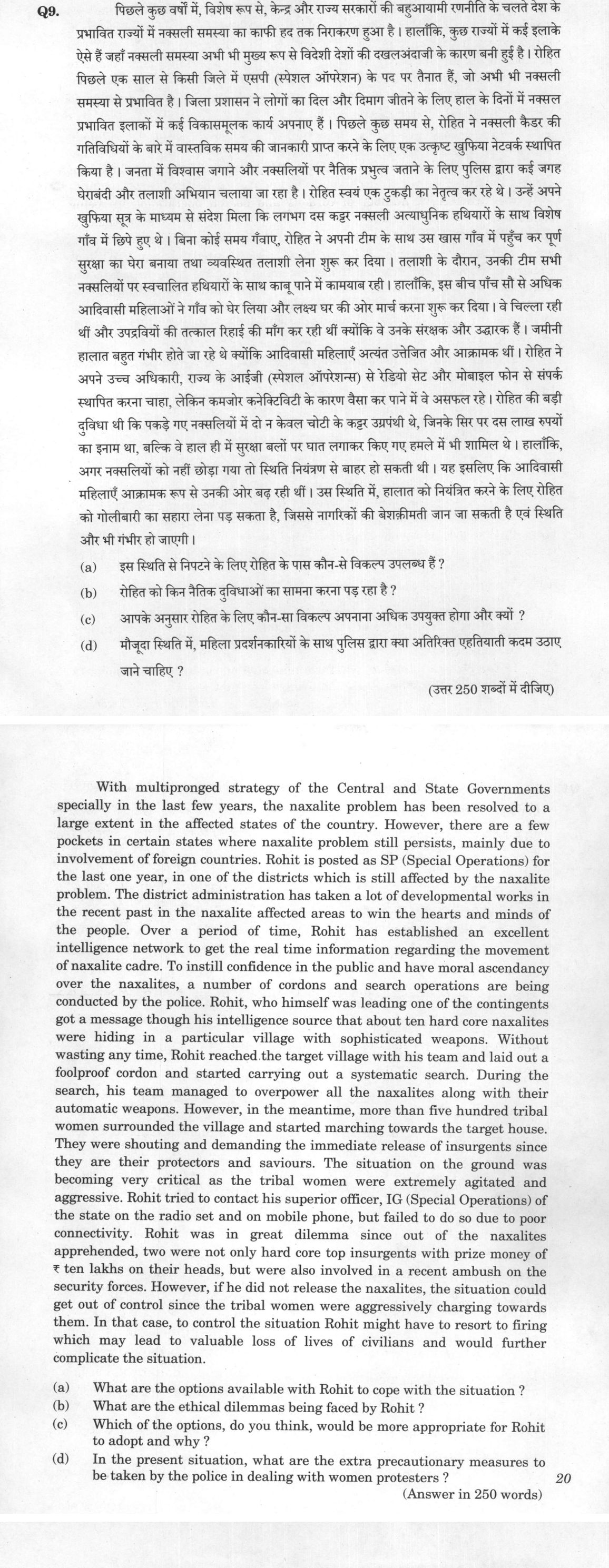
With multipronged strategy of the Central and State Governments specially in the last few years, the naxalite problem has been resolved to a large extent in the affected states of the country. However, there are a few pockets in certain states where naxalite problem still persists, mainly due to involvement of foreign countries. Rohit is posted as SP (Special Operations) for the last one year, in one of the districts which is still affected by the naxalite problem. The district administration has taken a lot of developmental works in the recent past in the naxalite affected areas to win the hearts and minds of the people. Over a period of time, Rohit has established an excellent intelligence network to get the real time information regarding the movement of naxalite cadre. To instill confidence in the public and have moral ascendancy over the naxalites, a number of cordons and search operations are being conducted by the police. Rohit, who himself was leading one of the contingents got a message though his intelligence source that about ten hard core naxalites were hiding in a particular village with sophisticated weapons. Without wasting any time, Rohit reached the target village with his team and laid out a foolproof cordon and started carrying out a systematic search. During the search, his team managed to overpower all the naxalites along with their automatic weapons. However, in the meantime, more than five hundred tribal women surrounded the village and started marching towards the target house. They were shouting and demanding the immediate release of insurgents since they are their protectors and saviours. The situation on the ground was becoming very critical as the tribal women were extremely agitated and aggressive. Rohit tried to contact his superior officer, IG (Special Operations) of the state on the radio set and on mobile phone, but failed to do so due to poor connectivity. Rohit was in great dilemma since out of the naxalites apprehended, two were not only hard core top insurgents with prize money of ₹ ten lakhs on their heads, but were also involved in a recent ambush on the security forces. However, if he did not release the naxalites, the situation could get out of control since the tribal women were aggressively charging towards them. In that case, to control the situation Rohit might have to resort to firing which may lead to valuable loss of lives of civilians and would further complicate the situation.
What are the options available with Rohit to cope with the situation?
What are the ethical dilemmas being faced by Rohit?
Which of the options, do you think, would be more appropriate for Rohit to adopt and why?
In the present situation, what are the extra precautionary measures to be taken by the police in dealing with women protesters?
(Answer in 250 words)
हिंदी में प्रश्न पढ़ें
पिछले कुछ वर्षों में, विशेष रूप से, केंद्र और राज्य सरकारों की बहुआयामी रणनीति के चलते देश के प्रभावित राज्यों में नक्सली समस्या का काफी हद तक निराकरण हुआ है। हालांकि, कुछ राज्यों में कई इलाके ऐसे हैं जहाँ नक्सली समस्या अभी भी मुख्य रूप से विदेशी देशों की दखलअंदाजी के कारण बनी हुई है। रोहित पिछले एक साल से किसी जिले में एसपी (स्पेशल ऑपरेशन) के पद पर तैनात हैं, जो अभी भी नक्सली समस्या से प्रभावित है। जिला प्रशासन ने लोगों का दिल और दिमाग जीतने के लिए हाल के दिनों में नक्सल प्रभावित इलाकों में कई विकासमूलक कार्य अपनाए हैं। पिछले कुछ समय से, रोहित ने नक्सली कैडर की गतिविधियों के बारे में वास्तविक समय की जानकारी प्राप्त करने के लिए एक उत्कृष्ट खुफिया नेटवर्क स्थापित किया है। जनता में विश्वास जगाने और नक्सलियों पर नैतिक प्रभुत्व जताने के लिए पुलिस द्वारा कई जगह घेराबंदी और तलाशी अभियान चलाया जा रहा है। रोहित स्वयं एक टुकड़ी का नेतृत्व कर रहे थे। उन्हें अपने खुफिया सूत्र के माध्यम से संदेश मिला कि लगभग दस कट्टर नक्सली अत्याधुनिक हथियारों के साथ विशेष गाँव में छिपे हुए थे। बिना कोई समय गँवाए, रोहित ने अपनी टीम के साथ उस खास गाँव में पहुँच कर पूर्ण सुरक्षा का घेरा बनाया तथा व्यवस्थित तलाशी लेना शुरू कर दिया। तलाशी के दौरान, उनकी टीम सभी नक्सलियों पर स्वचालित हथियारों के साथ काबू पाने में कामयाब रही। हालांकि, इस बीच पाँच सौ से अधिक आदिवासी महिलाओं ने गाँव को घेर लिया और लक्ष्य घर की ओर मार्च करना शुरू कर दिया। वे चिल्ला रही थीं और उपद्रवियों की तत्काल रिहाई की माँग कर रही थीं क्योंकि वे उनके संरक्षक और उद्धारक हैं। जमीनी हालात बहुत गंभीर होते जा रहे थे क्योंकि आदिवासी महिलाएँ अत्यंत उत्तेजित और आक्रामक थीं। रोहित ने अपने उच्च अधिकारी, राज्य के आईजी (स्पेशल ऑपरेशंस) से रेडियो सेट और मोबाइल फोन से संपर्क स्थापित करना चाहा, लेकिन कमजोर कनेक्टिविटी के कारण वैसा कर पाने में वे असफल रहे। रोहित की बड़ी दुविधा थी कि पकड़े गए नक्सलियों में दो न केवल चोटी के कट्टर उग्रपंथी थे, जिनके सिर पर दस लाख रुपयों का इनाम था, बल्कि वे हाल ही में सुरक्षा बलों पर घात लगाकर किए गए हमले में भी शामिल थे। हालाँकि, अगर नक्सलियों को नहीं छोड़ा गया तो स्थिति नियंत्रण से बाहर हो सकती थी। यह इसलिए कि आदिवासी महिलाएँ आक्रामक रूप से उनकी ओर बढ़ रही थीं। उस स्थिति में, हालात को नियंत्रित करने के लिए रोहित को गोलीबारी का सहारा लेना पड़ सकता है, जिससे नागरिकों की बेशकीमती जान जा सकती है एवं स्थिति और भी गंभीर हो जाएगी।
इस स्थिति से निपटने के लिए रोहित के पास कौन-से विकल्प उपलब्ध हैं?
रोहित को किन नैतिक दुविधाओं का सामना करना पड़ रहा है?
आपके अनुसार रोहित के लिए कौन-सा विकल्प अपनाना अधिक उपयुक्त होगा और क्यों?
मौजूदा स्थिति में, महिला प्रदर्शनकारियों के साथ पुलिस द्वारा क्या अतिरिक्त एहतियाती कदम उठाए जाने चाहिए?
(उत्तर 250 शब्दों में दीजिए)
Model answer
Written by UPSC Answer Check against this question's marking rubric, to the 250-word length. UPSC does not publish answers for Mains — this is one way to score well, not an official key.
Options Available Evaluating available courses against public order and long-term security outcomes:
- Release all cadres to prevent immediate violence and track them later via surveillance.
- Hold ground and use non-lethal crowd-control measures while waiting for reinforcements.
- Adopt a graduated settlement: release low-level cadres while retaining hardcore insurgents through mediation with community elders.
- Use kinetic force to disperse the crowd and retain custody, risking catastrophic civilian casualties.
Ethical Dilemmas The situation presents a clash between the legal duty to detain dangerous insurgents and the imperative to protect unarmed civilians—weighing the utilitarian calculus of minimizing immediate harm against strict deontological enforcement. Rohit faces a conflict between short-term operational gains and long-term trust erosion, testing the IPS moral code, operational pragmatism, and Rawlsian fairness toward vulnerable tribal populations.
Most Appropriate Option A graduated de-escalation strategy is the most effective approach as it secures the greatest net good. Rohit should negotiate with women representatives and village elders to release lower-level cadres, while covertly retaining the two hardcore insurgents involved in fatal ambushes. This preserves intelligence gains, upholds state moral ascendancy, prevents civilian bloodshed, and protects years of developmental goodwill under the 'winning hearts and minds' doctrine.
Precautionary Measures for Women Protesters In line with Supreme Court (2018) crowd-control directives and NHRC guidelines:
- Deploy women police personnel on the frontline to de-escalate tensions.
- Involve Gram Sabha women leaders and elders as dialogue intermediaries.
- Rely strictly on tiered non-lethal methods (tear smoke, water cannons); avoid kinetic force.
What "Evaluate" is asking you to do
Judge how well something has performed against the standard it set for itself — its stated aim, mandate or promise — and commit to a verdict. Name the yardstick before you judge; an unanchored judgement reads as opinion.
Structure that answers it
Name the yardstick — stated aim, mandate or benchmark → performance against it → shortfall against it → why the gap exists → verdict
Where marks are lost
Presenting both sides and then declining to decide, or delivering a verdict against a standard you never stated, which makes it look arbitrary.
How this answer will be evaluated
Approach
Framework: GS4 Ethical Dilemma & Decision Making. (a) enumerate: list the items in order > one line each > no commentary | (b) analyse: intro > causes > effects > stakeholders/linkages > way forward | (c) justify: claim > 3-4 reasons > evidence > conclusion | (d) suggest: the problem in one line > implementable measures > who acts > conclusion Full marks: Balanced, actionable, and legally sound reasoning with specific references.
Key points expected
- Release Naxalites to appease women
- Hold Naxalites and manage crowd
- Attempt to contact higher authority
- Use non-lethal crowd control measures
- Duty to law vs. duty to life
- Public safety vs. individual rights
- Political pressure vs. professional integrity
- Short-term peace vs. long-term security
Evaluation rubric
Each sub-part is marked on its own, against the marks and word limit printed on the paper.
- (a) List distinct courses of action available to Rohit.
enumerate— list the items in order → one line each → no commentary
Must cover
- Release Naxalites to appease women
- Hold Naxalites and manage crowd
- Attempt to contact higher authority
- Use non-lethal crowd control measures
Loses marks
- Listing only one option
- Vague options like 'do the right thing'
Earns more
- Negotiate with tribal leaders
- Delay action until connectivity restored
Extra mark
- Reference to specific police manual protocols
- (b) Identify the specific ethical conflicts in the scenario.
analyse— intro → causes → effects → stakeholders/linkages → way forward
Must cover
- Duty to law vs. duty to life
- Public safety vs. individual rights
- Political pressure vs. professional integrity
- Short-term peace vs. long-term security
Loses marks
- Generic ethical statements without context
- Ignoring the specific 'prize money' detail
Earns more
- Conflict of loyalty (state vs. people)
- Moral hazard of releasing criminals
Extra mark
- Reference to utilitarian vs. deontological ethics
- (c) Select the best option and provide reasoned arguments.
justify— claim → 3-4 reasons → evidence → conclusion
Must cover
- Clear selection of one option
- Reasoning based on 'greater good'
- Addressing the risk of firing
- Balancing security and human rights
Loses marks
- Choosing to fire on civilians
- Lack of logical connection between choice and reason
Earns more
- Mentioning 'hearts and minds' strategy
- Long-term impact on Naxalite narrative
Extra mark
- Citing a specific Supreme Court judgment on police powers
- (d) List precautionary measures for dealing with women protesters.
suggest— the problem in one line → implementable measures → who acts → conclusion
Must cover
- Use of female police personnel
- Non-lethal crowd control (water cannon)
- Communication and negotiation
- Ensuring medical aid is available
Loses marks
- Suggesting lethal force
- Ignoring the specific demographic (women)
Earns more
- Creating a buffer zone
- Using loudspeakers for calm instructions
Extra mark
- Reference to specific guidelines for women's safety
Practice this exact question
Write your answer and it is marked point by point against the model answer above — what you covered, what you missed, what you got wrong.
Evaluate my answer →More from General Studies 2024 GS Paper IV
- Q6 (a) "In Indian culture and value system, an equal opportunity has been provided irrespect…
- Q7 There is a technological company named ABC Incorporated which is the second largest world…
- Q8 Raman is a senior IPS officer and has recently been posted as D.G. of a state. Among the…
- Q9 With multipronged strategy of the Central and State Governments specially in the last few…
- Q10 Sneha is a Senior Manager working for a big reputed hospital chain in a mid-sized city. S…
- Q11 With the summer heat being exceptionally severe this year, the district has been facing s…
- Q12 Dr. Srinivasan is a senior scientist working for a reputed biotechnology company known fo…