GS Paper IV — Q3
Given below are three quotations of great thinkers. What do each of these quotations convey to you in the present context? (a)…
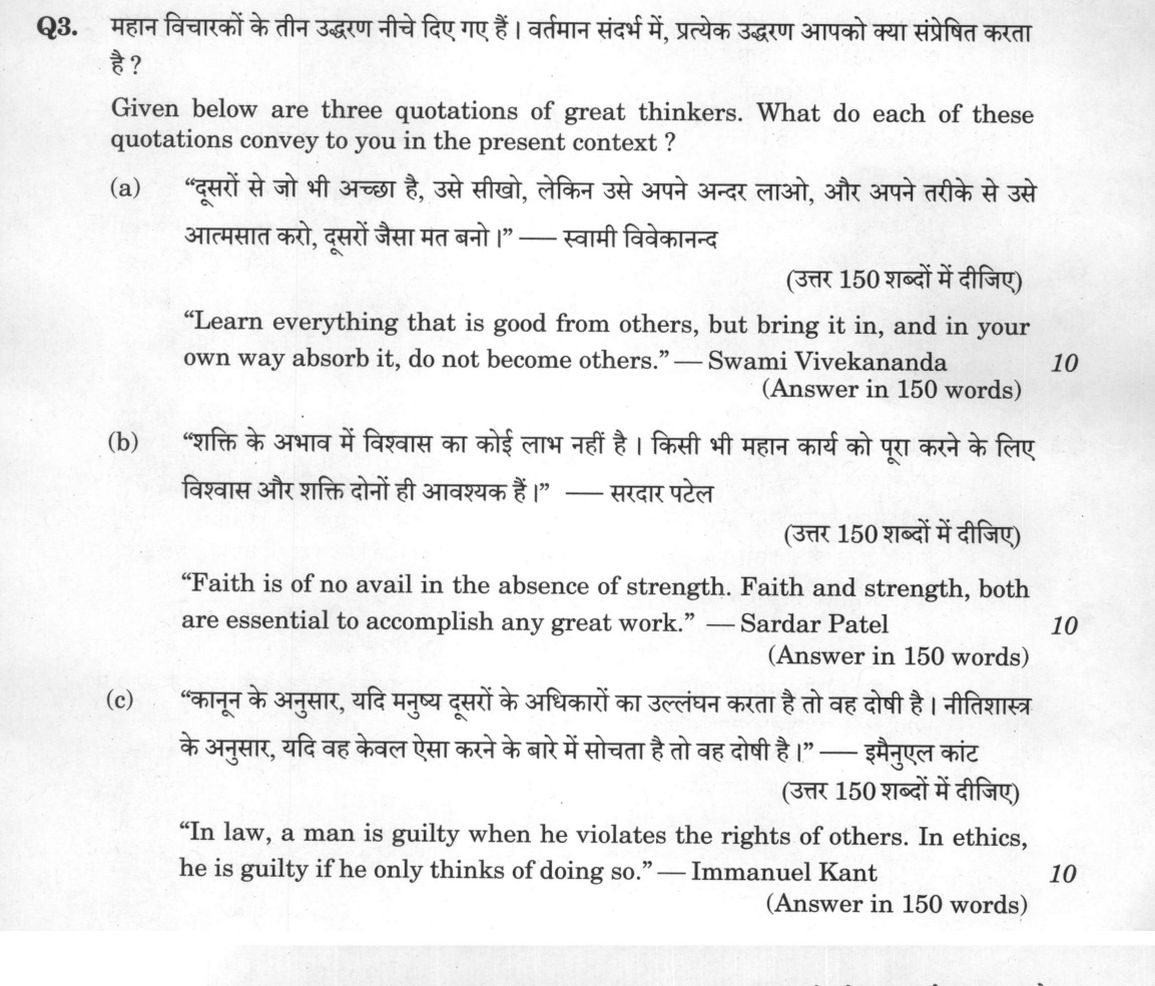
Given below are three quotations of great thinkers. What do each of these quotations convey to you in the present context?
"Learn everything that is good from others, but bring it in, and in your own way absorb it, do not become others." — Swami Vivekananda
(Answer in 150 words)
"Faith is of no avail in the absence of strength. Faith and strength, both are essential to accomplish any great work." — Sardar Patel
(Answer in 150 words)
"In law, a man is guilty when he violates the rights of others. In ethics, he is guilty if he only thinks of doing so." — Immanuel Kant
(Answer in 150 words)
हिंदी में प्रश्न पढ़ें
महान विचारकों के तीन उद्धरण नीचे दिए गए हैं। वर्तमान संदर्भ में, प्रत्येक उद्धरण आपको क्या संप्रेषित करता है?
"दूसरों से जो भी अच्छा है, उसे सीखो, लेकिन उसे अपने अंदर लाओ, और अपने तरीके से उसे आत्मसात करो, दूसरों जैसा मत बनो।" — स्वामी विवेकानन्द
(उत्तर 150 शब्दों में दीजिए)
"शक्ति के अभाव में विश्वास का कोई लाभ नहीं है। किसी भी महान कार्य को पूरा करने के लिए विश्वास और शक्ति दोनों ही आवश्यक हैं।" — सरदार पटेल
(उत्तर 150 शब्दों में दीजिए)
"कानून के अनुसार, यदि मनुष्य दूसरों के अधिकारों का उल्लंघन करता है तो वह दोषी है। नीतिशास्त्र के अनुसार, यदि वह केवल ऐसा करने के बारे में सोचता है तो वह दोषी है।" — इमैनुएल कांट
(उत्तर 150 शब्दों में दीजिए)
Model answer
Written by UPSC Answer Check against this question's marking rubric, to the 150-word length. UPSC does not publish answers for Mains — this is one way to score well, not an official key.
Ethical philosophy bridges internal conviction and external action. These three maxims together establish a comprehensive framework for moral autonomy, administrative fortitude, and subjective integrity in governance.
(a) Swami Vivekananda: Assimilation and Moral Autonomy
Vivekananda elucidates the vital difference between selective adaptation and uncritical mimicry. He advocates dynamic cultural syncretism, where external wisdom is digested to enrich one’s character without eroding indigenous identity. This philosophy is reflected in the Indian Constitution, which harmoniously integrated Westminster parliamentarianism, American fundamental rights, and Irish directive principles into a distinctly Indian socio-political fabric.
In the contemporary context, as India navigates rapid globalization and technological adoption—such as deploying Artificial Intelligence and global governance standards—it must localize these tools to domestic socioeconomic realities rather than blindly replicating Western templates. Similarly, the global projection of Yoga exemplifies the assimilation of modern scientific methods while retaining an enduring civilizational ethos.
(b) Sardar Patel: Synthesis of Vision and State Capacity
Patel distinguishes normative conviction (faith) from operational capacity and administrative will (strength). A vision devoid of execution remains ineffective idealism, whereas power without ethical purpose degenerates into tyranny. Patel demonstrated this synthesis during the integration of over 560 princely states, backing the constitutional faith in national unity with decisive administrative statecraft and unyielding resolve.
In modern public administration, transformative visions like PM Gati Shakti, net-zero climate commitments, and welfare saturation require robust state capacity, infrastructure, and resolute bureaucratic execution. Ethical leadership cannot rest on good intentions alone; it demands institutional strength and administrative courage to translate policy into measurable public welfare.
(c) Immanuel Kant: Deontological Purity and Conscience
Kant contrasts legal minimalism with ethical maximalism. Law regulates external conduct (actus reus), penalizing individuals only when rights are breached. In contrast, ethics governs the internal purity of the will and intent (mens rea), where harboring an unjust thought is itself a moral failure.
In public service, legal compliance alone is insufficient to secure good governance. Statutory watchdogs like the Lokpal and the Prevention of Corruption Act penalize overt wrongdoing, yet a civil servant can exploit legal loopholes for partisan or self-serving ends. Preventive ethics requires an active internal moral compass, ensuring that public duties are executed with intrinsic probity, free from corrupt motives long before any external act occurs.
Collectively, these philosophies converge on holistic ethical autonomy: Vivekananda provides the self-cultivated identity to absorb global knowledge, Patel delivers the operational strength to execute noble vision, and Kant anchors the internal conscience indispensable for probity in public life.
What "Elucidate" is asking you to do
Make a stated proposition plain and then prove it with instances. Elucidate stems almost always carry a claim or a named concept, and very often the words “with examples” or “with suitable diagrams” — the illustration is part of the directive, not decoration.
Structure that answers it
Plain-language statement of what the proposition means → the part that is obscure, resolved → first illustration → second illustration → why the proposition holds
Where marks are lost
Adding terminology; elucidate rewards removing it. The commoner loss is a clean explanation with no example, when the stem asked for examples.
How this answer will be evaluated
Approach
Framework: GS4 Ethical Reasoning & Situational Analysis. (a) comment: context > arguments both sides > judgment > close | (b) comment: context > arguments both sides > judgment > close | (c) comment: context > arguments both sides > judgment > close Full marks: Precise interpretation of the quote, strong contextual application to modern India, and a clear ethical/administrative conclusion.
Key points expected
- Define 'selective absorption' vs 'blind imitation'
- Contextualize with modern India's tech/education adoption
- Highlight the danger of cultural erosion
- Conclude with the need for indigenous innovation
- Define 'faith' as conviction/vision
- Define 'strength' as resources/competence
- Explain why one without the other fails
- Apply to a governance or development context
Evaluation rubric
Each sub-part is marked on its own, against the marks and word limit printed on the paper.
- (a) Interpret Vivekananda's quote on selective absorption of global knowledge without losing identity. 10 marks · 150 words
comment— context → arguments both sides → judgment → close
Must cover
- Define 'selective absorption' vs 'blind imitation'
- Contextualize with modern India's tech/education adoption
- Highlight the danger of cultural erosion
- Conclude with the need for indigenous innovation
Loses marks
- Preaching without concrete examples
- Ignoring the 'do not become others' aspect
- Vague generalities about culture
Earns more
- Mention 'Glocalization' or 'Indigenization' concepts
- Reference specific fields (e.g., AI, governance)
- Balance between learning and self-reliance
Extra mark
- Reference to 'Swadeshi' movement
- Specific example of successful indigenization
- (b) Analyze the interplay between faith (vision) and strength (capability) in public service. 10 marks · 150 words
comment— context → arguments both sides → judgment → close
Must cover
- Define 'faith' as conviction/vision
- Define 'strength' as resources/competence
- Explain why one without the other fails
- Apply to a governance or development context
Loses marks
- Treating faith as religious only
- Ignoring the 'strength' (practical) component
- Abstract philosophical talk without application
Earns more
- Link to 'Vision 2047' or long-term goals
- Mention 'administrative capacity' or 'infrastructure'
- Balanced view of idealism vs realism
Extra mark
- Reference to Sardar Patel's integration of India
- Specific example of a project needing both
- (c) Discuss the ethical standard of intent vs action in public administration. 10 marks · 150 words
comment— context → arguments both sides → judgment → close
Must cover
- Distinguish legal guilt (action) from ethical guilt (intent)
- Explain the 'duty of care' in public office
- Highlight the danger of 'benign' discriminatory thoughts
- Conclude with the need for internal moral policing
Loses marks
- Confusing law with ethics
- Ignoring the 'thinking' aspect of the quote
- Focusing only on punishment
Earns more
- Reference to 'Categorical Imperative' (Kant)
- Mention 'bias' or 'prejudice' in decision making
- Link to 'integrity' and 'impartiality' values
Extra mark
- Reference to 'Caste/Religion' bias in appointments
- Specific case of ethical lapse without legal violation
Practice this exact question
Write your answer and it is marked point by point against the model answer above — what you covered, what you missed, what you got wrong.
Evaluate my answer →More from General Studies 2024 GS Paper IV
- Q1 (a) The application of Artificial Intelligence as a dependable source of input for admini…
- Q2 (a) "It is not enough to talk about peace, one must believe in it; and it is not enough t…
- Q3 Given below are three quotations of great thinkers. What do each of these quotations conv…
- Q4 (a) "The concept of Just and Unjust is contextual. What was just a year back, may turn ou…
- Q5 (a) "The 'Code of Conduct' and 'Code of Ethics' are the sources of guidance in public adm…
- Q6 (a) "In Indian culture and value system, an equal opportunity has been provided irrespect…