GS Paper IV — Q5
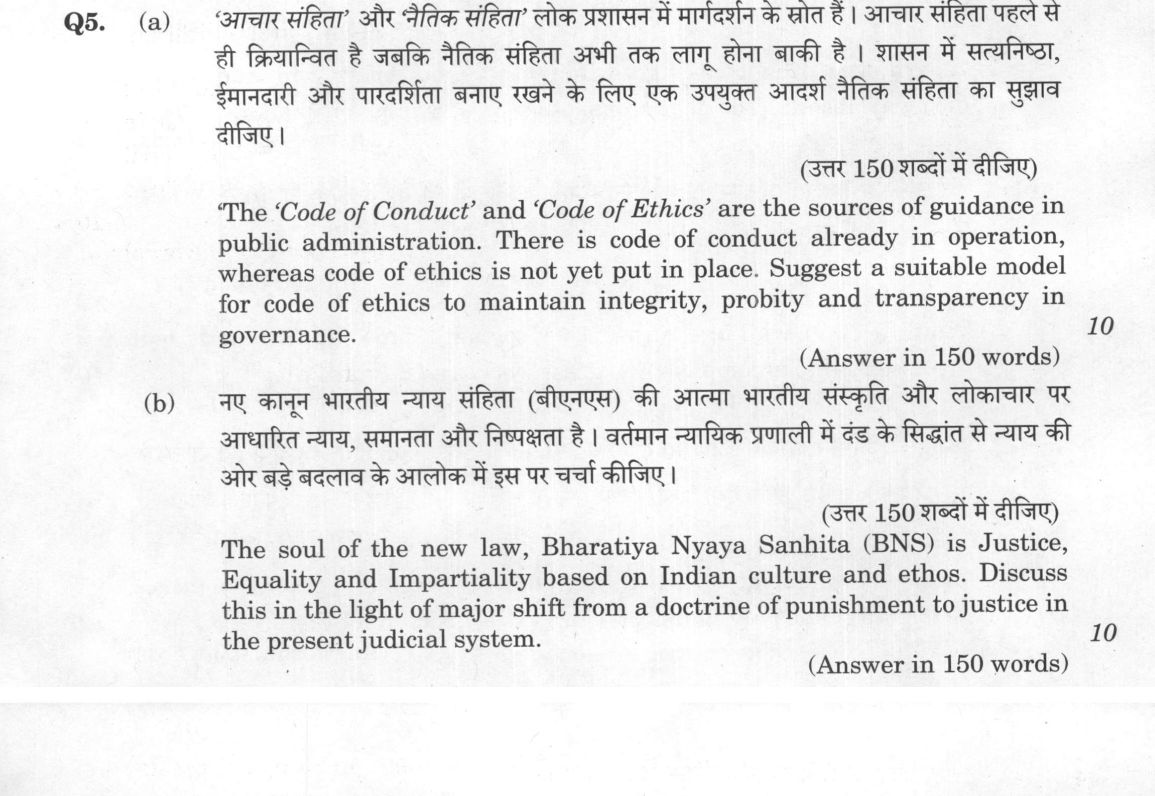
(a) "The 'Code of Conduct' and 'Code of Ethics' are the sources of guidance in public administration. There is code of conduct…
"The 'Code of Conduct' and 'Code of Ethics' are the sources of guidance in public administration. There is code of conduct already in operation, whereas code of ethics is not yet put in place. Suggest a suitable model for code of ethics to maintain integrity, probity and transparency in governance. (Answer in 150 words) 10 marks
The soul of the new law, Bharatiya Nyaya Sanhita (BNS) is Justice, Equality and Impartiality based on Indian culture and ethos. Discuss this in the light of major shift from a doctrine of punishment to justice in the present judicial system. (Answer in 150 words) 10 marks
हिंदी में प्रश्न पढ़ें
'आचार संहिता' और 'नैतिक संहिता' लोक प्रशासन में मार्गदर्शन के स्रोत हैं। आचार संहिता पहले से ही क्रियान्वित है जबकि नैतिक संहिता अभी तक लागू होना बाकी है। शासन में सत्यनिष्ठा, ईमानदारी और पारदर्शिता बनाए रखने के लिए एक उपयुक्त आदर्श नैतिक संहिता का सुझाव दीजिए। (उत्तर 150 शब्दों में दीजिए)
नए कानून भारतीय न्याय संहिता (बीएनएस) की आत्मा भारतीय संस्कृति और लोकाचार पर आधारित न्याय, समानता और निष्पक्षता है। वर्तमान न्यायिक प्रणाली में दंड के सिद्धांत से न्याय की ओर बड़े बदलाव के आलोक में इस पर चर्चा कीजिए। (उत्तर 150 शब्दों में दीजिए)
Model answer
Written by UPSC Answer Check against this question's marking rubric, to the 150-word length. UPSC does not publish answers for Mains — this is one way to score well, not an official key.
(a) In public administration, Code of Conduct is rule-based, compliance-focused; Code of Ethics is value-based, aspirational, guiding discretion. A suitable model should combine a legislative framework, like a 2nd ARC-recommended Civil Services Bill/Code of Ethics, with an independent National Ethics Commission to frame norms, audit disclosures and receive complaints. It should mandate asset/interest disclosure, protect whistleblowers, and link citizen charters to grievance redressal, making integrity, probity and transparency institutional habits.
(b) BNS recasts colonial punishment as justice, equality and impartiality. Its soul is restorative: Section 4 lists community service as a general punishment, with specific provisions applying it; attempt to suicide is partially decriminalised, except Section 226 for compelling/restraining a public servant; sedition is replaced by Section 152 on acts endangering sovereignty, unity and integrity; offences are gender-neutral. This reflects dharma, nyaya and Gandhian trusteeship, seeking reform over retribution. Thus, BNS shifts the present judicial system from punitive doctrine to equal, impartial, culture-rooted justice.
What "Suggest" is asking you to do
Propose measures that attach to the causes the question has just had you identify. Each should name who acts, on what, and why it would work; a measure with no actor behind it is a wish rather than a suggestion.
Structure that answers it
The problem in one line → measure 1 with the cause it addresses → measure 2 → measure 3 → how it would be implemented and what it requires
Where marks are lost
Prescriptions that would fit any question on any subject — awareness campaigns, capacity building, better coordination. The examiner checks whether each measure is traceable to a cause the answer itself named.
How this answer will be evaluated
Approach
Framework: GS4 Ethical Reasoning & Governance. (a) suggest: the problem in one line > implementable measures > who acts > conclusion | (b) discuss: intro > 3-4 dimensions > example > balanced close Full marks: Precise model/analysis, specific examples, clear distinction between concepts, strong link to Indian ethos.
Key points expected
- Distinguish Code of Conduct (rules) from Code of Ethics (values)
- Propose a specific model (e.g., values-based, stakeholder-centric)
- Link model to integrity, probity, and transparency
- Include implementation mechanism (e.g., training, monitoring)
- Define the 'soul' of BNS (Justice, Equality, Impartiality)
- Explain the shift from 'doctrine of punishment' to 'justice'
- Connect to Indian culture and ethos (e.g., restorative justice)
- Provide a balanced view of the judicial system's change
Evaluation rubric
Each sub-part is marked on its own, against the marks and word limit printed on the paper.
- (a) A specific, implementable model for a Code of Ethics to ensure integrity and transparency. 10 marks · 150 words
suggest— the problem in one line → implementable measures → who acts → conclusion
Must cover
- Distinguish Code of Conduct (rules) from Code of Ethics (values)
- Propose a specific model (e.g., values-based, stakeholder-centric)
- Link model to integrity, probity, and transparency
- Include implementation mechanism (e.g., training, monitoring)
Loses marks
- Preaching generic values without a structural model
- Confusing Code of Conduct with Code of Ethics
- Ignoring the 'not yet put in place' constraint
Earns more
- Mention of 'silent stakeholders' (citizens, future generations)
- Reference to specific ethical dilemmas in administration
- Balanced view of individual vs. institutional ethics
Extra mark
- Citing a specific committee report (e.g., 2nd ARC)
- Reference to a specific legal provision (e.g., RTI Act)
- (b) Analysis of BNS's shift from punishment to justice, rooted in Indian ethos. 10 marks · 150 words
discuss— intro → 3-4 dimensions → example → balanced close
Must cover
- Define the 'soul' of BNS (Justice, Equality, Impartiality)
- Explain the shift from 'doctrine of punishment' to 'justice'
- Connect to Indian culture and ethos (e.g., restorative justice)
- Provide a balanced view of the judicial system's change
Loses marks
- Treating BNS as just a name change for IPC
- Ignoring the 'Indian culture' aspect
- Failing to address the 'punishment to justice' shift
Earns more
- Mentioning specific BNS provisions (e.g., community service)
- Contrast with IPC's retributive approach
- Reference to 'Indian ethos' (e.g., Dharma, Ahimsa)
Extra mark
- Citing a specific BNS section number
- Reference to a specific judicial precedent
Practice this exact question
Write your answer and it is marked point by point against the model answer above — what you covered, what you missed, what you got wrong.
Evaluate my answer →More from General Studies 2024 GS Paper IV
- Q2 (a) "It is not enough to talk about peace, one must believe in it; and it is not enough t…
- Q3 Given below are three quotations of great thinkers. What do each of these quotations conv…
- Q4 (a) "The concept of Just and Unjust is contextual. What was just a year back, may turn ou…
- Q5 (a) "The 'Code of Conduct' and 'Code of Ethics' are the sources of guidance in public adm…
- Q6 (a) "In Indian culture and value system, an equal opportunity has been provided irrespect…
- Q7 There is a technological company named ABC Incorporated which is the second largest world…
- Q8 Raman is a senior IPS officer and has recently been posted as D.G. of a state. Among the…