GS Paper IV — Q11
With the summer heat being exceptionally severe this year, the district has been facing severe water shortage. The District…
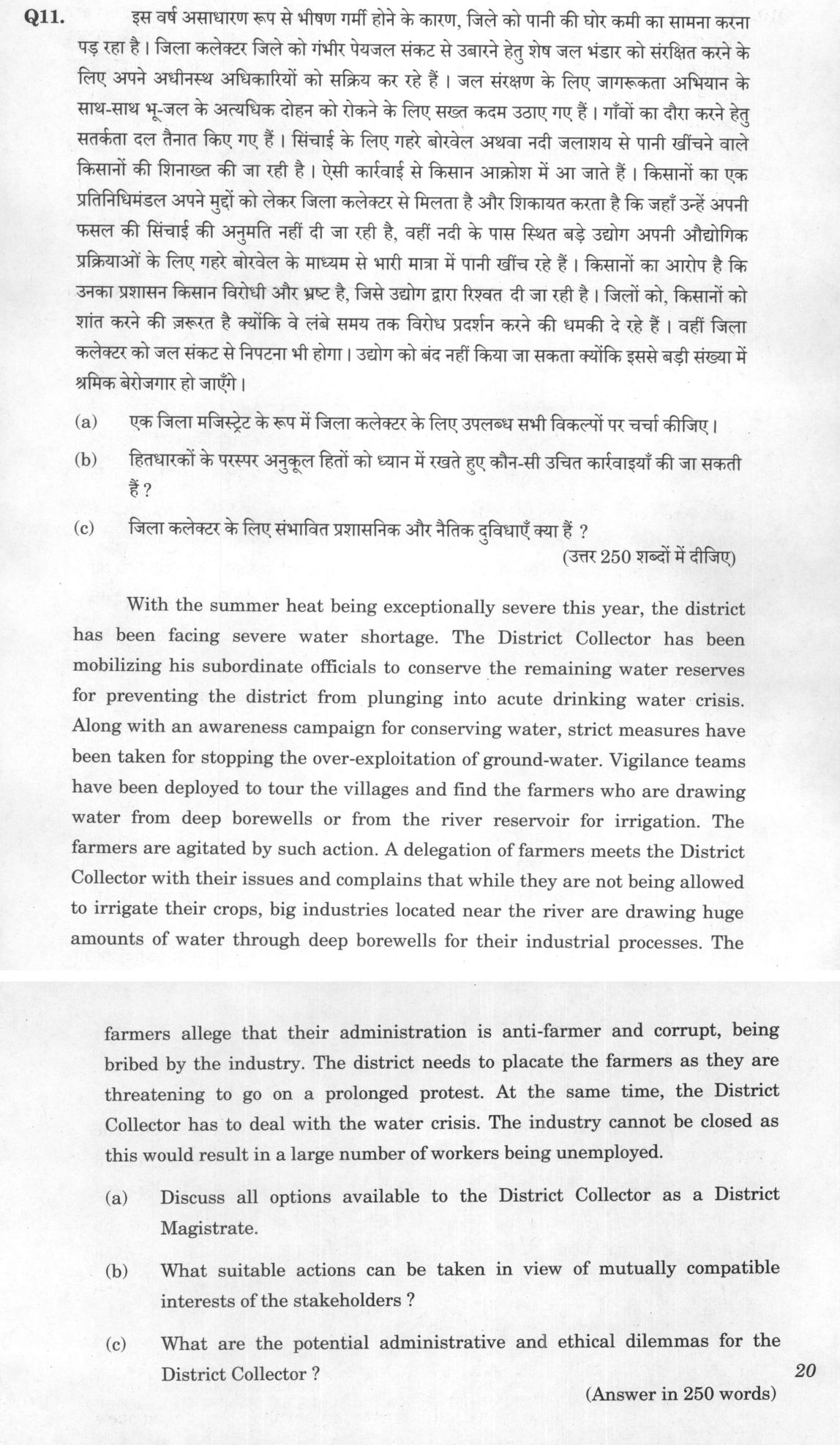
With the summer heat being exceptionally severe this year, the district has been facing severe water shortage. The District Collector has been mobilizing his subordinate officials to conserve the remaining water reserves for preventing the district from plunging into acute drinking water crisis. Along with an awareness campaign for conserving water, strict measures have been taken for stopping the over-exploitation of ground-water. Vigilance teams have been deployed to tour the villages and find the farmers who are drawing water from deep borewells or from the river reservoir for irrigation. The farmers are agitated by such action. A delegation of farmers meets the District Collector with their issues and complains that while they are not being allowed to irrigate their crops, big industries located near the river are drawing huge amounts of water through deep borewells for their industrial processes. The farmers allege that their administration is anti-farmer and corrupt, being bribed by the industry. The district needs to placate the farmers as they are threatening to go on a prolonged protest. At the same time, the District Collector has to deal with the water crisis. The industry cannot be closed as this would result in a large number of workers being unemployed.
Discuss all options available to the District Collector as a District Magistrate.
What suitable actions can be taken in view of mutually compatible interests of the stakeholders ?
What are the potential administrative and ethical dilemmas for the District Collector ?
हिंदी में प्रश्न पढ़ें
इस वर्ष असाधारण रूप से भीषण गर्मी होने के कारण, जिले को पानी की घोर कमी का सामना करना पड़ रहा है। जिला कलेक्टर जिले को गंभीर पेयजल संकट से उबारने हेतु शेष जल भंडार को संरक्षित करने के लिए अपने अधीनस्थ अधिकारियों को सक्रिय कर रहे हैं। जल संरक्षण के लिए जागरूकता अभियान के साथ-साथ भू-जल के अत्यधिक दोहन को रोकने के लिए सख्त कदम उठाए गए हैं। गाँवों का दौरा करने हेतु सतर्कता दल तैनात किए गए हैं। सिंचाई के लिए गहरे बोरवेल अथवा नदी जलाशय से पानी खींचने वाले किसानों की शिनाख्त की जा रही है। ऐसी कार्रवाई से किसान आक्रोश में आ जाते हैं। किसानों का एक प्रतिनिधिमंडल अपने मुद्दों को लेकर जिला कलेक्टर से मिलता है और शिकायत करता है कि जहाँ उन्हें अपनी फसल की सिंचाई की अनुमति नहीं दी जा रही है, वहीं नदी के पास स्थित बड़े उद्योग अपनी औद्योगिक प्रक्रियाओं के लिए गहरे बोरवेल के माध्यम से भारी मात्रा में पानी खींच रहे हैं। किसानों का आरोप है कि उनका प्रशासन किसान विरोधी और भ्रष्ट है, जिसे उद्योग द्वारा रिश्वत दी जा रही है। जिलों को, किसानों को शांत करने की ज़रूरत है क्योंकि वे लंबे समय तक विरोध प्रदर्शन करने की धमकी दे रहे हैं। वहीं जिला कलेक्टर को जल संकट से निपटना भी होगा। उद्योग को बंद नहीं किया जा सकता क्योंकि इससे बड़ी संख्या में श्रमिक बेरोज़गार हो जाएँगे।
एक जिला मजिस्ट्रेट के रूप में जिला कलेक्टर के लिए उपलब्ध सभी विकल्पों पर चर्चा कीजिए।
हितधारकों के परस्पर अनुकूल हितों को ध्यान में रखते हुए कौन-सी उचित कार्रवाइयाँ की जा सकती हैं ?
जिला कलेक्टर के लिए संभावित प्रशासनिक और नैतिक दुविधाएँ क्या हैं ?
Model answer
Written by UPSC Answer Check against this question's marking rubric, to the 250-word length. UPSC does not publish answers for Mains — this is one way to score well, not an official key.
Options available to the District Magistrate
Legally, the DM can invoke the Disaster Management Act, 2005 to regulate scarce supplies, issue orders under Section 144 CrPC to prevent law-and-order breakdown, address environmental nuisance under Section 133 CrPC, invoke the Essential Services Maintenance Act (ESMA) for drinking water, and enforce Section 188 IPC for non-compliance. Administratively, the DM can seal unauthorized borewells under Central Ground Water Authority (CGWA) guidelines, impose differential water pricing and quota rationing, and institute a multi-stakeholder District Water Committee for negotiated settlements.
Mutually Compatible Stakeholder Solutions
To balance livelihoods and industry, the administration can mandate industrial operations to switch to recycled wastewater and staggered production shifts, reducing freshwater extraction. Conducting a transparent, publicly disclosed water audit will clear corruption perceptions. For farmers, the DM can offer crop insurance coverage for adopting low-water-intensive crops and promote micro-irrigation. Institutionally, participatory groundwater management should be established drawing on Maharashtra’s Pani Panchayat and Haryana’s Sukhomajri models, alongside rejuvenating traditional water bodies under Jal Shakti Abhiyan.
Administrative and Ethical Dilemmas
Administrative: Upholding the rule of law versus handling mass democratic agitation; maintaining commercial confidentiality of industrial agreements versus ensuring transparency under the Right to Information; and mitigating personal career risk versus serving public interest under political pressure.
Ethical: Utilitarian aggregate welfare (saving factory jobs) versus Rawlsian justice (protecting vulnerable marginal farmers); public fiduciary duty toward farmers’ basic survival versus contractual obligations to industries; and uncompromising personal integrity versus administrative expediency.
A proactive approach grounded in Gandhian trusteeship and participatory water governance ensures equitable resource sharing while sustaining economic resilience.
What "Discuss" is asking you to do
Lay the issue out from more than one side — how it arose, what is claimed for it, what is held against it, and where it now stands. UPSC attaches discuss to broad topics with several live dimensions, so coverage of the dimensions earns more than the strength of your opinion.
Structure that answers it
Set the issue up → the case as it is made → the case against → the dimension both sides leave out → where the balance now lies
Where marks are lost
Listing facts with no thread between them, or arguing one side throughout and calling it a discussion.
How this answer will be evaluated
Approach
Framework: GS4 Ethical Dilemma & Administrative Action Framework. (a) discuss: intro > 3-4 dimensions > example > balanced close | (b) suggest: the problem in one line > implementable measures > who acts > conclusion | (c) highlight: name the salient points > one line of substance each > close Full marks: Comprehensive legal/administrative analysis with specific, actionable, and balanced solutions.
Key points expected
- Legal powers under Water Act/PC Act
- Administrative measures (rationing, monitoring)
- Diplomatic engagement with stakeholders
- Balancing immediate crisis vs long-term policy
- Water allocation framework (priority matrix)
- Incentives for water-efficient technology
- Transparency mechanisms to build trust
- Conflict resolution forum (joint committee)
Evaluation rubric
Each sub-part is marked on its own, against the marks and word limit printed on the paper.
- (a) Enumerate and evaluate legal and administrative options for the District Collector.
discuss— intro → 3-4 dimensions → example → balanced close
Must cover
- Legal powers under Water Act/PC Act
- Administrative measures (rationing, monitoring)
- Diplomatic engagement with stakeholders
- Balancing immediate crisis vs long-term policy
Loses marks
- Ignoring legal framework entirely
- Suggesting illegal or coercive measures
- Failing to address the industrial stakeholder
Earns more
- Mention of specific legal instruments
- Reference to judicial precedents
- Inclusion of technical solutions (drip irrigation)
Extra mark
- Citing specific state water policies
- Reference to Supreme Court water rights judgments
- (b) Propose actions that satisfy the interests of farmers, industry, and public.
suggest— the problem in one line → implementable measures → who acts → conclusion
Must cover
- Water allocation framework (priority matrix)
- Incentives for water-efficient technology
- Transparency mechanisms to build trust
- Conflict resolution forum (joint committee)
Loses marks
- One-sided solutions favoring only one group
- Vague suggestions without implementation details
- Ignoring the 'mutually compatible' constraint
Earns more
- Specific technical interventions (drip, rainwater harvesting)
- Economic incentives for industry (tax breaks for efficiency)
- Social safety nets for affected farmers
Extra mark
- Reference to 'Water Budgeting' concept
- Mention of specific government schemes (PMKSY)
- (c) Identify the specific administrative and ethical conflicts faced by the Collector.
highlight— name the salient points → one line of substance each → close
Must cover
- Conflict between rule of law and public pressure
- Dilemma of economic growth vs environmental sustainability
- Ethical challenge of perceived bias/corruption
- Administrative burden of managing multiple crises
Loses marks
- Generic ethical statements without context
- Failing to distinguish administrative vs ethical dilemmas
- Ignoring the specific allegations of corruption
Earns more
- Analysis of 'Public Trust' deficit
- Discussion of 'Moral Hazard' in industrial exemptions
- Reference to 'Administrative Discretion' limits
Extra mark
- Citing specific ethical codes (UPSC Code of Conduct)
- Reference to 'Stakeholder Theory' in public admin
Practice this exact question
Write your answer and it is marked point by point against the model answer above — what you covered, what you missed, what you got wrong.
Evaluate my answer →More from General Studies 2024 GS Paper IV
- Q8 Raman is a senior IPS officer and has recently been posted as D.G. of a state. Among the…
- Q9 With multipronged strategy of the Central and State Governments specially in the last few…
- Q10 Sneha is a Senior Manager working for a big reputed hospital chain in a mid-sized city. S…
- Q11 With the summer heat being exceptionally severe this year, the district has been facing s…
- Q12 Dr. Srinivasan is a senior scientist working for a reputed biotechnology company known fo…