GS Paper IV — Q7
There is a technological company named ABC Incorporated which is the second largest worldwide, situated in the Third World. You…
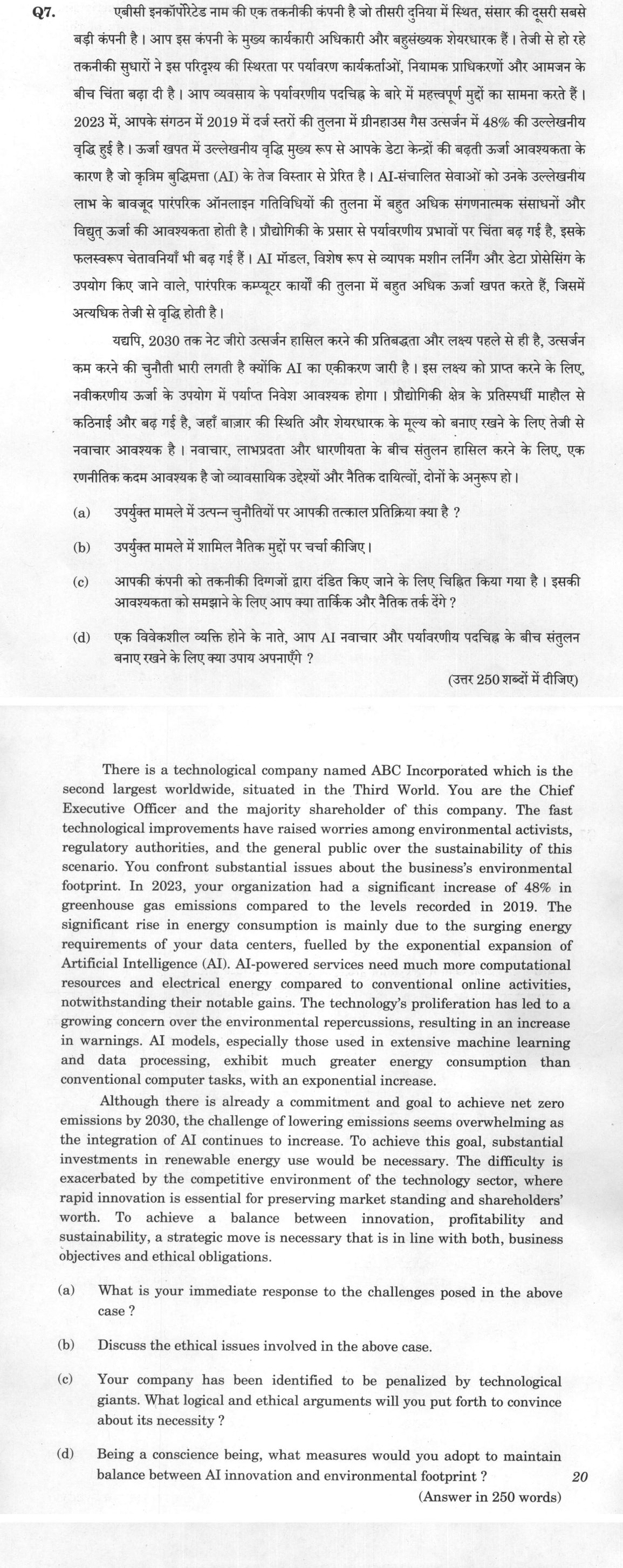
There is a technological company named ABC Incorporated which is the second largest worldwide, situated in the Third World. You are the Chief Executive Officer and the majority shareholder of this company. The fast technological improvements have raised worries among environmental activists, regulatory authorities, and the general public over the sustainability of this scenario. You confront substantial issues about the business's environmental footprint. In 2023, your organization had a significant increase of 48% in greenhouse gas emissions compared to the levels recorded in 2019. The significant rise in energy consumption is mainly due to the surging energy requirements of your data centers, fuelled by the exponential expansion of Artificial Intelligence (AI). AI-powered services need much more computational resources and electrical energy compared to conventional online activities, notwithstanding their notable gains. The technology's proliferation has led to a growing concern over the environmental repercussions, resulting in an increase in warnings. AI models, especially those used in extensive machine learning and data processing, exhibit much greater energy consumption than conventional computer tasks, with an exponential increase.
Although there is already a commitment and goal to achieve net zero emissions by 2030, the challenge of lowering emissions seems overwhelming as the integration of AI continues to increase. To achieve this goal, substantial investments in renewable energy use would be necessary. The difficulty is exacerbated by the competitive environment of the technology sector, where rapid innovation is essential for preserving market standing and shareholders' worth. To achieve a balance between innovation, profitability and sustainability, a strategic move is necessary that is in line with both, business objectives and ethical obligations.
What is your immediate response to the challenges posed in the above case?
Discuss the ethical issues involved in the above case.
Your company has been identified to be penalized by technological giants. What logical and ethical arguments will you put forth to convince about its necessity?
Being a conscience being, what measures would you adopt to maintain balance between AI innovation and environmental footprint?
हिंदी में प्रश्न पढ़ें
एबीसी इन्कॉर्पोरेटेड नाम की एक तकनीकी कंपनी है जो तीसरी दुनिया में स्थित, संसार की दूसरी सबसे बड़ी कंपनी है। आप इस कंपनी के मुख्य कार्यकारी अधिकारी और बहुसंख्यक शेयरधारक हैं। तेजी से हो रहे तकनीकी सुधारों ने इस परिदृश्य की स्थिरता पर पर्यावरण कार्यकर्ताओं, नियामक प्राधिकरणों और आमजन के बीच चिंता बढ़ा दी है। आप व्यवसाय के पर्यावरणीय पदचिह्न के बारे में महत्वपूर्ण मुद्दों का सामना करते हैं। 2023 में, आपके संगठन में 2019 में दर्ज स्तरों की तुलना में ग्रीनहाउस गैस उत्सर्जन में 48% की उल्लेखनीय वृद्धि हुई है। ऊर्जा खपत में उल्लेखनीय वृद्धि मुख्य रूप से आपके डेटा केंद्रों की बढ़ती ऊर्जा आवश्यकता के कारण है जो कृत्रिम बुद्धिमत्ता (AI) के तेज विस्तार से प्रेरित है। AI-संचालित सेवाओं को उनके उल्लेखनीय लाभ के बावजूद पारंपरिक ऑनलाइन गतिविधियों की तुलना में बहुत अधिक संगणनात्मक संसाधनों और विद्युत ऊर्जा की आवश्यकता होती है। प्रौद्योगिकी के प्रसार से पर्यावरणीय प्रभावों पर चिंता बढ़ गई है, इसके फलस्वरूप चेतावनियाँ भी बढ़ गई हैं। AI मॉडल, विशेष रूप से व्यापक मशीन लर्निंग और डेटा प्रोसेसिंग के उपयोग किए जाने वाले, पारंपरिक कम्प्यूटर कार्यों की तुलना में बहुत अधिक ऊर्जा खपत करते हैं, जिसमें अत्यधिक तेजी से वृद्धि होती है।
यद्यपि, 2030 तक नेट जीरो उत्सर्जन हासिल करने की प्रतिबद्धता और लक्ष्य पहले से ही हैं, उत्सर्जन कम करने की चुनौती भारी लगती है क्योंकि AI का एकीकरण जारी है। इस लक्ष्य को प्राप्त करने के लिए, नवीकरणीय ऊर्जा के उपयोग में पर्याप्त निवेश आवश्यक होगा। प्रौद्योगिकी क्षेत्र के प्रतिस्पर्धी माहौल से कठिनाई और बढ़ गई है, जहाँ बाजार की स्थिति और शेयरधारक के मूल्य को बनाए रखने के लिए तेजी से नवाचार आवश्यक है। नवाचार, लाभप्रदता और धारणीयता के बीच संतुलन हासिल करने के लिए, एक रणनीतिक कदम आवश्यक है जो व्यावसायिक उद्देश्यों और नैतिक दायित्वों, दोनों के अनुरूप हो।
उपर्युक्त मामले में उत्पन्न चुनौतियों पर आपकी तत्काल प्रतिक्रिया क्या है?
उपर्युक्त मामले में शामिल नैतिक मुद्दों पर चर्चा कीजिए।
आपकी कंपनी को तकनीकी दिग्गजों द्वारा दंडित किए जाने के लिए चिह्नित किया गया है। इसकी आवश्यकता को समझाने के लिए आप क्या तार्किक और नैतिक तर्क देंगे?
एक विवेकशील व्यक्ति होने के नाते, आप AI नवाचार और पर्यावरणीय पदचिह्न के बीच संतुलन बनाए रखने के लिए क्या उपाय अपनाएँगे?
Model answer
Written by UPSC Answer Check against this question's marking rubric, to the 250-word length. UPSC does not publish answers for Mains — this is one way to score well, not an official key.
As CEO of ABC Inc., navigating this dilemma requires reconciling cutting-edge technological expansion with ecological integrity through moral and strategic leadership.
Immediate Response I will immediately initiate transparent crisis communication, publicly disclosing third-party audited carbon emissions data to rebuild trust. Simultaneously, a Rapid Decarbonization Task Force will be formed to execute interim mitigation measures, including server virtualization, thermal load optimization, and shifting energy-intensive AI model training to off-peak, low-carbon hours.
Ethical Issues Involved Inter-generational Equity: Prioritizing short-term computational dominance risks exhausting ecological capital, transferring severe climate vulnerabilities to future generations. Shareholder Primacy versus Stakeholder Stewardship: The moral friction between maximizing immediate investor returns and fulfilling broader Corporate Social Responsibility (CSR). Technological Determinism versus Environmental Ethics: The fatalistic assumption that AI expansion must proceed unchecked regardless of ecological limits. Distributive Justice: Balancing the Third World’s legitimate aspirations for digital sovereignty and economic growth against global decarbonization imperatives.
Arguments Regarding Penalties Defending the company requires invoking the Polluter Pays Principle with fairness, drawing from National Green Tribunal (NGT) jurisprudence emphasizing proportional, non-discriminatory liability rather than punitive market suppression. There is an essential ethical distinction between transition-phase emissions arising from foundational infrastructure building and culpable, negligent pollution. Our proactive commitment to achieve Net Zero by 2030 demonstrates institutional good faith, warranting collaborative enablement over exclusionary penalties.
Conscience-Based Measures Green AI Architecture: Transitioning from computationally bloated models to energy-efficient, pruned algorithms and carbon-aware computing frameworks. Renewable Infrastructure: Investing in dedicated captive clean energy grids through Power Purchase Agreements (PPAs), emulating large-scale models like India’s Bhadla Solar Park. Circular Economy: Enforcing hardware life-cycle extensions, modular upgrades, and responsible e-waste recycling to curtail embodied carbon. Values-Driven Governance: Institutionalizing algorithmic environmental impact assessments aligned with the UNESCO Recommendation on the Ethics of Artificial Intelligence.
Sustainable technological progress requires decoupling digital innovation from ecological degradation, proving that commercial excellence and environmental stewardship can co-exist synergistically.
What "Discuss" is asking you to do
Lay the issue out from more than one side — how it arose, what is claimed for it, what is held against it, and where it now stands. UPSC attaches discuss to broad topics with several live dimensions, so coverage of the dimensions earns more than the strength of your opinion.
Structure that answers it
Set the issue up → the case as it is made → the case against → the dimension both sides leave out → where the balance now lies
Where marks are lost
Listing facts with no thread between them, or arguing one side throughout and calling it a discussion.
How this answer will be evaluated
Approach
Framework: GS4 Ethical Dilemma & Case Study Framework. (a) explain: definition/context > points in order > small example > short close | (b) discuss: intro > 3-4 dimensions > example > balanced close | (c) justify: claim > 3-4 reasons > evidence > conclusion | (d) suggest: the problem in one line > implementable measures > who acts > conclusion Full marks: Balances business logic with ethical depth; specific, actionable measures; clear structure.
Key points expected
- Acknowledge the 48% emission increase
- Identify AI data centers as the source
- Immediate audit of energy consumption
- Public communication strategy
- Conflict: Shareholder value vs. Environmental duty
- Conflict: Innovation speed vs. Sustainability
- Duty to future generations
- Corporate social responsibility
Evaluation rubric
Each sub-part is marked on its own, against the marks and word limit printed on the paper.
- (a) Immediate administrative and strategic response to the 48% emission surge.
explain— definition/context → points in order → small example → short close
Must cover
- Acknowledge the 48% emission increase
- Identify AI data centers as the source
- Immediate audit of energy consumption
- Public communication strategy
Loses marks
- Ignoring the specific AI context
- Vague generalities without immediate action
Earns more
- Mentioning stakeholder engagement
- Short-term energy efficiency measures
Extra mark
- Reference to specific ESG reporting standards
- (b) Analysis of ethical conflicts between profit, innovation, and environment.
discuss— intro → 3-4 dimensions → example → balanced close
Must cover
- Conflict: Shareholder value vs. Environmental duty
- Conflict: Innovation speed vs. Sustainability
- Duty to future generations
- Corporate social responsibility
Loses marks
- Preaching values without analyzing the dilemma
- Ignoring the competitive pressure mentioned
Earns more
- Mentioning 'triple bottom line' concept
- Reference to ethical leadership
Extra mark
- Citing a specific ethical framework (e.g., Utilitarianism)
- (c) Logical and ethical arguments to defend the company's necessity.
justify— claim → 3-4 reasons → evidence → conclusion
Must cover
- Argument: AI's net positive social impact
- Argument: Economic contribution/employment
- Argument: Commitment to net-zero by 2030
- Argument: Innovation drives efficiency
Loses marks
- Defensive tone without logical structure
- Ignoring the environmental damage
Earns more
- Mentioning 'green AI' initiatives
- Reference to regulatory compliance
Extra mark
- Specific example of AI solving an environmental problem
- (d) Measures to balance AI innovation with environmental footprint.
suggest— the problem in one line → implementable measures → who acts → conclusion
Must cover
- Investment in renewable energy
- Green computing/efficient algorithms
- Long-term sustainability roadmap
- Stakeholder collaboration
Loses marks
- Generic advice not specific to AI
- Ignoring the 'conscience being' aspect
Earns more
- Mentioning carbon offsetting
- Reference to circular economy
Extra mark
- Specific technology (e.g., liquid cooling for data centers)
Practice this exact question
Write your answer and it is marked point by point against the model answer above — what you covered, what you missed, what you got wrong.
Evaluate my answer →More from General Studies 2024 GS Paper IV
- Q4 (a) "The concept of Just and Unjust is contextual. What was just a year back, may turn ou…
- Q5 (a) "The 'Code of Conduct' and 'Code of Ethics' are the sources of guidance in public adm…
- Q6 (a) "In Indian culture and value system, an equal opportunity has been provided irrespect…
- Q7 There is a technological company named ABC Incorporated which is the second largest world…
- Q8 Raman is a senior IPS officer and has recently been posted as D.G. of a state. Among the…
- Q9 With multipronged strategy of the Central and State Governments specially in the last few…
- Q10 Sneha is a Senior Manager working for a big reputed hospital chain in a mid-sized city. S…