GS Paper IV — Q4
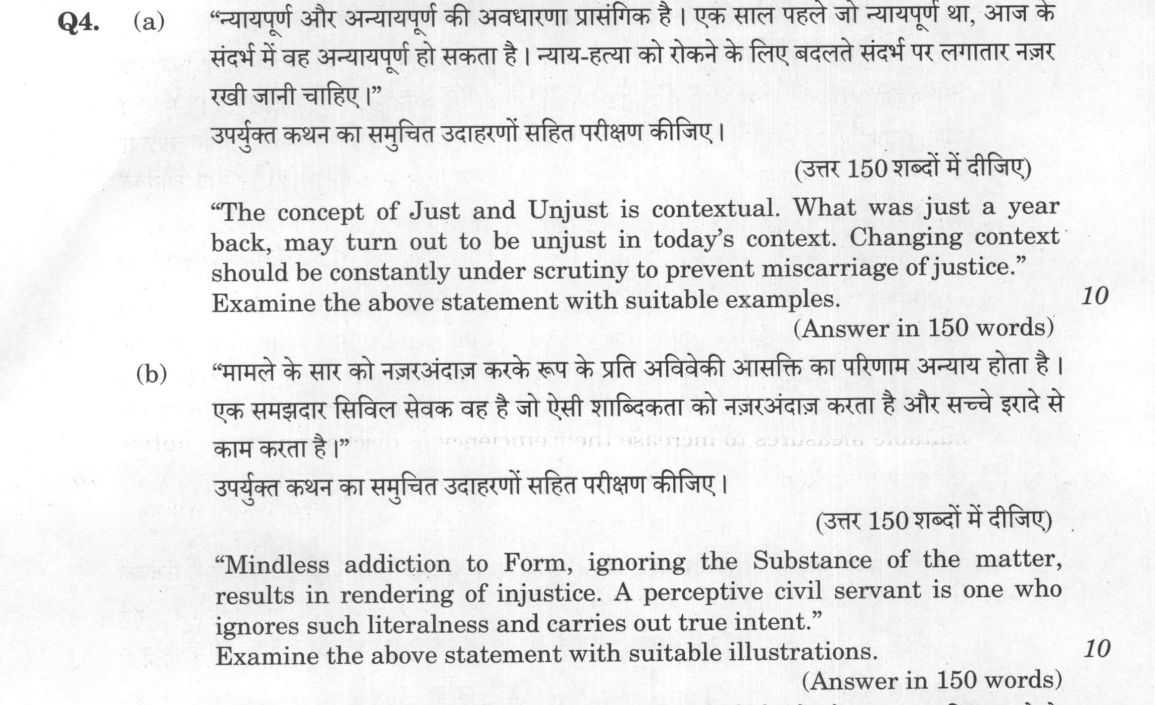
(a) "The concept of Just and Unjust is contextual. What was just a year back, may turn out to be unjust in today's context…
"The concept of Just and Unjust is contextual. What was just a year back, may turn out to be unjust in today's context. Changing context should be constantly under scrutiny to prevent miscarriage of justice."
Examine the above statement with suitable examples.
(Answer in 150 words)
"Mindless addiction to Form, ignoring the Substance of the matter, results in rendering of injustice. A perceptive civil servant is one who ignores such literalness and carries out true intent."
Examine the above statement with suitable illustrations.
(Answer in 150 words)
हिंदी में प्रश्न पढ़ें
"न्यायपूर्ण और अन्यायपूर्ण की अवधारणा प्रासंगिक है। एक साल पहले जो न्यायपूर्ण था, आज के संदर्भ में वह अन्यायपूर्ण हो सकता है। न्याय-हत्या को रोकने के लिए बदलते संदर्भ पर लगातार नजर रखी जानी चाहिए।"
उपर्युक्त कथन का समुचित उदाहरणों सहित परीक्षण कीजिए।
(उत्तर 150 शब्दों में दीजिए)
"मामले के सार को नजरअंदाज करके रूप के प्रति अविवेकी आसक्ति का परिणाम अन्याय होता है। एक समझदार सिविल सेवक वह है जो ऐसी शाब्दिकता को नजरअंदाज करता है और सच्चे इरादे से काम करता है।"
उपर्युक्त कथन का समुचित उदाहरणों सहित परीक्षण कीजिए।
(उत्तर 150 शब्दों में दीजिए)
Model answer
Written by UPSC Answer Check against this question's marking rubric, to the 150-word length. UPSC does not publish answers for Mains — this is one way to score well, not an official key.
Contextual Justice and Scrutiny Justice is dynamic and socially constructed rather than absolute. Societal evolution redefines justice over time; practices once legally sanctioned—such as Section 377, Triple Talaq, or outdated evidentiary thresholds in rape laws—are recognized as unjust today. Preventing miscarriage of justice requires continuous institutional scrutiny through judicial review, legislative amendments, and Public Interest Litigations (PILs), ensuring laws adapt to evolving notions of human dignity.
Substance Over Form in Administration A mindless addiction to formal legality over substantive justice subverts legislative intent. In public administration, rigidly denying PDS rations or welfare pensions due to minor documentation or biometric mismatches turns procedure into an instrument of exclusion. A perceptive civil servant employs purposive interpretation, looking past literal technicalities to fulfill the welfare state’s core purpose.
Thus, administrative integrity lies in exercising guided discretion—anchored in Article 14 and constitutional morality—ensuring that procedural rules serve justice rather than obstruct it.
What "Examine" is asking you to do
Test the proposition the question puts to you and return a finding on how far it holds. Examine stems carry a claim, or ask whether something has happened, and expect evidence weighed both ways before the extent is stated — often with remedial measures attached.
Structure that answers it
Restate the claim as the question frames it → evidence that supports it → evidence that undercuts it → the conditions under which it holds → verdict on how far it stands
Where marks are lost
Stopping at description. An examination has to reach a finding, and “examine with justification” means the extent must be stated, not implied.
How this answer will be evaluated
Approach
Framework: GS4 Ethical Dilemma & Administrative Ethics. (a) examine: intro > how/why with reasoning > evidence > conclusion | (b) examine: intro > how/why with reasoning > evidence > conclusion Full marks: Clear distinction between form/substance and context/justice with specific, relevant examples.
Key points expected
- Define contextual nature of just/unjust
- Provide example of shifting social/legal norms
- Link context change to miscarriage of justice
- Conclude on need for constant scrutiny
- Define 'Form' vs 'Substance' in administration
- Illustrate how literalism causes injustice
- Define the role of a 'perceptive' civil servant
- Conclude on the duty to carry out true intent
Evaluation rubric
Each sub-part is marked on its own, against the marks and word limit printed on the paper.
- (a) Analyze the contextual nature of justice with examples of changing norms. 10 marks · 150 words
examine— intro → how/why with reasoning → evidence → conclusion
Must cover
- Define contextual nature of just/unjust
- Provide example of shifting social/legal norms
- Link context change to miscarriage of justice
- Conclude on need for constant scrutiny
Loses marks
- Abstract moralizing without concrete examples
- Ignoring the 'unjust' aspect of the shift
- Failing to address the 'scrutiny' requirement
Earns more
- Reference to specific legal or social reform
- Distinction between static and dynamic justice
- Mention of 'living constitution' or similar concept
Extra mark
- Cite a specific landmark judgment on context
- Reference to a specific historical shift in rights
- (b) Critique the conflict between procedural form and substantive intent in administration. 10 marks · 150 words
examine— intro → how/why with reasoning → evidence → conclusion
Must cover
- Define 'Form' vs 'Substance' in administration
- Illustrate how literalism causes injustice
- Define the role of a 'perceptive' civil servant
- Conclude on the duty to carry out true intent
Loses marks
- Preaching values without administrative context
- Ignoring the 'injustice' resulting from form
- Failing to define the 'perceptive' officer's role
Earns more
- Example of rigid rule application vs public good
- Reference to 'spirit of the law' vs 'letter of the law'
- Mention of discretionary powers in administration
Extra mark
- Cite a specific case of administrative failure due to form
- Reference to a specific ethical code or principle
Practice this exact question
Write your answer and it is marked point by point against the model answer above — what you covered, what you missed, what you got wrong.
Evaluate my answer →More from General Studies 2024 GS Paper IV
- Q1 (a) The application of Artificial Intelligence as a dependable source of input for admini…
- Q2 (a) "It is not enough to talk about peace, one must believe in it; and it is not enough t…
- Q3 Given below are three quotations of great thinkers. What do each of these quotations conv…
- Q4 (a) "The concept of Just and Unjust is contextual. What was just a year back, may turn ou…
- Q5 (a) "The 'Code of Conduct' and 'Code of Ethics' are the sources of guidance in public adm…
- Q6 (a) "In Indian culture and value system, an equal opportunity has been provided irrespect…
- Q7 There is a technological company named ABC Incorporated which is the second largest world…