GS Paper II — Q1
Discuss the 'corrupt practices' for the purpose of the Representation of the People Act, 1951. Analyze whether the increase in…
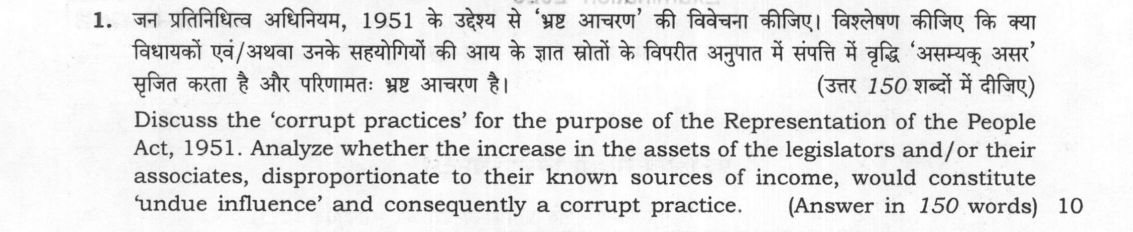
Discuss the 'corrupt practices' for the purpose of the Representation of the People Act, 1951. Analyze whether the increase in the assets of the legislators and/or their associates, disproportionate to their known sources of income, would constitute 'undue influence' and consequently a corrupt practice. (Answer in 150 words) 10 marks
हिंदी में प्रश्न पढ़ें
जन प्रतिनिधित्व अधिनियम, 1951 के उद्देश्य से 'भ्रष्ट आचरण' की विवेचना कीजिए। विश्लेषण कीजिए कि क्या विधायकों एवं/अथवा उनके सहयोगियों की आय के ज्ञात स्रोतों के विपरीत अनुपात में संपत्ति में वृद्धि 'असम्यक असर' सृजित करता है और परिणामतः भ्रष्ट आचरण है। (उत्तर 150 शब्दों में दीजिए)
Model answer
Written by UPSC Answer Check against this question's marking rubric, to the 150-word length. UPSC does not publish answers for Mains — this is one way to score well, not an official key.
Section 123 of the Representation of the People Act, 1951 defines corrupt practices as bribery, undue influence, personation, breach of secrecy and false statements. Undue influence under Section 123(2) is a species of corrupt practice: any direct or indirect interference, or attempt, to interfere with the free exercise of an electoral right, not merely wealth. Disproportionate increase in assets of a legislator or associates does not automatically amount to undue influence under the RPA, as unexplained wealth is not an electoral offence. Kanwar Singh v. Delhi Administration (1965) recognised disproportionate assets as corruption under the Prevention of Corruption Act (PCA), not RPA undue influence. The 1988 PCA addresses unexplained assets; later judicial interpretation reads undue influence as interference with voters’ free choice. Yet wealth may evidence undue influence if used to coerce or sway electors. Legislative clarity or judicial expansion on asset disclosure as electoral malpractice is needed.
What "Discuss" is asking you to do
Lay the issue out from more than one side — how it arose, what is claimed for it, what is held against it, and where it now stands. UPSC attaches discuss to broad topics with several live dimensions, so coverage of the dimensions earns more than the strength of your opinion.
Structure that answers it
Set the issue up → the case as it is made → the case against → the dimension both sides leave out → where the balance now lies
Where marks are lost
Listing facts with no thread between them, or arguing one side throughout and calling it a discussion.
How this answer will be evaluated
Approach
Framework: GS2 Paper 2: Constitutional & Legal Framework. analyse: intro > causes > effects > stakeholders/linkages > way forward Full marks: Precise legal analysis linking asset inflation to the specific definition of undue influence under RPA 1951.
Key points expected
- Define 'corrupt practices' under Section 123 of RPA 1951
- Define 'undue influence' as a specific corrupt practice
- Analyze the link between disproportionate assets and undue influence
- Provide a balanced conclusion on the legal interpretation
Evaluation rubric
Each sub-part is marked on its own, against the marks and word limit printed on the paper.
- The answer Define corrupt practices under RPA 1951 and analyze if asset inflation constitutes undue influence. 10 marks · 150 words
analyse— intro → causes → effects → stakeholders/linkages → way forward
Must cover
- Define 'corrupt practices' under Section 123 of RPA 1951
- Define 'undue influence' as a specific corrupt practice
- Analyze the link between disproportionate assets and undue influence
- Provide a balanced conclusion on the legal interpretation
Loses marks
- Reciting Section 123 without analyzing the specific asset question
- Confusing 'undue influence' with 'bribery' or 'appeal to religion'
- Failing to address the 'disproportionate to known sources' aspect
Earns more
- Mention Section 123(3) regarding undue influence
- Reference the concept of 'known sources of income'
- Discuss the difficulty of proving 'undue influence' in court
- Mention the role of the Election Commission in monitoring assets
Extra mark
- Cite a specific Supreme Court judgment on asset declaration
- Reference the 2nd ARC or Law Commission recommendations on electoral reforms
Practice this exact question
Write your answer and it is marked point by point against the model answer above — what you covered, what you missed, what you got wrong.
Evaluate my answer →More from General Studies 2025 GS Paper II
- Q1 Discuss the 'corrupt practices' for the purpose of the Representation of the People Act,…
- Q2 Comment on the need of administrative tribunals as compared to the court system. Assess t…
- Q3 Compare and contrast the President's power to pardon in India and in the USA. Are there a…
- Q4 Discuss the nature of Jammu and Kashmir Legislative Assembly after the Jammu and Kashmir…