GS Paper II — Q11
"Constitutional morality is the fulcrum which acts as an essential check upon the high functionaries and citizens alike...." In…
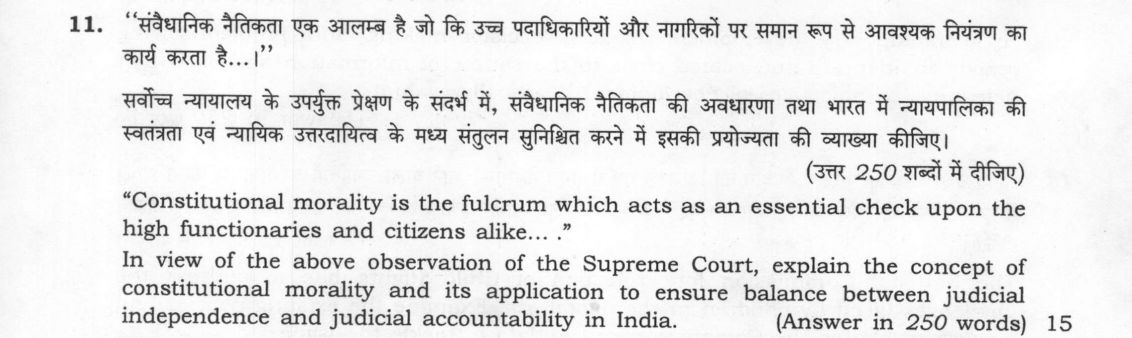
"Constitutional morality is the fulcrum which acts as an essential check upon the high functionaries and citizens alike...." In view of the above observation of the Supreme Court, explain the concept of constitutional morality and its application to ensure balance between judicial independence and judicial accountability in India. (Answer in 250 words) 15 marks
हिंदी में प्रश्न पढ़ें
"संवैधानिक नैतिकता एक आलम्ब है जो कि उच्च पदाधिकारियों और नागरिकों पर समान रूप से आवश्यक नियंत्रण का कार्य करता है...।" सर्वोच्च न्यायालय के उपर्युक्त प्रेक्षण के संदर्भ में, संवैधानिक नैतिकता की अवधारणा तथा भारत में न्यायपालिका की स्वतंत्रता एवं न्यायिक उत्तरदायित्व के मध्य संतुलन सुनिश्चित करने में इसकी प्रयोज्यता की व्याख्या कीजिए। (उत्तर 250 शब्दों में दीजिए)
Model answer
Written by UPSC Answer Check against this question's marking rubric, to the 250-word length. UPSC does not publish answers for Mains — this is one way to score well, not an official key.
Constitutional morality, as Ambedkar urged, is not mere political morality but faith in the Constitution’s values of liberty, equality and fraternity. The Supreme Court in Navtej Singh Johar (2018) and Sabarimala (2018) described it as a commitment to constitutional principles over majoritarian or traditional practices. It is rooted in the Preamble, Fundamental Rights (Articles 14, 15 and 21), Directive Principles and the Constitution’s transformative purpose, binding citizens and high functionaries.
In judicial independence, constitutional morality protects judges from executive or legislative pressure. Kesavananda Bharati (1973) shows this: the Court’s fearless assertion of the basic structure required fidelity to constitutional limits rather than deference to political power.
For accountability, the same principle restrains judicial overreach. Judges must remain within the constitutional text, separation of powers and reasoned interpretation. Indira Gandhi v. Raj Narain (1975), by striking down Article 329A and affirming the basic structure, shows that constitutional limits bind all organs of the State, reinforcing separation of powers and preventing institutional self-aggrandisement.
The balance is maintained through internal checks such as the collegium and impeachment, external checks such as review and curative petitions, and the discipline of constitutional silences, which require restraint where the Constitution is silent. The NJAC judgment (2015), striking down the NJAC and preserving judicial primacy in appointments, shows that accountability must resist both judicial populism and executive control, demanding constitutional fidelity.
Thus, constitutional morality is the fulcrum: it secures fearless adjudication while demanding constitutional fidelity, ensuring that judicial independence and accountability reinforce rather than undermine each other.
What "Explain" is asking you to do
Make the working of something clear — what sets it off, what follows from what, and what it produces. Explain is the Commission's mechanism word: it dominates the technical papers and the “explain why” stems, where the marks sit in the causal chain and not in the label.
Structure that answers it
State what it is → the initiating condition → the chain of cause, step by step → an instance where it plays out → what the chain produces
Where marks are lost
Describing what something looks like instead of why it works that way. Naming the stages without linking them reads as description too.
How this answer will be evaluated
Approach
Framework: GS2 Paper 2 (Polity & Governance). explain: definition/context > points in order > small example > short close Full marks: Precise definition, clear distinction between independence/accountability, and a strong analytical link via constitutional morality.
Key points expected
- Define constitutional morality as a check on functionaries/citizens
- Explain the concept of judicial independence
- Explain the concept of judicial accountability
- Demonstrate how constitutional morality balances these two
Evaluation rubric
Each sub-part is marked on its own, against the marks and word limit printed on the paper.
- The answer Define constitutional morality and apply it to balance judicial independence and accountability. 15 marks · 250 words
explain— definition/context → points in order → small example → short close
Must cover
- Define constitutional morality as a check on functionaries/citizens
- Explain the concept of judicial independence
- Explain the concept of judicial accountability
- Demonstrate how constitutional morality balances these two
Loses marks
- Reciting Articles without analytical application
- Failing to address the 'balance' aspect
- Activist tone or vague generalities
Earns more
- Cite relevant Supreme Court judgments (e.g., Kesavananda Bharati)
- Mention specific mechanisms of accountability (e.g., NJAC, ethics)
- Reference the 'fulcrum' metaphor from the prompt
- Discuss the role of the Constitution as the supreme law
Extra mark
- Cite 2nd ARC or Law Commission recommendations
- Reference specific Articles (e.g., Art 124, 125, 215)
Practice this exact question
Write your answer and it is marked point by point against the model answer above — what you covered, what you missed, what you got wrong.
Evaluate my answer →More from General Studies 2025 GS Paper II
- Q8 Civil Society Organizations are often perceived as being anti-State actors than non-State…
- Q9 India-Africa digital partnership is achieving mutual respect, co-development and long-ter…
- Q10 "With the waning of globalization, post-Cold War world is becoming a site of sovereign na…
- Q11 "Constitutional morality is the fulcrum which acts as an essential check upon the high fu…
- Q12 Indian Constitution has conferred the amending power on the ordinary legislative institut…
- Q13 Discuss the evolution of collegium system in India. Critically examine the advantages and…
- Q14 Examine the evolving pattern of Centre-State financial relations in the context of planne…