GS Paper II — Q5
"The Attorney General of India plays a crucial role in guiding the legal framework of the Union Government and ensuring sound…
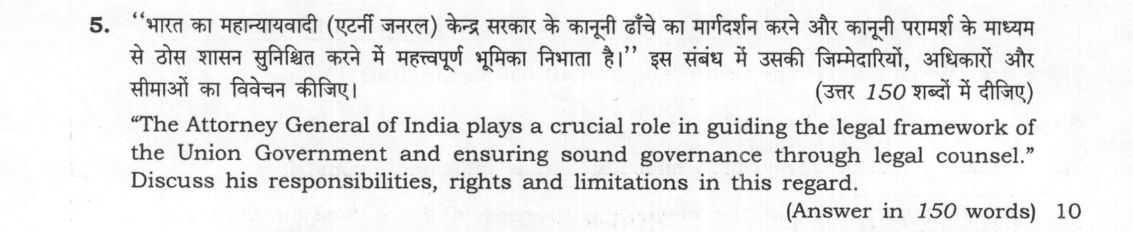
"The Attorney General of India plays a crucial role in guiding the legal framework of the Union Government and ensuring sound governance through legal counsel." Discuss his responsibilities, rights and limitations in this regard. (Answer in 150 words) 10 marks
हिंदी में प्रश्न पढ़ें
"भारत का महान्यायवादी (एटर्नी जनरल) केन्द्र सरकार के कानूनी ढांचे का मार्गदर्शन करने और कानूनी परामर्श के माध्यम से ठोस शासन सुनिश्चित करने में महत्वपूर्ण भूमिका निभाता है।" इस संबंध में उसकी जिम्मेदारियों, अधिकारों और सीमाओं का विवेचन कीजिए। (उत्तर 150 शब्दों में दीजिए)
Model answer
Written by UPSC Answer Check against this question's marking rubric, to the 150-word length. UPSC does not publish answers for Mains — this is one way to score well, not an official key.
Under Article 76, the President appoints the Attorney General, who must be qualified for appointment as a Supreme Court judge. As the Union’s chief legal adviser, he advises the Government on constitutional matters, represents and defends the Union in the Supreme Court and High Courts, including constitutional cases; Governors are represented by their Advocate General. He also liaises with Union ministries to frame advice.
His rights include right of audience in all courts and, under Article 105, freedom of speech in Parliament, though he cannot vote. He is not a government servant, holds office during the President’s pleasure, and has no executive authority. His counsel is not binding; he cannot advise against the Government, and in criminal matters the Union’s defence requires consent. In Article 370 abrogation and electoral bonds litigation, his role shaped Union positions. Thus, the AGI balances legal independence with executive accountability, strengthening rule of law in federal governance.
What "Discuss" is asking you to do
Lay the issue out from more than one side — how it arose, what is claimed for it, what is held against it, and where it now stands. UPSC attaches discuss to broad topics with several live dimensions, so coverage of the dimensions earns more than the strength of your opinion.
Structure that answers it
Set the issue up → the case as it is made → the case against → the dimension both sides leave out → where the balance now lies
Where marks are lost
Listing facts with no thread between them, or arguing one side throughout and calling it a discussion.
How this answer will be evaluated
Approach
Framework: Principle > Institution or Article > Problem with example > Realistic reform. discuss: intro > 3-4 dimensions > example > balanced close Full marks: Precise legal analysis of Art 76 with specific examples of AGI's role in governance.
Key points expected
- Cite Article 76 for constitutional status
- Detail legal advisory role to Union Government
- Explain representation in Supreme Court
- Discuss limitations like non-remuneration or non-removal
Evaluation rubric
Each sub-part is marked on its own, against the marks and word limit printed on the paper.
- The answer Analytical overview of AGI's constitutional mandate, powers, and operational constraints. 10 marks · 150 words
discuss— intro → 3-4 dimensions → example → balanced close
Must cover
- Cite Article 76 for constitutional status
- Detail legal advisory role to Union Government
- Explain representation in Supreme Court
- Discuss limitations like non-remuneration or non-removal
Loses marks
- Reciting Articles without explaining the function
- Confusing AGI with Advocate General of State
- Ending without a reform or critical observation
Earns more
- Mention role in legal aid (Art 76(2))
- Reference specific landmark cases handled by AGI
- Note the 'sinecure' nature of the office
- Mention the 3-year term limit
Extra mark
- Cite 2nd ARC or Law Commission recommendations
- Reference a specific Supreme Court judgment on AGI's role
Practice this exact question
Write your answer and it is marked point by point against the model answer above — what you covered, what you missed, what you got wrong.
Evaluate my answer →More from General Studies 2025 GS Paper II
- Q2 Comment on the need of administrative tribunals as compared to the court system. Assess t…
- Q3 Compare and contrast the President's power to pardon in India and in the USA. Are there a…
- Q4 Discuss the nature of Jammu and Kashmir Legislative Assembly after the Jammu and Kashmir…
- Q5 "The Attorney General of India plays a crucial role in guiding the legal framework of the…
- Q6 Women's social capital complements in advancing empowerment and gender equity. Explain. (…
- Q7 e-governance projects have a built-in bias towards technology and back-end integration th…
- Q8 Civil Society Organizations are often perceived as being anti-State actors than non-State…