GS Paper II — Q4
Discuss the nature of Jammu and Kashmir Legislative Assembly after the Jammu and Kashmir Reorganization Act, 2019. Briefly…
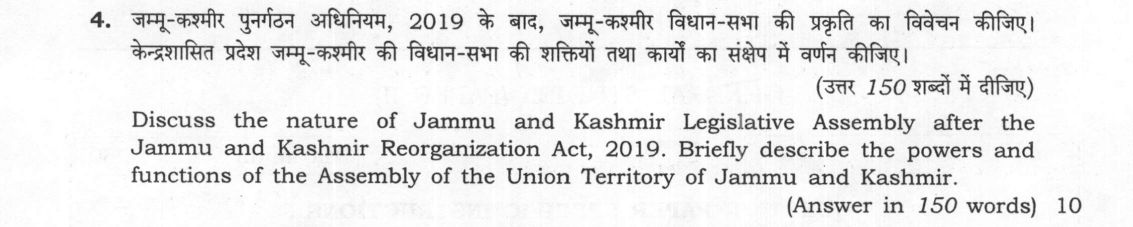
Discuss the nature of Jammu and Kashmir Legislative Assembly after the Jammu and Kashmir Reorganization Act, 2019. Briefly describe the powers and functions of the Assembly of the Union Territory of Jammu and Kashmir. (Answer in 150 words) 10 marks
हिंदी में प्रश्न पढ़ें
जम्मू-कश्मीर पुनर्गठन अधिनियम, 2019 के बाद, जम्मू-कश्मीर विधान-सभा की प्रकृति का विवेचन कीजिए। केन्द्रशासित प्रदेश जम्मू-कश्मीर की विधान-सभा की शक्तियों तथा कार्यों का संक्षेप में वर्णन कीजिए। (उत्तर 150 शब्दों में दीजिए)
Model answer
Written by UPSC Answer Check against this question's marking rubric, to the 150-word length. UPSC does not publish answers for Mains — this is one way to score well, not an official key.
The Jammu and Kashmir Reorganisation Act, 2019 converted J&K from a state into a Union Territory, downgrading its legislature from a state legislature to a UT legislature with reduced autonomy. The bicameral legislature became unicameral, with the Legislative Council abolished. The Assembly, created by the Act under Article 3, functions under it, but its powers are circumscribed by the Lieutenant Governor’s expanded role. Under Sections 32 and 53, the LG acts on aid and advice in most matters, but may act in his discretion in specified cases, weakening ministerial responsibility. Law-making is restricted: the Assembly cannot legislate on Police, public order or All India Services, and its bills require the LG’s assent. Financial powers include passing the budget and levying taxes, still narrower than a state’s. Oversight through questions and committees persists, but Parliament prevails in concurrent matters. A way forward is strengthening legislative autonomy within this constrained, executive-heavy framework.
What "Discuss" is asking you to do
Lay the issue out from more than one side — how it arose, what is claimed for it, what is held against it, and where it now stands. UPSC attaches discuss to broad topics with several live dimensions, so coverage of the dimensions earns more than the strength of your opinion.
Structure that answers it
Set the issue up → the case as it is made → the case against → the dimension both sides leave out → where the balance now lies
Where marks are lost
Listing facts with no thread between them, or arguing one side throughout and calling it a discussion.
How this answer will be evaluated
Approach
Framework: GS2 Paper 2: Constitutional & Administrative. discuss: intro > 3-4 dimensions > example > balanced close Full marks: Precisely defines the 'UT with legislature' status and accurately lists powers/functions within the 150-word limit.
Key points expected
- Identify status as UT with legislature (Article 239AA)
- Mention 2019 Reorganization Act as the legal basis
- Distinguish powers from full State Assemblies (e.g., no 'State' in name)
- List key functions: legislation, budget, executive control
Evaluation rubric
Each sub-part is marked on its own, against the marks and word limit printed on the paper.
- The answer Analyze the constitutional status of the J&K Assembly post-2019 and its legislative powers. 10 marks · 150 words
discuss— intro → 3-4 dimensions → example → balanced close
Must cover
- Identify status as UT with legislature (Article 239AA)
- Mention 2019 Reorganization Act as the legal basis
- Distinguish powers from full State Assemblies (e.g., no 'State' in name)
- List key functions: legislation, budget, executive control
Loses marks
- Reciting Article 370 abrogation without linking to Assembly nature
- Confusing UT Assembly powers with State Assembly powers
- Failing to mention the 2019 Act as the operative law
Earns more
- Reference to Governor's role in legislative process
- Mention of specific legislative subjects (State List)
- Comparison with pre-2019 status (Article 370 context)
Extra mark
- Cite specific Article 239AA clause regarding Assembly powers
- Reference to 2nd ARC or Law Commission on UT governance
Practice this exact question
Write your answer and it is marked point by point against the model answer above — what you covered, what you missed, what you got wrong.
Evaluate my answer →More from General Studies 2025 GS Paper II
- Q1 Discuss the 'corrupt practices' for the purpose of the Representation of the People Act,…
- Q2 Comment on the need of administrative tribunals as compared to the court system. Assess t…
- Q3 Compare and contrast the President's power to pardon in India and in the USA. Are there a…
- Q4 Discuss the nature of Jammu and Kashmir Legislative Assembly after the Jammu and Kashmir…
- Q5 "The Attorney General of India plays a crucial role in guiding the legal framework of the…
- Q6 Women's social capital complements in advancing empowerment and gender equity. Explain. (…
- Q7 e-governance projects have a built-in bias towards technology and back-end integration th…