GS Paper II — Q17
"In contemporary development models, decision-making and problem-solving responsibilities are not located close to the source of…
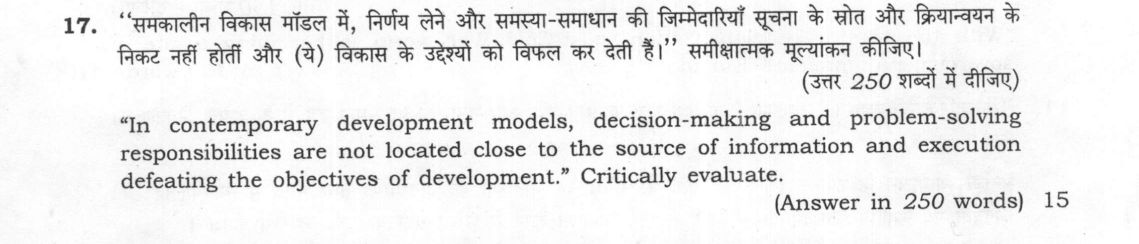
"In contemporary development models, decision-making and problem-solving responsibilities are not located close to the source of information and execution defeating the objectives of development." Critically evaluate. (Answer in 250 words) 15 marks
हिंदी में प्रश्न पढ़ें
"समकालीन विकास मॉडल में, निर्णय लेने और समस्या-समाधान की जिम्मेदारियाँ सूचना के स्रोत और क्रियान्वयन के निकट नहीं होती और (ये) विकास के उद्देश्यों को विफल कर देती हैं।" समीक्षात्मक मूल्यांकन कीजिए। (उत्तर 250 शब्दों में दीजिए)
Model answer
Written by UPSC Answer Check against this question's marking rubric, to the 250-word length. UPSC does not publish answers for Mains — this is one way to score well, not an official key.
Contemporary development discourse increasingly highlights a structural mismatch: top-down decision-making detached from grassroots realities. As articulated in Friedrich Hayek’s "local knowledge problem," centralized planners lack the contextual, tacit information available at the ground level, leading to policy distortions and implementation gaps.
Limitations of Top-Down Development
In India, despite the 73rd and 74th Constitutional Amendments institutionalizing democratic decentralization, incomplete devolution of the 3Fs—Funds, Functions, and Functionaries—keeps decision-making centralized. Technocratic, top-down initiatives like the Smart Cities Mission have faced criticism for utilizing Special Purpose Vehicles (SPVs) that bypass elected Urban Local Bodies, alienating local needs. Similarly, while centralized mandates in schemes like MGNREGA enforce accountability, rigid top-down digital systems (e.g., app-based attendance and centralized wage disbursement) often disrupt execution due to local connectivity and administrative deficits.
Necessity of Centralized Coordination
However, centralization is indispensable for issues requiring economies of scale, standard-setting, and macro-coordination. During the COVID-19 pandemic and climate adaptation planning, unified command structures under the Disaster Management Act, 2005 proved essential. Furthermore, purely localized decision-making in India frequently suffers from fiscal incapacity, technical deficits, and the risk of local elite capture along caste and gender lines. Programmes like PMGSY succeeded precisely because uniform central technical standards were married with state-level execution.
Verdict
Centralized decision-making defeats development objectives only when applied indiscriminately to hyper-local challenges. Development must be anchored in the principle of subsidiarity endorsed by the 2nd Administrative Reforms Commission—entrusting functions to the lowest competent authority. Bridging the information-execution gap requires genuine fiscal devolution to local bodies, coupled with digital governance and cooperative federalism to align national strategy with local agency.
What "Critically evaluate" is asking you to do
Judge how well something has performed against the standard it set for itself — its stated aim, mandate or promise — and commit to a verdict. Name the yardstick before you judge; an unanchored judgement reads as opinion. “Critically” is not a section added at the end: name the yardstick you are judging by — the evidence, the stated objective, a constitutional principle, a rival explanation — and let a verdict close each part of the body. Where the question quotes a claim, that verdict must land on the claim itself, accepted, qualified or rejected, and not on the theme in general.
Structure that answers it
Name the yardstick — stated aim, mandate or benchmark → performance against it → shortfall against it → why the gap exists → verdict
Where marks are lost
Merits in one paragraph, demerits in the next, and a conclusion calling for a balanced and holistic approach. That is a survey with the judgement left out and it holds the answer in the middle band. The opposite error is reading “critically” as permission to attack — and with the odd pairings, critically describe or critically explain, the exposition still carries most of the marks, the judgement being a layer on it rather than a substitute for it.
How this answer will be evaluated
Approach
Framework: GS2 Governance & Public Policy. critically evaluate: positives > negatives/limits > conditions/safeguards > conclusion Full marks: Sharp analysis of the information-execution gap with specific examples and 2nd ARC references.
Key points expected
- Identify the gap between information source and decision authority
- Explain how this gap defeats development objectives
- Provide a specific example of policy failure
- Suggest a realistic reform or decentralization mechanism
Evaluation rubric
Each sub-part is marked on its own, against the marks and word limit printed on the paper.
- The answer Assess the impact of centralized decision-making on development outcomes. 15 marks · 250 words
critically evaluate— positives → negatives/limits → conditions/safeguards → conclusion
Must cover
- Identify the gap between information source and decision authority
- Explain how this gap defeats development objectives
- Provide a specific example of policy failure
- Suggest a realistic reform or decentralization mechanism
Loses marks
- Reciting constitutional articles without analysis
- Failing to link the gap to specific development failures
- Ending without a concrete reform or way forward
Earns more
- Reference to 73rd/74th Constitutional Amendments
- Mention of Panchayati Raj or local governance
- Discussion of 'bottom-up' vs 'top-down' approaches
- Citing specific development schemes (e.g., MGNREGA)
Extra mark
- Reference to 2nd ARC recommendations
- Citing a specific Supreme Court judgment on local governance
Practice this exact question
Write your answer and it is marked point by point against the model answer above — what you covered, what you missed, what you got wrong.
Evaluate my answer →More from General Studies 2025 GS Paper II
- Q14 Examine the evolving pattern of Centre-State financial relations in the context of planne…
- Q15 What are environmental pressure groups? Discuss their role in raising awareness, influenc…
- Q16 Inequality in the ownership pattern of resources is one of the major causes of poverty. D…
- Q17 "In contemporary development models, decision-making and problem-solving responsibilities…
- Q18 The National Commission for Protection of Child Rights has to address the challenges face…
- Q19 "Energy security constitutes the dominant kingpin of India's foreign policy, and is linke…
- Q20 "The reform process in the United Nations remains unresolved, because of the delicate imb…