GS Paper II — Q19
"Energy security constitutes the dominant kingpin of India's foreign policy, and is linked with India's overarching influence in…
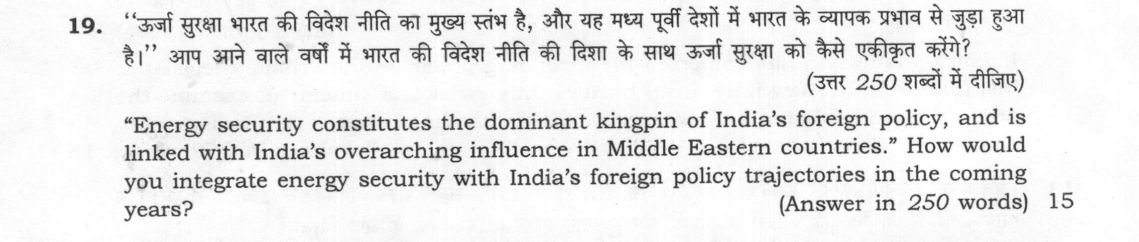
"Energy security constitutes the dominant kingpin of India's foreign policy, and is linked with India's overarching influence in Middle Eastern countries." How would you integrate energy security with India's foreign policy trajectories in the coming years? (Answer in 250 words) 15 marks
हिंदी में प्रश्न पढ़ें
"ऊर्जा सुरक्षा भारत की विदेश नीति का मुख्य स्तंभ है, और यह मध्य पूर्वी देशों में भारत के व्यापक प्रभाव से जुड़ा हुआ है।" आप आने वाले वर्षों में भारत की विदेश नीति की दिशा के साथ ऊर्जा सुरक्षा को कैसे एकीकृत करेंगे? (उत्तर 250 शब्दों में दीजिए)
Model answer
Written by UPSC Answer Check against this question's marking rubric, to the 250-word length. UPSC does not publish answers for Mains — this is one way to score well, not an official key.
India imports over 85% of its crude oil, with West Asian nations—principally Iraq, Saudi Arabia, and the UAE—forming the historic bedrock of its energy supply. However, regional instability and supply vulnerabilities necessitate integrating energy security across multifaceted foreign policy trajectories to safeguard strategic autonomy.
Geographic Diversification and Connectivity India’s diplomatic outreach is actively diversifying energy corridors by scaling long-term US LNG imports and securing crude from Russia’s Far East via the Vladivostok-Chennai Maritime Corridor. Simultaneously, foreign policy must leverage continental transit through the International North-South Transport Corridor (INSTC) and pursue dialogue around the TAPI pipeline to integrate Central Asian energy reserves into India’s matrix.
Renewable Energy and Critical Mineral Diplomacy Energy diplomacy is increasingly defined by the green transition. India utilizes the International Solar Alliance (ISA) to assert leadership in the Global South, while negotiating green hydrogen and clean technology partnerships with the European Union and Japan. Crucially, diplomatic efforts through Khanij Bidesh India Ltd. (KABIL) secure critical mineral supply chains, marked by lithium agreements with Argentina and Australia.
Strategic Autonomy and Maritime Security Energy diplomacy directly reinforces strategic autonomy by resisting sanctions-driven pressures—demonstrated in discounted Russian oil imports—and expanding local currency mechanisms, such as the Rupee-Dirham settlement system. Furthermore, safeguarding vital Sea Lines of Communication (SLOCs) across the Indian Ocean Region (IOR) aligns India's naval posture with its SAGAR framework.
Moving forward, India must balance traditional West Asian partnerships with emerging Indo-Pacific clean energy architectures, counter climate-linked trade barriers, and secure advanced tech-transfers, forging a resilient, multi-aligned energy diplomacy.
What "Analyse" is asking you to do
Break the subject into its working parts and show how they act on each other. The marks are in the interconnections — which factor drives which, and what the resulting structure explains — not in the inventory of factors.
Structure that answers it
Define the whole → separate it into its parts → show which part drives which → what that interaction produces → what the structure implies
Where marks are lost
A flat list of causes with no account of which drives which. An answer of neatly separated headings, each self-contained, scores as description.
How this answer will be evaluated
Approach
Framework: GS2 Foreign Policy & International Relations. analyse: intro > causes > effects > stakeholders/linkages > way forward Full marks: Strategic, forward-looking analysis with specific policy examples and geopolitical nuance.
Key points expected
- Diversification of energy sources (hydrocarbons, renewables, nuclear).
- Leveraging energy diplomacy for geopolitical influence in the Middle East.
- Linkage between energy security and India's 'Act East' or 'Neighbourhood First' policy.
- Specific policy trajectories (e.g., India-Middle East-Europe Economic Corridor).
Evaluation rubric
Each sub-part is marked on its own, against the marks and word limit printed on the paper.
- The answer Strategic integration of energy security with India's Middle East foreign policy for the future. 15 marks · 250 words
analyse— intro → causes → effects → stakeholders/linkages → way forward
Must cover
- Diversification of energy sources (hydrocarbons, renewables, nuclear).
- Leveraging energy diplomacy for geopolitical influence in the Middle East.
- Linkage between energy security and India's 'Act East' or 'Neighbourhood First' policy.
- Specific policy trajectories (e.g., India-Middle East-Europe Economic Corridor).
Loses marks
- Generic discussion on energy without specific Middle East focus.
- Reciting history of India-Middle East relations without future trajectory.
- Ignoring the 'foreign policy' aspect and focusing only on economics.
Earns more
- Mention of specific initiatives like I2U2 or India-UAE CEPA.
- Reference to strategic autonomy in energy procurement.
- Discussion on the role of diaspora in energy diplomacy.
- Balanced view on balancing relations with US, Russia, and Iran.
Extra mark
- Citing specific data on India's energy import dependency.
- Reference to the 'Energy Chord' concept in foreign policy.
Practice this exact question
Write your answer and it is marked point by point against the model answer above — what you covered, what you missed, what you got wrong.
Evaluate my answer →More from General Studies 2025 GS Paper II
- Q16 Inequality in the ownership pattern of resources is one of the major causes of poverty. D…
- Q17 "In contemporary development models, decision-making and problem-solving responsibilities…
- Q18 The National Commission for Protection of Child Rights has to address the challenges face…
- Q19 "Energy security constitutes the dominant kingpin of India's foreign policy, and is linke…
- Q20 "The reform process in the United Nations remains unresolved, because of the delicate imb…