GS Paper II — Q14
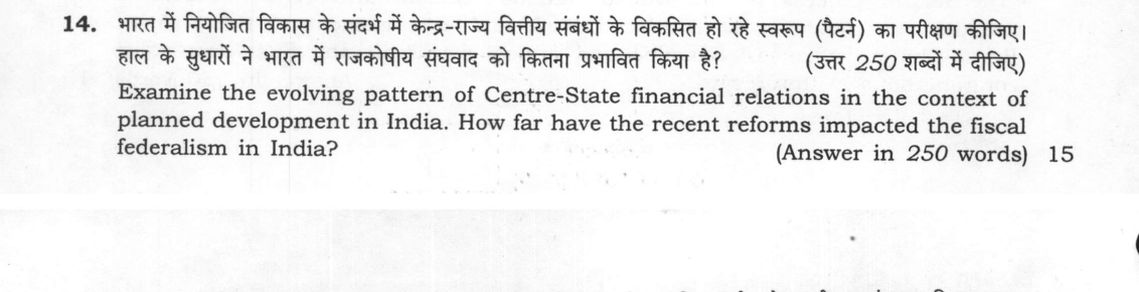
Examine the evolving pattern of Centre-State financial relations in the context of planned development in India. How far have the…
Examine the evolving pattern of Centre-State financial relations in the context of planned development in India. How far have the recent reforms impacted the fiscal federalism in India? (Answer in 250 words) 15 marks
हिंदी में प्रश्न पढ़ें
भारत में नियोजित विकास के संदर्भ में केंद्र-राज्य वित्तीय संबंधों के विकसित होते स्वरूप (पैटर्न) का परीक्षण कीजिए। हाल के सुधारों ने भारत में राजकोषीय संघवाद को कितना प्रभावित किया है? (उत्तर 250 शब्दों में दीजिए)
Model answer
Written by UPSC Answer Check against this question's marking rubric, to the 250-word length. UPSC does not publish answers for Mains — this is one way to score well, not an official key.
Centre-State financial relations in India have transitioned from the Planning Commission era—characterized by discretionary Plan grants under Article 282 and Gadgil-Mukherjee formulas—to constitutional, rule-based transfers following the replacement of the Planning Commission with the purely advisory NITI Aayog in 2015.
Impact of Recent Fiscal Reforms
Statutory Devolution and the Divisible Pool: The 14th and 15th Finance Commissions structurally enhanced unconditional tax devolution to 42% and 41% respectively, expanding the fiscal autonomy of states. However, this expansion has been diluted by the Centre’s growing reliance on non-shareable cesses and surcharges (under Article 271), which now account for nearly 15–18% of Gross Tax Revenue, effectively shrinking the divisible pool.
The GST Architecture: The introduction of the Goods and Services Tax (GST) in 2017 institutionalized cooperative federalism through the GST Council. Yet, it curtailed states’ sovereign taxation powers over sales tax and VAT. The expiry of the mandatory five-year GST compensation mechanism in June 2022 has severely aggravated fiscal stress across major states.
Conditionalities and Centralized Spending: The expansion of Centrally Sponsored Schemes (CSS) like the Jal Jeevan Mission—with rigid matching grants and implementation conditionalities—alongside direct cash transfers like PM-KISAN, has restricted state-level expenditure flexibility. Stricter enforcement of borrowing limits under Article 293(3), including the inclusion of off-budget borrowings in state fiscal deficit caps, has provoked widespread representations from states.
Verdict
Recent reforms present a distinct duality: while statutory devolution and the GST Council have reinforced institutional federalism, operational centralization—driven by expanding non-divisible cesses, CSS conditionalities, and borrowing curbs—has constrained sub-national fiscal space. True fiscal federalism now hinges on shrinking the cess footprint and rationalizing CSS architecture.
What "Examine" is asking you to do
Test the proposition the question puts to you and return a finding on how far it holds. Examine stems carry a claim, or ask whether something has happened, and expect evidence weighed both ways before the extent is stated — often with remedial measures attached.
Structure that answers it
Restate the claim as the question frames it → evidence that supports it → evidence that undercuts it → the conditions under which it holds → verdict on how far it stands
Where marks are lost
Stopping at description. An examination has to reach a finding, and “examine with justification” means the extent must be stated, not implied.
How this answer will be evaluated
Approach
Framework: GS2 Paper 2: Governance & Federalism. examine: intro > how/why with reasoning > evidence > conclusion Full marks: Analyzes the shift from cooperative to competitive federalism with specific reference to Finance Commissions and GST.
Key points expected
- Evolution of Finance Commission's role in devolution
- Shift from grants to conditional grants
- Impact of GST on vertical fiscal imbalance
- Judgment on the balance of fiscal autonomy
Evaluation rubric
Each sub-part is marked on its own, against the marks and word limit printed on the paper.
- The answer Trace the shift from cooperative to competitive federalism in fiscal relations and assess the impact of recent reforms. · 250 words
examine— intro → how/why with reasoning → evidence → conclusion
Must cover
- Evolution of Finance Commission's role in devolution
- Shift from grants to conditional grants
- Impact of GST on vertical fiscal imbalance
- Judgment on the balance of fiscal autonomy
Loses marks
- Reciting Articles without analyzing the financial flow
- Ignoring the impact of GST on state revenues
- Ending without a balanced judgment on fiscal federalism
Earns more
- Reference to 14th/15th Finance Commission recommendations
- Mention of 100th Schedule or 73rd/74th Amendments
- Discussion of the 15th Finance Commission's 41% devolution
- Reference to the GST Council's decision-making mechanism
Extra mark
- Citing the 13th Finance Commission's 42% recommendation
- Mentioning the 100th Schedule's role in local bodies
Practice this exact question
Write your answer and it is marked point by point against the model answer above — what you covered, what you missed, what you got wrong.
Evaluate my answer →More from General Studies 2025 GS Paper II
- Q11 "Constitutional morality is the fulcrum which acts as an essential check upon the high fu…
- Q12 Indian Constitution has conferred the amending power on the ordinary legislative institut…
- Q13 Discuss the evolution of collegium system in India. Critically examine the advantages and…
- Q14 Examine the evolving pattern of Centre-State financial relations in the context of planne…
- Q15 What are environmental pressure groups? Discuss their role in raising awareness, influenc…
- Q16 Inequality in the ownership pattern of resources is one of the major causes of poverty. D…
- Q17 "In contemporary development models, decision-making and problem-solving responsibilities…