GS Paper II — Q12
Indian Constitution has conferred the amending power on the ordinary legislative institutions with a few procedural hurdles. In…
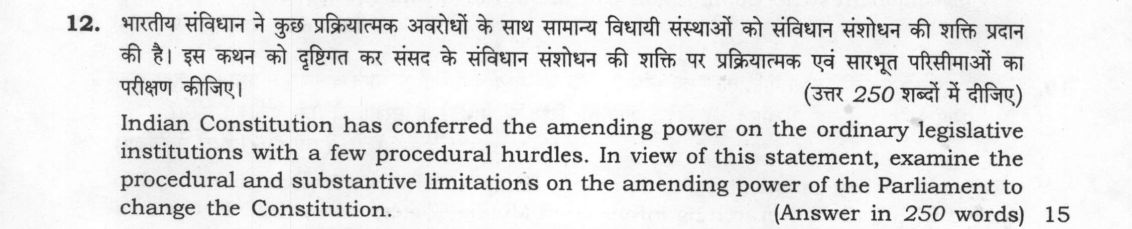
Indian Constitution has conferred the amending power on the ordinary legislative institutions with a few procedural hurdles. In view of this statement, examine the procedural and substantive limitations on the amending power of the Parliament to change the Constitution. (Answer in 250 words) 15 marks
हिंदी में प्रश्न पढ़ें
भारतीय संविधान ने कुछ प्रक्रियात्मक अवरोधों के साथ सामान्य विधायी संस्थाओं को संविधान संशोधन की शक्ति प्रदान की है। इस कथन को दृष्टिगत कर संसद के संविधान संशोधन की शक्ति पर प्रक्रियात्मक एवं सारभूत परिसीमाओं का परीक्षण कीजिए। (उत्तर 250 शब्दों में दीजिए)
Model answer
Written by UPSC Answer Check against this question's marking rubric, to the 250-word length. UPSC does not publish answers for Mains — this is one way to score well, not an official key.
The statement is broadly correct: Article 368 gives Parliament wide amending power, but it is not plenary.
Procedural hurdles. An amendment bill must be passed by a special majority—majority of the total membership of each House and at least two-thirds of members present and voting. Where the amendment affects federal or institutional arrangements, such as the election of the President, legislative powers, High Courts, or certain tax and emergency provisions, it must also be ratified by the legislatures of at least half the States.
Substantive limits. The decisive limitation is judicial. Golak Nath (1967) initially held fundamental rights unamendable; Kesavananda Bharati (1973) overruled that, permitting amendment of fundamental rights but not the Constitution’s basic structure. Minerva Mills (1980) reinforced that harmony between fundamental rights and DPSP is basic. The NJAC judgment (2015) struck down the 99th Amendment, protecting judicial independence. Thus judicial review, federalism, secularism, judicial independence, rule of law, separation of powers, and free and fair elections are treated as unamendable.
Parliament responded to judicial limitations through the 42nd Amendment, which sought to shield amendments from judicial review; the 44th Amendment partially rolled this back by deleting Article 31C and restoring scrutiny of laws under Article 19. Contemporary debates on constitutional amendments and judicial review—such as the 2024 Electoral Bonds judgment, which struck down ordinary legislation under Article 19(1)(a) rather than an amendment—show that courts continue to police constitutional limits.
The amending power is therefore flexible enough to adapt, but rigid enough to preserve the Constitution’s identity.
What "Examine" is asking you to do
Test the proposition the question puts to you and return a finding on how far it holds. Examine stems carry a claim, or ask whether something has happened, and expect evidence weighed both ways before the extent is stated — often with remedial measures attached.
Structure that answers it
Restate the claim as the question frames it → evidence that supports it → evidence that undercuts it → the conditions under which it holds → verdict on how far it stands
Where marks are lost
Stopping at description. An examination has to reach a finding, and “examine with justification” means the extent must be stated, not implied.
How this answer will be evaluated
Approach
Framework: GS2 Constitutional Law & Governance. examine: intro > how/why with reasoning > evidence > conclusion Full marks: Distinguishes procedural vs substantive limits with case law and clear reasoning.
Key points expected
- Procedural hurdles: simple, special, and state consent majorities
- Substantive limits: Basic Structure Doctrine (Kesavananda Bharati)
- Distinction between ordinary legislation and constitutional amendment
- Judicial review as a check on amending power
Evaluation rubric
Each sub-part is marked on its own, against the marks and word limit printed on the paper.
- The answer Analyze the procedural and substantive limits on Parliament's amending power under Article 368. 15 marks · 250 words
examine— intro → how/why with reasoning → evidence → conclusion
Must cover
- Procedural hurdles: simple, special, and state consent majorities
- Substantive limits: Basic Structure Doctrine (Kesavananda Bharati)
- Distinction between ordinary legislation and constitutional amendment
- Judicial review as a check on amending power
Loses marks
- Reciting Article 368 text without analysis
- Ignoring the 'substantive' limitation aspect
- Confusing ordinary legislative power with amending power
Earns more
- Reference to 24th/25th/42nd Amendments
- Mention of Article 368(2) requirements
- Discussion of 'Constitutional Morality' as a limit
- Reference to 99th Amendment (NJAC) strike-down
Extra mark
- Citing specific Supreme Court judgments (e.g., Minerva Mills)
- Mentioning Law Commission recommendations on amendment
Practice this exact question
Write your answer and it is marked point by point against the model answer above — what you covered, what you missed, what you got wrong.
Evaluate my answer →More from General Studies 2025 GS Paper II
- Q9 India-Africa digital partnership is achieving mutual respect, co-development and long-ter…
- Q10 "With the waning of globalization, post-Cold War world is becoming a site of sovereign na…
- Q11 "Constitutional morality is the fulcrum which acts as an essential check upon the high fu…
- Q12 Indian Constitution has conferred the amending power on the ordinary legislative institut…
- Q13 Discuss the evolution of collegium system in India. Critically examine the advantages and…
- Q14 Examine the evolving pattern of Centre-State financial relations in the context of planne…
- Q15 What are environmental pressure groups? Discuss their role in raising awareness, influenc…