GS Paper II — Q7
e-governance projects have a built-in bias towards technology and back-end integration than user-centric designs. Examine…
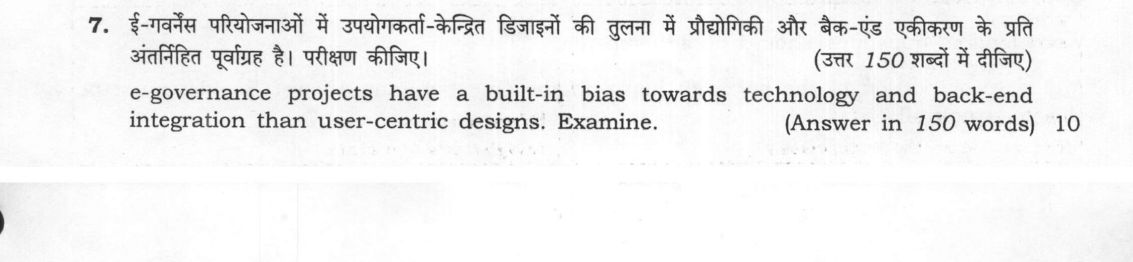
e-governance projects have a built-in bias towards technology and back-end integration than user-centric designs. Examine. (Answer in 150 words) 10 marks
हिंदी में प्रश्न पढ़ें
ई-गवर्नेंस परियोजनाओं में उपयोगकर्ता-केंद्रित डिजाइनों की तुलना में प्रौद्योगिकी और बैक-एंड एकीकरण के प्रति अंतर्निहित पूर्वाग्रह है। परीक्षण कीजिए। (उत्तर 150 शब्दों में दीजिए)
Model answer
Written by UPSC Answer Check against this question's marking rubric, to the 150-word length. UPSC does not publish answers for Mains — this is one way to score well, not an official key.
E-governance in India has historically prioritized technological architecture and back-end integration over front-end usability, driven by a technocratic administrative approach.
Drivers and Manifestations of Tech Bias Public procurement systems heavily favor hardware acquisition, software licenses, and technical metrics (such as server uptime and database interoperability) over user-experience (UX) research. The absence of institutionalized user testing and service design thinking results in complex navigation, language barriers, and digital literacy assumptions, as seen in early compliance hurdles with GSTN and initial access bottlenecks in web-only portals.
Emerging User-Centric Shifts However, modern delivery models are actively rebalancing this bias:
- Mobile-first accessibility: The UMANG platform consolidates multi-departmental services into a single, intuitive interface.
- Citizen feedback: MyGov incorporates crowdsourcing and continuous user feedback.
- Assisted access: Kerala’s Akshaya centers and Common Services Centers (CSC 2.0) bridge interface complexities for rural citizens.
Way Forward To transition from mere computerization to true citizen-centricity, governments must mandate participatory service design, institutionalize independent UX audits, prioritize vernacular and mobile-first frameworks, and replace purely technical SLAs with outcome-based citizen satisfaction indices.
What "Examine" is asking you to do
Test the proposition the question puts to you and return a finding on how far it holds. Examine stems carry a claim, or ask whether something has happened, and expect evidence weighed both ways before the extent is stated — often with remedial measures attached.
Structure that answers it
Restate the claim as the question frames it → evidence that supports it → evidence that undercuts it → the conditions under which it holds → verdict on how far it stands
Where marks are lost
Stopping at description. An examination has to reach a finding, and “examine with justification” means the extent must be stated, not implied.
How this answer will be evaluated
Approach
Framework: GS2 Governance. examine: intro > how/why with reasoning > evidence > conclusion Full marks: Deep analysis of the tech-first paradigm with specific examples and a clear critique of the user experience gap.
Key points expected
- Define the 'built-in bias' toward tech over user needs
- Explain the role of back-end integration in driving design
- Identify the disconnect between IT logic and citizen experience
- Provide a specific example of a failed or biased project
Evaluation rubric
Each sub-part is marked on its own, against the marks and word limit printed on the paper.
- The answer Analyze the structural reasons for the technology-first bias in e-governance projects. 10 marks · 150 words
examine— intro → how/why with reasoning → evidence → conclusion
Must cover
- Define the 'built-in bias' toward tech over user needs
- Explain the role of back-end integration in driving design
- Identify the disconnect between IT logic and citizen experience
- Provide a specific example of a failed or biased project
Loses marks
- Reciting features of e-governance without analyzing the bias
- Focusing only on the benefits of technology
- Ignoring the 'user-centric' aspect of the prompt
Earns more
- Mention the 'digital divide' or accessibility issues
- Reference the 'last mile' delivery failure
- Discuss the lack of user-centricity in procurement
- Cite the Digital India or MyGov initiatives
Extra mark
- Cite a specific Supreme Court judgment on digital rights
- Reference a specific Law Commission report on e-governance
Practice this exact question
Write your answer and it is marked point by point against the model answer above — what you covered, what you missed, what you got wrong.
Evaluate my answer →More from General Studies 2025 GS Paper II
- Q4 Discuss the nature of Jammu and Kashmir Legislative Assembly after the Jammu and Kashmir…
- Q5 "The Attorney General of India plays a crucial role in guiding the legal framework of the…
- Q6 Women's social capital complements in advancing empowerment and gender equity. Explain. (…
- Q7 e-governance projects have a built-in bias towards technology and back-end integration th…
- Q8 Civil Society Organizations are often perceived as being anti-State actors than non-State…
- Q9 India-Africa digital partnership is achieving mutual respect, co-development and long-ter…
- Q10 "With the waning of globalization, post-Cold War world is becoming a site of sovereign na…