GS Paper II — Q20
"The reform process in the United Nations remains unresolved, because of the delicate imbalance of East and West and entanglement…
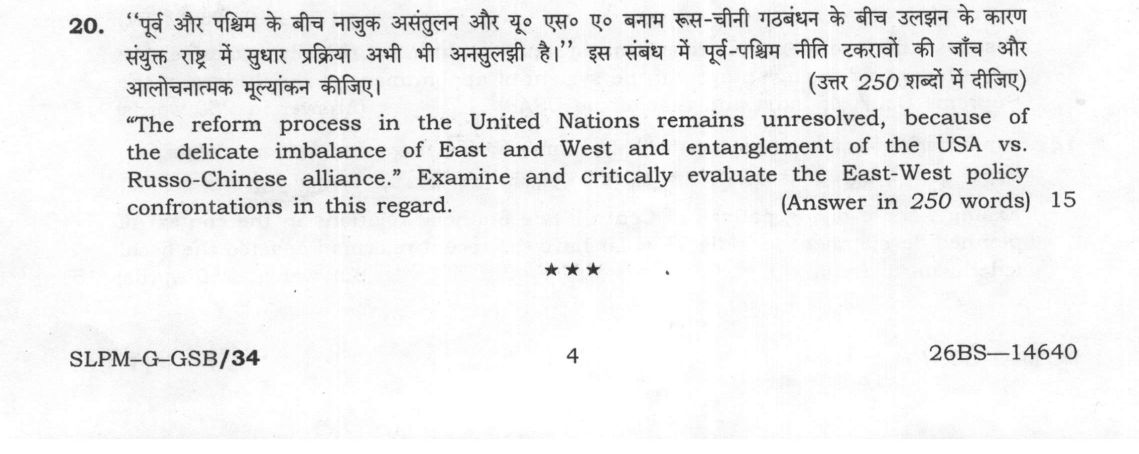
"The reform process in the United Nations remains unresolved, because of the delicate imbalance of East and West and entanglement of the USA vs. Russo-Chinese alliance." Examine and critically evaluate the East-West policy confrontations in this regard. (Answer in 250 words) 15 marks
हिंदी में प्रश्न पढ़ें
"पूर्व और पश्चिम के बीच नाजुक असंतुलन और यू० एस० ए० बनाम रूस-चीनी गठबंधन के बीच उलझन के कारण संयुक्त राष्ट्र में सुधार प्रक्रिया अभी भी अनसुलझी है।" इस संबंध में पूर्व-पश्चिम नीति टकरावों की जाँच और आलोचनात्मक मूल्यांकन कीजिए। (उत्तर 250 शब्दों में दीजिए)
Model answer
Written by UPSC Answer Check against this question's marking rubric, to the 250-word length. UPSC does not publish answers for Mains — this is one way to score well, not an official key.
The paralysis in United Nations (UN) reforms reflects an acute structural crisis rooted in great-power rivalry.
East-West Policy Confrontations and Reform Gridlock The expansion of the UN Security Council (UNSC) remains deadlocked within the triangular dynamics of the USA, Russia, and China. While Washington offers conditional support to select allies, Moscow and Beijing resist structural changes that dilute their P5 dominance, frequently leveraging the divide between the G4 nations (India, Japan, Germany, Brazil) and the ‘Uniting for Consensus’ (UfC) coalition.
Veto confrontations further illustrate this ideological divide. Western pushes for humanitarian intervention under the 'Responsibility to Protect' framework consistently clash with Russo-Chinese assertions of absolute state sovereignty, evidenced by paralyzing deadlocks over Syria and Ukraine. Beyond the Security Council, this rivalry stalls actionable peacekeeping mandates, politicises Secretariat appointments, and weaponises scale of budget assessments.
Critical Evaluation: Beyond Bipolarity However, attributing the reform deadlock exclusively to East-West bipolarity is incomplete. Stagnation is equally sustained by:
- Institutional inertia and the rigid amendment threshold under Article 108 of the UN Charter.
- Intractable regional rivalries within the Global South, such as the African Union's Ezulwini Consensus requiring two veto-wielding permanent seats, and regional peers blocking candidate nations.
India’s Position and Verdict India, as a leading G4 contender, navigates this impasse through strategic autonomy, balancing partnerships with the West while maintaining engagement within the Global South and BRICS.
Ultimately, while regional frictions and procedural rigidities complicate consensus, the US vs. Russo-Chinese polarization remains the decisive barrier to structural reform. Without reconciling this great-power deadlock, the UN risks sliding into permanent institutional obsolescence.
What "Critically evaluate" is asking you to do
Judge how well something has performed against the standard it set for itself — its stated aim, mandate or promise — and commit to a verdict. Name the yardstick before you judge; an unanchored judgement reads as opinion. “Critically” is not a section added at the end: name the yardstick you are judging by — the evidence, the stated objective, a constitutional principle, a rival explanation — and let a verdict close each part of the body. Where the question quotes a claim, that verdict must land on the claim itself, accepted, qualified or rejected, and not on the theme in general.
Structure that answers it
Name the yardstick — stated aim, mandate or benchmark → performance against it → shortfall against it → why the gap exists → verdict
Where marks are lost
Merits in one paragraph, demerits in the next, and a conclusion calling for a balanced and holistic approach. That is a survey with the judgement left out and it holds the answer in the middle band. The opposite error is reading “critically” as permission to attack — and with the odd pairings, critically describe or critically explain, the exposition still carries most of the marks, the judgement being a layer on it rather than a substitute for it.
How this answer will be evaluated
Approach
Framework: GS2 International Relations. critically evaluate: positives > negatives/limits > conditions/safeguards > conclusion Full marks: Deep analysis of veto politics and specific reform proposals with critical judgment.
Key points expected
- Identify the specific UN reform issues (e.g., Security Council expansion).
- Explain the 'East-West' imbalance (USA vs. Russia/China) as a barrier.
- Critically evaluate the 'entanglement' of the USA vs. Russo-Chinese alliance.
- Provide a balanced judgment on the feasibility of reform.
Evaluation rubric
Each sub-part is marked on its own, against the marks and word limit printed on the paper.
- The answer Assess the impact of East-West geopolitical rivalries on the stalled UN reform process. 15 marks · 250 words
critically evaluate— positives → negatives/limits → conditions/safeguards → conclusion
Must cover
- Identify the specific UN reform issues (e.g., Security Council expansion).
- Explain the 'East-West' imbalance (USA vs. Russia/China) as a barrier.
- Critically evaluate the 'entanglement' of the USA vs. Russo-Chinese alliance.
- Provide a balanced judgment on the feasibility of reform.
Loses marks
- Reciting general Cold War history without UN context.
- Failing to link the 'imbalance' to specific institutional blocks.
- Ignoring the 'Russo-Chinese' entanglement aspect of the prompt.
Earns more
- Mention the 'Uniting for Peace' resolution or veto power dynamics.
- Reference the G4 (India, Japan, Germany, Brazil) reform proposal.
- Discuss the 'P5' vs 'P5+1' or 'P5+2' dynamics.
- Cite specific instances of veto use blocking reform.
Extra mark
- Reference the 2005 World Summit Outcome document.
- Mention the 'A3' (African Union) or 'LAC' (Latin America) positions.
Practice this exact question
Write your answer and it is marked point by point against the model answer above — what you covered, what you missed, what you got wrong.
Evaluate my answer →More from General Studies 2025 GS Paper II
- Q17 "In contemporary development models, decision-making and problem-solving responsibilities…
- Q18 The National Commission for Protection of Child Rights has to address the challenges face…
- Q19 "Energy security constitutes the dominant kingpin of India's foreign policy, and is linke…
- Q20 "The reform process in the United Nations remains unresolved, because of the delicate imb…