GS Paper II — Q18
The National Commission for Protection of Child Rights has to address the challenges faced by children in the digital era…
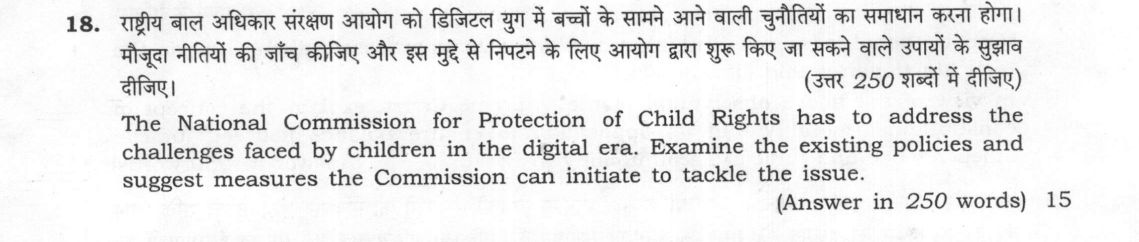
The National Commission for Protection of Child Rights has to address the challenges faced by children in the digital era. Examine the existing policies and suggest measures the Commission can initiate to tackle the issue. (Answer in 250 words) 15 marks
हिंदी में प्रश्न पढ़ें
राष्ट्रीय बाल अधिकार संरक्षण आयोग को डिजिटल युग में बच्चों के सामने आने वाली चुनौतियों का समाधान करना होगा। मौजूदा नीतियों की जाँच कीजिए और इस मुद्दे से निपटने के लिए आयोग द्वारा शुरू किए जा सकने वाले उपायों के सुझाव दीजिए। (उत्तर 250 शब्दों में दीजिए)
Model answer
Written by UPSC Answer Check against this question's marking rubric, to the 250-word length. UPSC does not publish answers for Mains — this is one way to score well, not an official key.
India’s rapid digital expansion exposes children to critical risks, including cyberbullying, online grooming, Child Sexual Abuse Material (CSAM), gaming addiction, algorithmic manipulation, and privacy violations.
Critical Examination of Existing Framework The legislative framework—comprising Section 67B of the IT Act 2000, the POCSO Act 2012, and the Juvenile Justice Act 2015—penalises child abuse and protects privacy. Administratively, the NCPCR formulated the 2020 Guidelines on Online Safety, runs a Cyber Crime Unit, and operates the POCSO e-Box in coordination with the Ministry of Home Affairs (MHA) and MeitY.
However, examination reveals significant gaps. Interventions remain predominantly reactive. Regulatory enforcement struggles against end-to-end encryption, cross-border jurisdictional hurdles, weak compliance by social media intermediaries, and inadequate digital literacy among children and parents, limiting the efficacy of reporting mechanisms.
Measures for NCPCR NCPCR must adopt a proactive, multi-pronged approach. First, it should enforce compliance under the IT Rules 2021, mandating social media intermediaries to deploy robust, privacy-preserving age-verification protocols and swift content takedown systems. Second, the Commission must upgrade the POCSO e-Box and its Cyber Crime Unit with AI-driven triaging, linking them seamlessly with MHA’s National Cybercrime Reporting Portal.
Third, NCPCR should institute national digital literacy and cyber-hygiene curricula in schools, targeting parents and educators. Finally, a multi-stakeholder framework is essential, integrating civil society, tech platforms, and global partnerships with INTERPOL and the WePROTECT Global Alliance to disrupt transnational CSAM networks.
NCPCR must transition from post-facto grievance redressal to systemic, preventive digital governance, ensuring safe digital access without compromising child protection.
What "Examine" is asking you to do
Test the proposition the question puts to you and return a finding on how far it holds. Examine stems carry a claim, or ask whether something has happened, and expect evidence weighed both ways before the extent is stated — often with remedial measures attached.
Structure that answers it
Restate the claim as the question frames it → evidence that supports it → evidence that undercuts it → the conditions under which it holds → verdict on how far it stands
Where marks are lost
Stopping at description. An examination has to reach a finding, and “examine with justification” means the extent must be stated, not implied.
How this answer will be evaluated
Approach
Framework: GS2 Governance & Social Justice. examine: intro > how/why with reasoning > evidence > conclusion Full marks: Sharp critique of policy gaps with specific, actionable NCPCR measures.
Key points expected
- Identify specific digital challenges (cyberbullying, data privacy, addiction)
- Critique existing policies (IT Act, Juvenile Justice Act, NCPCR guidelines)
- Suggest specific measures for the Commission to initiate
- Link measures to the Commission's statutory mandate
Evaluation rubric
Each sub-part is marked on its own, against the marks and word limit printed on the paper.
- The answer Assess existing child protection policies in the digital context and propose specific NCPCR-led interventions. 15 marks · 250 words
examine— intro → how/why with reasoning → evidence → conclusion
Must cover
- Identify specific digital challenges (cyberbullying, data privacy, addiction)
- Critique existing policies (IT Act, Juvenile Justice Act, NCPCR guidelines)
- Suggest specific measures for the Commission to initiate
- Link measures to the Commission's statutory mandate
Loses marks
- Reciting general child rights without digital context
- Vague suggestions without institutional mechanism
- Ignoring the specific role of the Commission
Earns more
- Mention of IT Rules 2021 or Digital Personal Data Protection Act
- Reference to specific NCPCR guidelines or reports
- Discussion of 'Safe Internet' or 'Digital Literacy' initiatives
- Balanced view on regulation vs. self-regulation
Extra mark
- Citing a specific Supreme Court judgment on child rights
- Reference to Law Commission or 2nd ARC recommendations
Practice this exact question
Write your answer and it is marked point by point against the model answer above — what you covered, what you missed, what you got wrong.
Evaluate my answer →More from General Studies 2025 GS Paper II
- Q15 What are environmental pressure groups? Discuss their role in raising awareness, influenc…
- Q16 Inequality in the ownership pattern of resources is one of the major causes of poverty. D…
- Q17 "In contemporary development models, decision-making and problem-solving responsibilities…
- Q18 The National Commission for Protection of Child Rights has to address the challenges face…
- Q19 "Energy security constitutes the dominant kingpin of India's foreign policy, and is linke…
- Q20 "The reform process in the United Nations remains unresolved, because of the delicate imb…