GS Paper IV — Q1
(a) In the present digital age, social media has revolutionised our way of communication and interaction. However, it has raised…
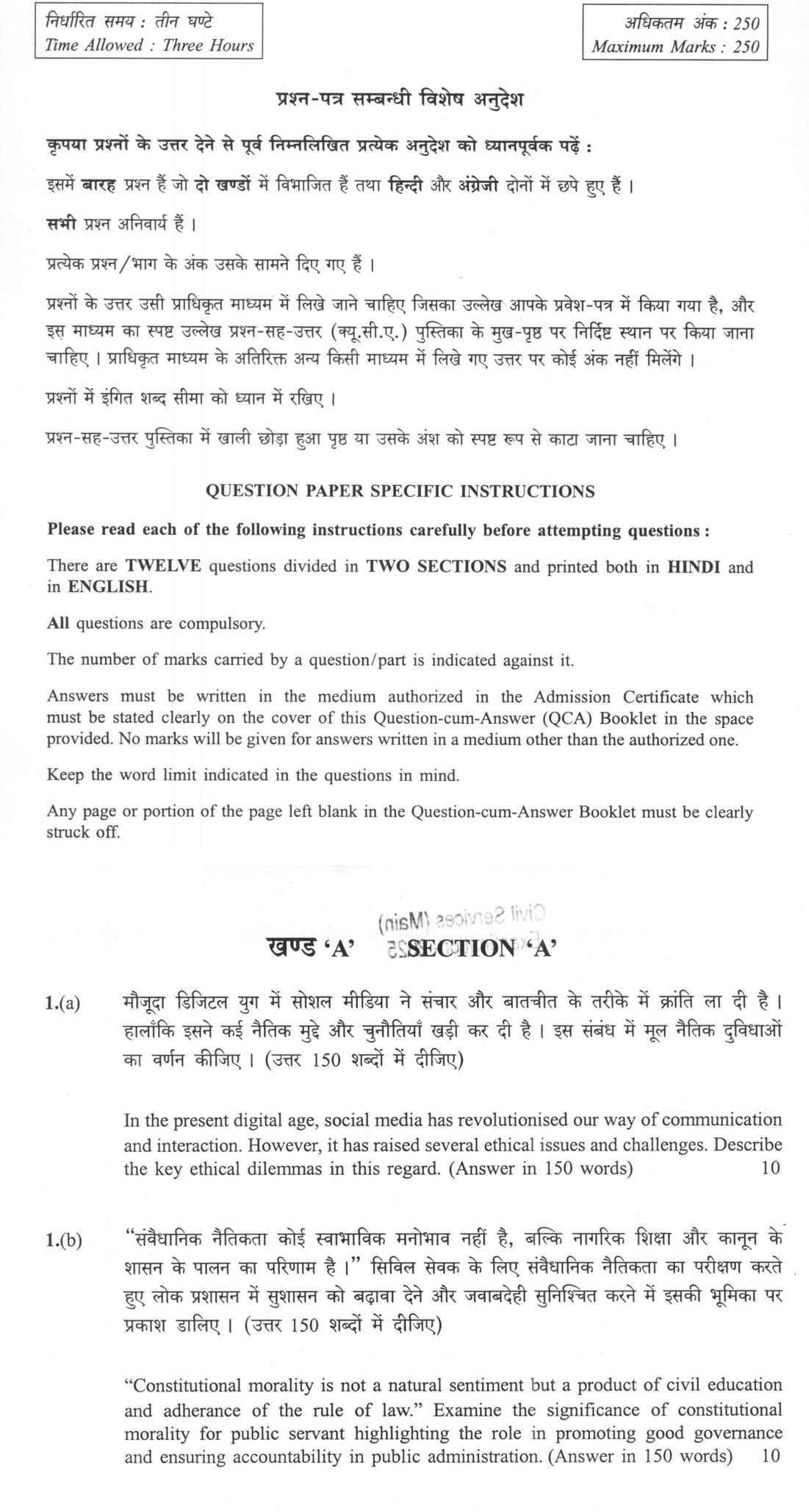
In the present digital age, social media has revolutionised our way of communication and interaction. However, it has raised several ethical issues and challenges. Describe the key ethical dilemmas in this regard. (Answer in 150 words) 10 marks
"Constitutional morality is not a natural sentiment but a product of civil education and adherence of the rule of law." Examine the significance of constitutional morality for public servant highlighting the role in promoting good governance and ensuring accountability in public administration. (Answer in 150 words) 10 marks
हिंदी में प्रश्न पढ़ें
मौजूदा डिजिटल युग में सोशल मीडिया ने संचार और बातचीत के तरीके में क्रांति ला दी है। हालांकि इसने कई नैतिक मुद्दे और चुनौतियाँ खड़ी कर दी हैं। इस संबंध में मूल नैतिक दुविधाओं का वर्णन कीजिए। (उत्तर 150 शब्दों में दीजिए) 10 marks
"संवैधानिक नैतिकता कोई स्वाभाविक मनोभाव नहीं है, बल्कि नागरिक शिक्षा और कानून के शासन के पालन का परिणाम है।" सिविल सेवक के लिए संवैधानिक नैतिकता का परीक्षण करते हुए लोक प्रशासन में सुशासन को बढ़ावा देने और जवाबदेही सुनिश्चित करने में इसकी भूमिका पर प्रकाश डालिए। (उत्तर 150 शब्दों में दीजिए) 10 marks
Model answer
Written by UPSC Answer Check against this question's marking rubric, to the 150-word length. UPSC does not publish answers for Mains — this is one way to score well, not an official key.
(a) Ethical Dilemmas in Social Media
Social media poses key ethical challenges:
- Privacy and Surveillance Capitalism: Unchecked commodification of personal data infringes on individual autonomy.
- Algorithmic Bias and Echo Chambers: Predictive algorithms reinforce filter bubbles, distorting objective reality and polarizing public discourse.
- Infodemic and Harm: Rapid dissemination of fake news, digital hate speech, and cyberbullying undermines human dignity and social cohesion.
- Free Expression versus Regulation: Balancing intermediary platform accountability against the constitutional right to free speech under Article 19(1)(a) creates persistent regulatory friction.
(b) Constitutional Morality in Public Administration
As established in Puttaswamy (2017) and Navtej Singh Johar (2018), constitutional morality supersedes subjective, majoritarian popular morality by upholding foundational constitutional values. Cultivated through civic education and the rule of law, it requires civil servants to act with impartiality, non-discrimination, and resist partisan political pressure.
It drives good governance by ensuring inclusive, rights-based policymaking, while reinforcing institutional accountability through mechanisms like RTI and social audits. Consequently, constitutional morality provides the indispensable ethical framework for administrators to govern emerging digital spaces while safeguarding democratic justice.
What "Describe" is asking you to do
Give a full, ordered account of the thing named — its parts, stages or mechanism — in the sequence in which it actually exists or occurs. Most describe questions come from the science optionals, where the marks sit in correct technical detail and, where the stem says so, a labelled diagram.
Structure that answers it
One-line identification of the subject → the parts or stages in their real order, each with its defining detail → labelled diagram where the subject is structural → closing line on function or significance
Where marks are lost
Loose general prose where the examiner is ticking named parts, correct terminology and their sequence; and in the General Studies papers, turning to evaluation before the description is finished.
How this answer will be evaluated
Approach
Framework: GS4 Ethical Dilemma & Constitutional Morality. (a) describe: define > structure or process in order > labelled diagram > significance | (b) examine: intro > how/why with reasoning > evidence > conclusion Full marks: Precise definitions, specific examples, clear link to governance/accountability, balanced reasoning.
Key points expected
- Define the digital communication context
- Identify 3-4 specific ethical dilemmas (e.g., privacy, misinformation)
- Explain the nature of the conflict in each dilemma
- Conclude with the impact on social interaction
- Define constitutional morality as a product of law/education
- Link it to the public servant's duty
- Explain its role in promoting good governance
- Explain its role in ensuring accountability
Evaluation rubric
Each sub-part is marked on its own, against the marks and word limit printed on the paper.
- (a) Define social media's role and list key ethical dilemmas in communication. 10 marks · 150 words
describe— define → structure or process in order → labelled diagram → significance
Must cover
- Define the digital communication context
- Identify 3-4 specific ethical dilemmas (e.g., privacy, misinformation)
- Explain the nature of the conflict in each dilemma
- Conclude with the impact on social interaction
Loses marks
- Generic listing without explaining the dilemma
- Focusing only on technical aspects, not ethics
- Preaching moral values without structural analysis
Earns more
- Mention specific platforms or mechanisms (algorithms)
- Reference data privacy or surveillance
- Discuss the spread of fake news/rumors
- Highlight the erosion of trust
Extra mark
- Cite a specific IT Act section or regulation
- Reference a specific landmark case on digital ethics
- (b) Examine constitutional morality's role in public servant accountability and governance. 10 marks · 150 words
examine— intro → how/why with reasoning → evidence → conclusion
Must cover
- Define constitutional morality as a product of law/education
- Link it to the public servant's duty
- Explain its role in promoting good governance
- Explain its role in ensuring accountability
Loses marks
- Confusing constitutional morality with personal ethics
- Failing to link to public administration/governance
- Vague generalities without specific administrative context
Earns more
- Contrast with 'natural sentiment' or personal morality
- Mention rule of law adherence
- Discuss impartiality and objectivity in administration
- Reference the spirit of the Constitution
Extra mark
- Cite a specific Supreme Court judgment on constitutional morality
- Reference a specific Article of the Constitution
Practice this exact question
Write your answer and it is marked point by point against the model answer above — what you covered, what you missed, what you got wrong.
Evaluate my answer →More from General Studies 2025 GS Paper IV
- Q1 (a) In the present digital age, social media has revolutionised our way of communication…
- Q2 (a) Carl von Clausewitz once said, "War is a diplomacy by other means." Critically analys…
- Q3 Given below are three quotations of great thinkers. What do each of these quotations conv…
- Q4 (a) "For any kind of social re-engineering by successfully implementing welfare schemes,…