GS Paper IV — Q8
In line with the Directive Principles of State Policy enshrined in the Indian Constitution, the government has a constitutional…
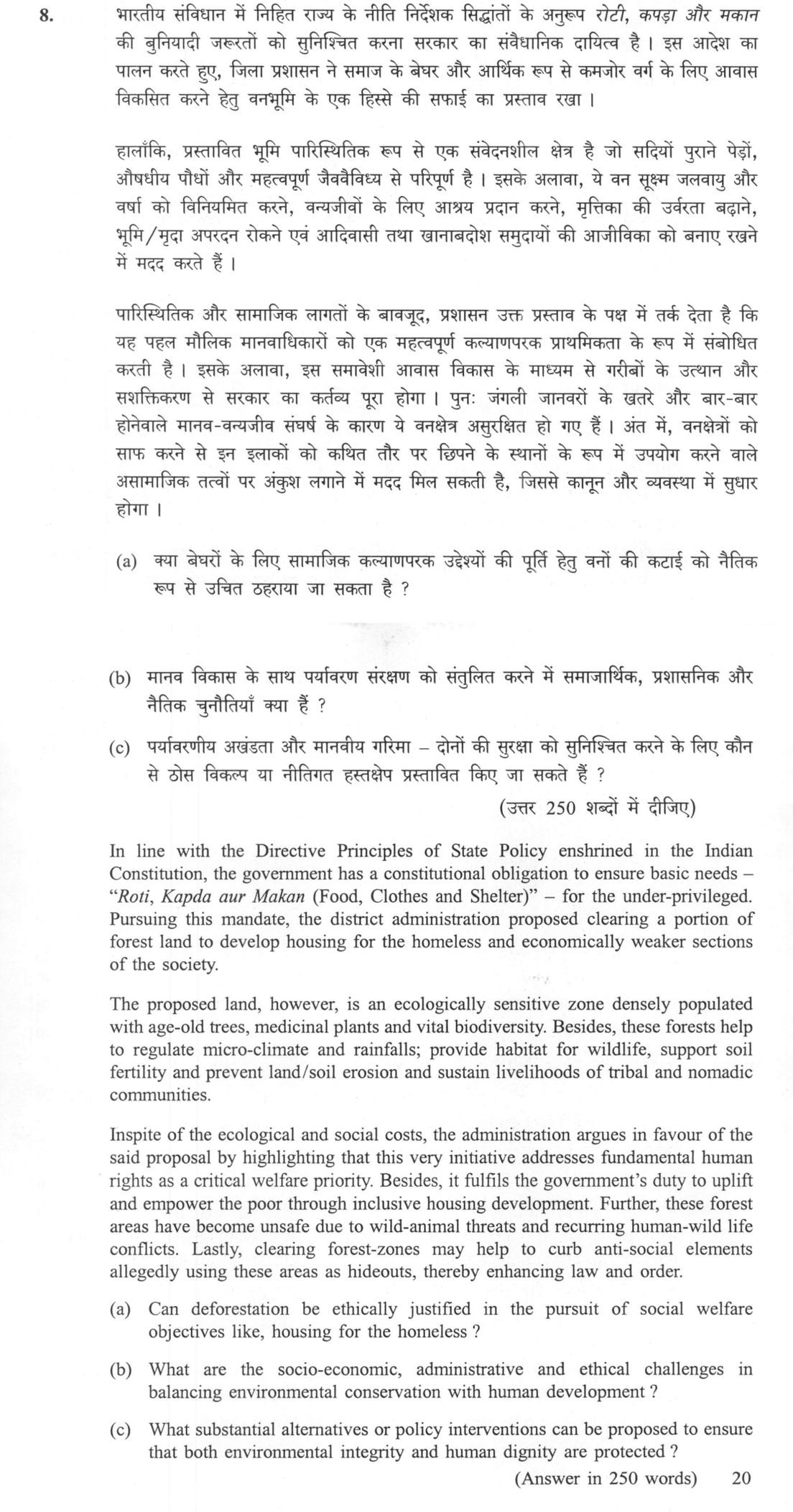
In line with the Directive Principles of State Policy enshrined in the Indian Constitution, the government has a constitutional obligation to ensure basic needs – "Roti, Kapda aur Makan (Food, Clothes and Shelter)" – for the under-privileged. Pursuing this mandate, the district administration proposed clearing a portion of forest land to develop housing for the homeless and economically weaker sections of the society.
The proposed land, however, is an ecologically sensitive zone densely populated with age-old trees, medicinal plants and vital biodiversity. Besides, these forests help to regulate micro-climate and rainfalls; provide habitat for wildlife, support soil fertility and prevent land/soil erosion and sustain livelihoods of tribal and nomadic communities.
Inspite of the ecological and social costs, the administration argues in favour of the said proposal by highlighting that this very initiative addresses fundamental human rights as a critical welfare priority. Besides, it fulfils the government's duty to uplift and empower the poor through inclusive housing development. Further, these forest areas have become unsafe due to wild-animal threats and recurring human-wild life conflicts. Lastly, clearing forest-zones may help to curb anti-social elements allegedly using these areas as hideouts, thereby enhancing law and order.
Can deforestation be ethically justified in the pursuit of social welfare objectives like, housing for the homeless ?
What are the socio-economic, administrative and ethical challenges in balancing environmental conservation with human development ?
What substantial alternatives or policy interventions can be proposed to ensure that both environmental integrity and human dignity are protected ?
हिंदी में प्रश्न पढ़ें
भारतीय संविधान में निहित राज्य के नीति निदेशक सिद्धांतों के अनुरूप रोटी, कपड़ा और मकान की बुनियादी जरूरतों को सुनिश्चित करना सरकार का संवैधानिक दायित्व है। इस आदेश का पालन करते हुए, जिला प्रशासन ने समाज के बेहर और आर्थिक रूप से कमजोर वर्ग के लिए आवास विकसित करने हेतु वनभूमि के एक हिस्से की सफाई का प्रस्ताव रखा।
हालांकि, प्रस्तावित भूमि पारिस्थितिक रूप से एक संवेदनशील क्षेत्र है जो सदियों पुराने पेड़ों, औषधीय पौधों और महत्वपूर्ण जैवविविधता से परिपूर्ण है। इसके अलावा, ये वन सूक्ष्म जलवायु और वर्षा को विनियमित करने, वन्यजीवों के लिए आश्रय प्रदान करने, मृत्तिका की उर्वरता बढ़ाने, भूमि/मृदा अपरदन रोकने एवं आदिवासी तथा खानाबदोश समुदायों की आजीविका को बनाए रखने में मदद करते हैं।
पारिस्थितिक और सामाजिक लागतों के बावजूद, प्रशासन उक्त प्रस्ताव के पक्ष में तर्क देता है कि यह पहल मौलिक मानवाधिकारों को एक महत्वपूर्ण कल्याणपरक प्राथमिकता के रूप में संबोधित करती है। इसके अलावा, इस समावेशी आवास विकास के माध्यम से गरीबों के उत्थान और सशक्तिकरण से सरकार का कर्तव्य पूरा होगा। पुनः जंगली जानवरों के खतरे और बार-बार होनेवाले मानव-वन्यजीव संघर्ष के कारण ये वनक्षेत्र असुरक्षित हो गए हैं। अंत में, वनक्षेत्रों को साफ करने से इन इलाकों को कथित तौर पर छिपने के स्थानों के रूप में उपयोग करने वाले असामाजिक तत्वों पर अंकुश लगाने में मदद मिल सकती है, जिससे कानून और व्यवस्था में सुधार होगा।
क्या बेहरों के लिए सामाजिक कल्याणपरक उद्देश्यों की पूर्ति हेतु वनों की कटाई को नैतिक रूप से उचित ठहराया जा सकता है ?
मानव विकास के साथ पर्यावरण संरक्षण को संतुलित करने में समाजार्थिक, प्रशासनिक और नैतिक चुनौतियाँ क्या हैं ?
पर्यावरणीय अखंडता और मानवीय गरिमा – दोनों की सुरक्षा को सुनिश्चित करने के लिए कौन से ठोस विकल्प या नीतिगत हस्तक्षेप प्रस्तावित किए जा सकते हैं ?
Model answer
Written by UPSC Answer Check against this question's marking rubric, to the 250-word length. UPSC does not publish answers for Mains — this is one way to score well, not an official key.
Ethical Justification of Deforestation
Deforesting ecologically sensitive zones creates a false dichotomy between welfare and conservation. A utilitarian justification of providing shelter fails against irreversible biodiversity loss and the Precautionary Principle. Deontologically, the state’s welfare mandate under DPSPs (Articles 38 and 47) must harmonise with Article 48A and Fundamental Duties (Article 51A(g)). Sacrificing pristine ecology violates intergenerational equity and Gandhian trusteeship. Using law-and-order or animal conflicts to rationalise clear-felling reflects narrow anthropocentrism over ecological rights. Deforestation for welfare is ethically untenable when non-forest alternatives exist.
Multi-Dimensional Challenges
Socio-economically, clearing forests displaces indigenous communities, erodes non-timber forest livelihoods, and ignores the massive opportunity costs and valuation of lost ecosystem services.
Administratively, poor master planning, weak inter-departmental coordination between housing and forest departments, and non-compliance with the Forest Rights Act (FRA), 2006 hinder balanced execution.
Ethically, the conflict between ecocentric preservation and anthropocentric development exposes intra-generational inequity between urban homeless and tribals, reinforced by bureaucratic paternalism that overrides participatory governance.
Alternatives and Policy Interventions
Substantial Alternatives: Deploy vertical housing, brownfield redevelopment, and in-situ slum upgradation under PMAY. Shift projects to degraded non-forest land funded via the Compensatory Afforestation Fund Management and Planning Authority (CAMPA) Act, 2016, while enforcing green building norms and protecting Community Forest Rights.
What "Critically examine" is asking you to do
Test the proposition the question puts to you and return a finding on how far it holds. Examine stems carry a claim, or ask whether something has happened, and expect evidence weighed both ways before the extent is stated — often with remedial measures attached. “Critically” is not a section added at the end: name the yardstick you are judging by — the evidence, the stated objective, a constitutional principle, a rival explanation — and let a verdict close each part of the body. Where the question quotes a claim, that verdict must land on the claim itself, accepted, qualified or rejected, and not on the theme in general.
Structure that answers it
Restate the claim as the question frames it → evidence that supports it → evidence that undercuts it → the conditions under which it holds → verdict on how far it stands
Where marks are lost
Merits in one paragraph, demerits in the next, and a conclusion calling for a balanced and holistic approach. That is a survey with the judgement left out and it holds the answer in the middle band. The opposite error is reading “critically” as permission to attack — and with the odd pairings, critically describe or critically explain, the exposition still carries most of the marks, the judgement being a layer on it rather than a substitute for it.
How this answer will be evaluated
Approach
Framework: GS4 Ethical Dilemma & Governance. (a) justify: claim > 3-4 reasons > evidence > conclusion | (b) challenges: 3-4 challenges > solutions mapped to them > conclusion | (c) suggest: the problem in one line > implementable measures > who acts > conclusion Full marks: Balanced ethical reasoning, specific policy alternatives, and clear distinction between challenge types.
Key points expected
- State the ethical conflict (welfare vs ecology)
- Apply a specific ethical framework (e.g., Utilitarianism)
- Address the 'silent stakeholder' (wildlife/future generations)
- Provide a reasoned judgment on justification
- List specific socio-economic challenges (e.g., livelihood loss)
- List specific administrative challenges (e.g., bureaucratic red tape)
- List specific ethical challenges (e.g., intergenerational equity)
- Map solutions or mitigation strategies to these challenges
Evaluation rubric
Each sub-part is marked on its own, against the marks and word limit printed on the paper.
- (a) Evaluate the ethical validity of deforestation for social welfare.
justify— claim → 3-4 reasons → evidence → conclusion
Must cover
- State the ethical conflict (welfare vs ecology)
- Apply a specific ethical framework (e.g., Utilitarianism)
- Address the 'silent stakeholder' (wildlife/future generations)
- Provide a reasoned judgment on justification
Loses marks
- Preaching 'save the trees' without ethical reasoning
- Ignoring the 'homeless' aspect of the dilemma
- One-sided argument without weighing trade-offs
Earns more
- Mention 'Sustainable Development' as a middle path
- Reference 'Ecological Footprint' or 'Carrying Capacity'
- Cite the 'Precautionary Principle'
Extra mark
- Reference the 'Right to Life' (Art 21) vs 'Right to Environment'
- Mention the 'Polluter Pays Principle'
- (b) Identify socio-economic, administrative, and ethical challenges in balancing conservation and development.
challenges— 3-4 challenges → solutions mapped to them → conclusion
Must cover
- List specific socio-economic challenges (e.g., livelihood loss)
- List specific administrative challenges (e.g., bureaucratic red tape)
- List specific ethical challenges (e.g., intergenerational equity)
- Map solutions or mitigation strategies to these challenges
Loses marks
- Generic points like 'lack of awareness' without context
- Failing to distinguish between the three types of challenges
- Listing challenges without attempting to map solutions
Earns more
- Mention 'Political pressure' as an administrative challenge
- Cite 'Outdated laws' or 'Policy gaps' as barriers
- Discuss 'Institutional trust' issues
Extra mark
- Reference the 'Forest Rights Act, 2006' as a legal/administrative hurdle
- Mention 'Environmental Impact Assessment (EIA)' process delays
- (c) Propose substantial alternatives or policy interventions to protect both environment and human dignity.
suggest— the problem in one line → implementable measures → who acts → conclusion
Must cover
- Propose specific alternatives to deforestation (e.g., vertical housing)
- Suggest policy interventions (e.g., land-use planning)
- Ensure proposals protect 'environmental integrity'
- Ensure proposals protect 'human dignity' (housing)
Loses marks
- Vague suggestions like 'raise awareness'
- Ignoring the 'human dignity' aspect in solutions
- Proposing solutions that are not 'substantial' or implementable
Earns more
- Mention 'Green Building' or 'Sustainable Architecture'
- Suggest 'Community-based Forest Management' (CBFM)
- Propose 'Relocation' with rehabilitation packages
Extra mark
- Reference 'Smart City Mission' for urban planning
- Mention 'Forest Certification' schemes
Practice this exact question
Write your answer and it is marked point by point against the model answer above — what you covered, what you missed, what you got wrong.
Evaluate my answer →More from General Studies 2025 GS Paper IV
- Q5 (a) "One who is devoted to one's duty attains highest perfection in life." Analyse this s…
- Q6 (a) It is said that for an ethical work culture, there must be code of ethics in place in…
- Q7 Vijay was Deputy Commissioner of remote district of Hilly Northern State of the country f…
- Q8 In line with the Directive Principles of State Policy enshrined in the Indian Constitutio…
- Q9 Subash is Secretary, PWD in the State Government. He is a senior officer, known for his c…
- Q10 Rajesh is a Group A officer with nine years of service. He is posted as Administrative Of…
- Q11 Mahatma Gandhi National Rural Employment Guarantee Program, MGNREGA was earlier known as…