GS Paper IV — Q9
Subash is Secretary, PWD in the State Government. He is a senior officer, known for his competence, integrity and dedication to…
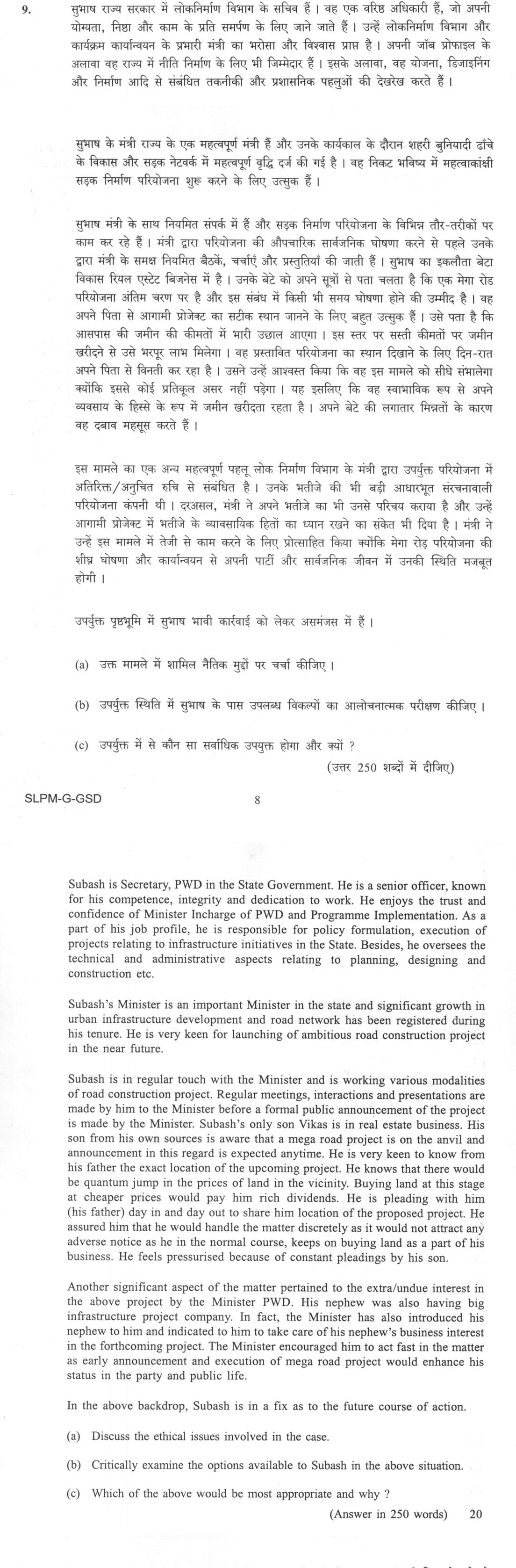
Subash is Secretary, PWD in the State Government. He is a senior officer, known for his competence, integrity and dedication to work. He enjoys the trust and confidence of Minister Incharge of PWD and Programme Implementation. As a part of his job profile, he is responsible for policy formulation, execution of projects relating to infrastructure initiatives in the State. Besides, he oversees the technical and administrative aspects relating to planning, designing and construction etc.
Subash's Minister is an important Minister in the state and significant growth in urban infrastructure development and road network has been registered during his tenure. He is very keen for launching of ambitious road construction project in the near future.
Subash is in regular touch with the Minister and is working various modalities of road construction project. Regular meetings, interactions and presentations are made by him to the Minister before a formal public announcement of the project is made by the Minister. Subash's only son Vikas is in real estate business. His son from his own sources is aware that a mega road project is on the anvil and announcement in this regard is expected anytime. He is very keen to know from his father the exact location of the upcoming project. He knows that there would be quantum jump in the prices of land in the vicinity. Buying land at this stage at cheaper prices would pay him rich dividends. He is pleading with him (his father) day in and day out to share him location of the proposed project. He assured him that he would handle the matter discretely as it would not attract any adverse notice as he in the normal course, keeps on buying land as a part of his business. He feels pressurised because of constant pleadings by his son.
Another significant aspect of the matter pertained to the extra/undue interest in the above project by the Minister PWD. His nephew was also having big infrastructure project company. In fact, the Minister has also introduced his nephew to him and indicated to him to take care of his nephew's business interest in the forthcoming project. The Minister encouraged him to act fast in the matter as early announcement and execution of mega road project would enhance his status in the party and public life.
In the above backdrop, Subash is in a fix as to the future course of action.
Discuss the ethical issues involved in the case.
Critically examine the options available to Subash in the above situation.
Which of the above would be most appropriate and why ?
हिंदी में प्रश्न पढ़ें
सुभाष राज्य सरकार में लोकनिर्माण विभाग के सचिव हैं। वह एक वरिष्ठ अधिकारी हैं, जो अपनी योग्यता, निष्ठा और काम के प्रति समर्पण के लिए जाने जाते हैं। उन्हें लोकनिर्माण विभाग और कार्यक्रम कार्यान्वयन के प्रभारी मंत्री का भरोसा और विश्वास प्राप्त है। अपनी जॉब प्रोफाइल के अलावा वह राज्य में नीति निर्माण के लिए भी जिम्मेदार हैं। इसके अलावा, वह योजना, डिजाइनिंग और निर्माण आदि से संबंधित तकनीकी और प्रशासनिक पहलुओं की देखरेख करते हैं।
सुभाष के मंत्री राज्य के एक महत्वपूर्ण मंत्री हैं और उनके कार्यकाल के दौरान शहरी बुनियादी ढांचे के विकास और सड़क नेटवर्क में महत्वपूर्ण वृद्धि दर्ज की गई है। वह निकट भविष्य में महत्वाकांक्षी सड़क निर्माण परियोजना शुरू करने के लिए उत्सुक हैं।
सुभाष मंत्री के साथ नियमित संपर्क में हैं और सड़क निर्माण परियोजना के विभिन्न तौर-तरीकों पर काम कर रहे हैं। मंत्री द्वारा परियोजना की औपचारिक सार्वजनिक घोषणा करने से पहले उनके द्वारा मंत्री के समक्ष नियमित बैठकें, चर्चाएं और प्रस्तुतियाँ की जाती हैं। सुभाष का इकलौता बेटा विकास रियल एस्टेट बिजनेस में है। उनके बेटे को अपने सूत्रों से पता चलता है कि एक मेगा रोड परियोजना अंतिम चरण पर है और इस संबंध में किसी भी समय घोषणा होने की उम्मीद है। वह अपने पिता से आगामी प्रोजेक्ट का सटीक स्थान जानने के लिए बहुत उत्सुक है। उसे पता है कि आसपास की जमीन की कीमतों में भारी उछाल आएगा। इस स्तर पर सस्ती कीमतों पर जमीन खरीदने से उसे भरपूर लाभ मिलेगा। वह प्रस्तावित परियोजना का स्थान दिखाने के लिए दिन-रात अपने पिता से विनती कर रहा है। उसने उन्हें आश्वस्त किया कि वह इस मामले को सीधे संभालेगा क्योंकि इससे कोई प्रतिकूल असर नहीं पड़ेगा। यह इसलिए कि वह स्वाभाविक रूप से अपने व्यवसाय के हिस्से के रूप में जमीन खरीदता रहता है। अपने बेटे की लगातार मिन्नतों के कारण वह दबाव महसूस करते हैं।
इस मामले का एक अन्य महत्वपूर्ण पहलू लोक निर्माण विभाग के मंत्री द्वारा उपर्युक्त परियोजना में अतिरिक्त/अनुचित रुचि से संबंधित है। उनके भतीजे की भी बड़ी आधारभूत संरचनावाली परियोजना कंपनी थी। दरअसल, मंत्री ने अपने भतीजे का भी उनसे परिचय कराया है और उन्हें आगामी प्रोजेक्ट में भतीजे के व्यावसायिक हितों का ध्यान रखने का संकेत भी दिया है। मंत्री ने उन्हें इस मामले में तेजी से काम करने के लिए प्रोत्साहित किया क्योंकि मेगा रोड परियोजना की शीघ्र घोषणा और कार्यान्वयन से अपनी पार्टी और सार्वजनिक जीवन में उनकी स्थिति मजबूत होगी।
उपर्युक्त पृष्ठभूमि में सुभाष भावी कार्रवाई को लेकर असमंजस में हैं।
उक्त मामले में शामिल नैतिक मुद्दों पर चर्चा कीजिए।
उपर्युक्त स्थिति में सुभाष के पास उपलब्ध विकल्पों का आलोचनात्मक परीक्षण कीजिए।
उपर्युक्त में से कौन सा सर्वाधिक उपयुक्त होगा और क्यों?
Model answer
Written by UPSC Answer Check against this question's marking rubric, to the 250-word length. UPSC does not publish answers for Mains — this is one way to score well, not an official key.
(a) The case pits personal loyalty against public duty. Subash faces conflict of interest: his son’s real-estate business may profit from unpublished road-project location. Sharing it is insider-information misuse, breaching All India Services (Conduct) Rules, 1968; RTI exemptions do not create confidentiality, but the duty arises from Official Secrets Act and service rules. The Minister’s pressure for his nephew adds nepotism and undue political influence, eroding public trust and institutional integrity, and compromising integrity, objectivity and accountability.
(b) Options: complete disclosure to Vikas, rationalised as family favour, is dangerous under the Prevention of Corruption Act, damaging career and long-term reputation. Partial disclosure or mere non-disclosure is inadequate: partial leaks material information; non-disclosure alone ignores the Minister’s pressure. Formal recusal is ethically clean but impractical for a Secretary and does not stop the nephew being favoured. Reporting the Minister to the Chief Secretary/CM or vigilance is courageous, though politically risky. Documented refusal with preventive measures—written advice against insider dealing, open tendering, asset declarations and recusal of relatives—balances duty and risk.
(c) The most appropriate course is documented refusal plus safeguards. Deontology, over utilitarianism, requires duty to public trust to outweigh familial or political pressure; transparent procurement serves the public good. This aligns with constitutional values of public interest and rule of law, and CVC vigilance principles. Subash should record advice in writing, informally persuade the Minister to keep the nephew out of pre-announcement benefits, and ensure asset disclosure and open competitive bidding. This preserves moral courage, institutional integrity and long-term public trust.
What "Critically examine" is asking you to do
Test the proposition the question puts to you and return a finding on how far it holds. Examine stems carry a claim, or ask whether something has happened, and expect evidence weighed both ways before the extent is stated — often with remedial measures attached. “Critically” is not a section added at the end: name the yardstick you are judging by — the evidence, the stated objective, a constitutional principle, a rival explanation — and let a verdict close each part of the body. Where the question quotes a claim, that verdict must land on the claim itself, accepted, qualified or rejected, and not on the theme in general.
Structure that answers it
Restate the claim as the question frames it → evidence that supports it → evidence that undercuts it → the conditions under which it holds → verdict on how far it stands
Where marks are lost
Merits in one paragraph, demerits in the next, and a conclusion calling for a balanced and holistic approach. That is a survey with the judgement left out and it holds the answer in the middle band. The opposite error is reading “critically” as permission to attack — and with the odd pairings, critically describe or critically explain, the exposition still carries most of the marks, the judgement being a layer on it rather than a substitute for it.
How this answer will be evaluated
Approach
Framework: GS4 Ethical Dilemma Framework. (a) discuss: intro > 3-4 dimensions > example > balanced close | (b) examine: intro > how/why with reasoning > evidence > conclusion | (c) justify: claim > 3-4 reasons > evidence > conclusion Full marks: Identifies all conflicts, critically weighs options with consequences, and justifies a firm, ethical course of action.
Key points expected
- Conflict of interest: son's real estate vs. official duty
- Minister's undue influence: nepotism and political pressure
- Breach of confidentiality: leaking pre-announcement project details
- Public trust: integrity of infrastructure procurement
- Option 1: Comply with son (consequences: corruption, legal risk)
- Option 2: Comply with Minister (consequences: nepotism, career risk)
- Option 3: Refuse both (consequences: family conflict, political pressure)
- Option 4: Report/Whistleblow (consequences: institutional integrity)
Evaluation rubric
Each sub-part is marked on its own, against the marks and word limit printed on the paper.
- (a) Identify and analyze the ethical dilemmas and conflicts of interest.
discuss— intro → 3-4 dimensions → example → balanced close
Must cover
- Conflict of interest: son's real estate vs. official duty
- Minister's undue influence: nepotism and political pressure
- Breach of confidentiality: leaking pre-announcement project details
- Public trust: integrity of infrastructure procurement
Loses marks
- Listing values without linking to the specific case facts
- Ignoring the Minister's role in the ethical breach
Earns more
- Mention of 'insider trading' in land prices
- Reference to 'nepotism' in government contracts
- Distinction between personal and professional ethics
Extra mark
- Citing the 'Lokpal and Lokayukta Act' or 'RTI Act' context
- (b) Critically evaluate the options available to Subash with reasoning.
examine— intro → how/why with reasoning → evidence → conclusion
Must cover
- Option 1: Comply with son (consequences: corruption, legal risk)
- Option 2: Comply with Minister (consequences: nepotism, career risk)
- Option 3: Refuse both (consequences: family conflict, political pressure)
- Option 4: Report/Whistleblow (consequences: institutional integrity)
Loses marks
- Presenting options without critical analysis of consequences
- Missing the option of reporting the Minister's undue interest
Earns more
- Weighing 'duty to family' vs 'duty to state'
- Analyzing the 'easy-but-wrong' option of partial disclosure
- Considering the 'silent stakeholder' (taxpayers/public)
Extra mark
- Reference to 'Whistleblower Protection Act'
- (c) Select the most appropriate course of action and justify it.
justify— claim → 3-4 reasons → evidence → conclusion
Must cover
- Refuse to share information with son (integrity)
- Refuse to favor Minister's nephew (impartiality)
- Report the Minister's undue interest to higher authority
- Justification based on 'public interest' and 'rule of law'
Loses marks
- Choosing a 'middle path' that compromises integrity
- Conclusion that merely repeats the introduction
Earns more
- Action in three horizons: immediate refusal, short-term reporting, long-term reform
- Balancing 'compassion' for son with 'firmness' in duty
- Closing on the restoration of 'public trust'
Extra mark
- Citing a specific Supreme Court judgment on conflict of interest
Practice this exact question
Write your answer and it is marked point by point against the model answer above — what you covered, what you missed, what you got wrong.
Evaluate my answer →More from General Studies 2025 GS Paper IV
- Q6 (a) It is said that for an ethical work culture, there must be code of ethics in place in…
- Q7 Vijay was Deputy Commissioner of remote district of Hilly Northern State of the country f…
- Q8 In line with the Directive Principles of State Policy enshrined in the Indian Constitutio…
- Q9 Subash is Secretary, PWD in the State Government. He is a senior officer, known for his c…
- Q10 Rajesh is a Group A officer with nine years of service. He is posted as Administrative Of…
- Q11 Mahatma Gandhi National Rural Employment Guarantee Program, MGNREGA was earlier known as…
- Q12 Ashok is Divisional Commissioner of one of the border districts of the North East State.…