GS Paper IV — Q4
(a) "For any kind of social re-engineering by successfully implementing welfare schemes, a civil servant must use reason and…
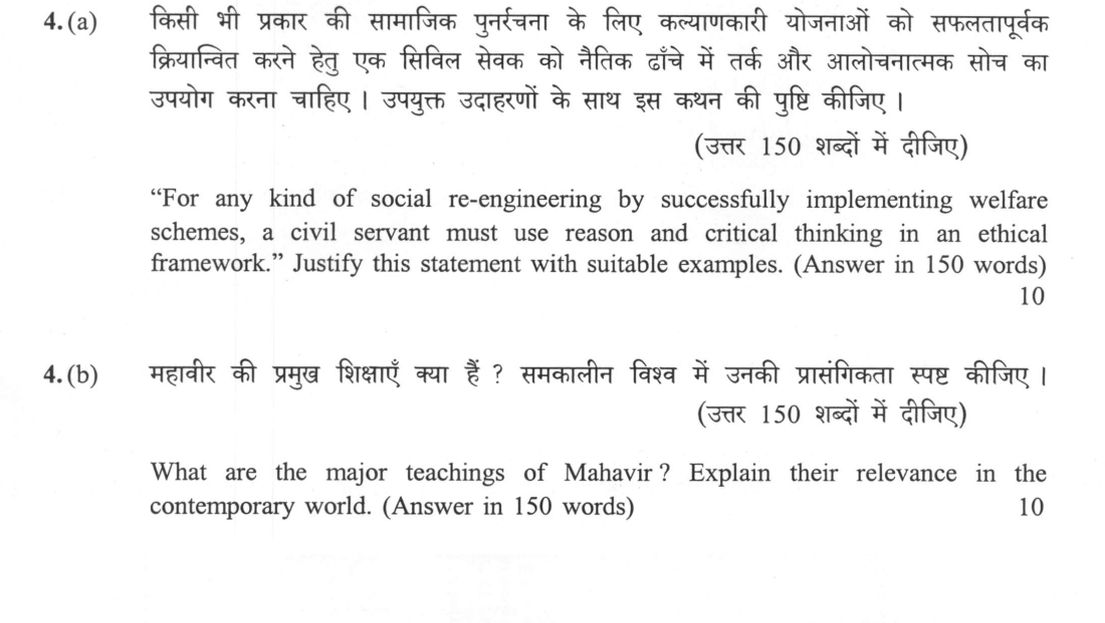
"For any kind of social re-engineering by successfully implementing welfare schemes, a civil servant must use reason and critical thinking in an ethical framework." Justify this statement with suitable examples. (Answer in 150 words) 10 marks
What are the major teachings of Mahavir? Explain their relevance in the contemporary world. (Answer in 150 words) 10 marks
हिंदी में प्रश्न पढ़ें
किसी भी प्रकार की सामाजिक पुनर्चना के लिए कल्याणकारी योजनाओं को सफलतापूर्वक क्रियान्वित करने हेतु एक सिविल सेवक को नैतिक ढांचे में तर्क और आलोचनात्मक सोच का उपयोग करना चाहिए। उपयुक्त उदाहरणों के साथ इस कथन की पुष्टि कीजिए। (उत्तर 150 शब्दों में दीजिए) 10 marks
महावीर की प्रमुख शिक्षाएं क्या हैं ? समकालीन विश्व में उनकी प्रासंगिकता स्पष्ट कीजिए। (उत्तर 150 शब्दों में दीजिए) 10 marks
Model answer
Written by UPSC Answer Check against this question's marking rubric, to the 150-word length. UPSC does not publish answers for Mains — this is one way to score well, not an official key.
(a) Ethical Rationality in Welfare Implementation
A civil servant requires critical thinking anchored in an ethical framework to translate policy intent into substantive social justice. Pure technocratic reasoning risks bureaucratic rigidity and exclusion errors, whereas ethical rationality prevents arbitrariness. In implementing schemes like MGNREGA and PM-GKAY, critical evaluation helps identify systemic leakages, while empathy ensures that technological tools (like Aadhaar-based authentication) do not deny rations to marginalized beneficiaries. Ethical reasoning thus balances procedural compliance with constitutional morality, ensuring inclusive targeting and human dignity.
(b) Teachings of Mahavira and Contemporary Relevance
Lord Mahavira’s Pancha Mahavratas offer enduring ethical solutions to modern crises:
- Ahimsa (Non-violence): Essential for ecological conservation, conflict resolution, and addressing anthropogenic climate change.
- Aparigraha (Non-possession): Serves as an antidote to unsustainable consumerism and resource depletion.
- Satya (Truthfulness) & Asteya (Non-stealing): Provide the moral bedrock for administrative integrity, transparency, anti-corruption, and accountability in public life.
- Brahmacharya (Self-restraint): Promotes moral discipline and personal integrity.
Mahavira’s philosophy remains vital for fostering sustainable development and value-based governance.
What "Justify" is asking you to do
Defend a position with reasons that carry evidence, and show why the contrary view does not hold. Where the stem runs as a question and asks you to justify your answer, the position is yours to choose and the marks lie wholly in the defence.
Structure that answers it
Position stated plainly → reason 1 with evidence → reason 2 with evidence → strongest objection, met → position restated as qualified
Where marks are lost
Reasons stated and none of them evidenced. The other standard loss is fence-sitting — an answer that finds merit on both sides and commits to neither has justified nothing.
How this answer will be evaluated
Approach
Framework: GS4 Ethical Framework: Reason, Critical Thinking, and Ethical Dilemmas. (a) justify: claim > 3-4 reasons > evidence > conclusion | (b) explain: definition/context > points in order > small example > short close Full marks: Clear, concise, and well-structured with specific examples and strong ethical reasoning.
Key points expected
- Define the ethical framework for social re-engineering
- Explain the role of reason and critical thinking
- Provide a suitable example of a welfare scheme
- Link the example to the ethical framework
- List the major teachings of Mahavir (e.g., Ahimsa, Satya)
- Explain the meaning of each teaching
- Connect the teachings to contemporary issues
- Provide a specific example of relevance
Evaluation rubric
Each sub-part is marked on its own, against the marks and word limit printed on the paper.
- (a) Justify the necessity of reason and critical thinking in an ethical framework for implementing welfare schemes. 10 marks · 150 words
justify— claim → 3-4 reasons → evidence → conclusion
Must cover
- Define the ethical framework for social re-engineering
- Explain the role of reason and critical thinking
- Provide a suitable example of a welfare scheme
- Link the example to the ethical framework
Loses marks
- Preaching instead of reasoning
- Lack of a concrete example
- Ignoring the ethical framework
Earns more
- Mention specific ethical principles (e.g., justice, equity)
- Discuss potential dilemmas in implementation
- Reference a specific civil servant's role
- Highlight the impact on public trust
Extra mark
- Cite a specific Supreme Court judgment on welfare
- Reference a specific government report or data
- (b) Explain the major teachings of Mahavir and their relevance in the contemporary world. 10 marks · 150 words
explain— definition/context → points in order → small example → short close
Must cover
- List the major teachings of Mahavir (e.g., Ahimsa, Satya)
- Explain the meaning of each teaching
- Connect the teachings to contemporary issues
- Provide a specific example of relevance
Loses marks
- Listing teachings without explaining relevance
- Vague or generic examples
- Ignoring the contemporary context
Earns more
- Discuss the concept of 'Anekantavada' (many-sidedness)
- Link teachings to environmental sustainability
- Reference modern social movements
- Highlight the role of non-violence in conflict resolution
Extra mark
- Quote a specific verse from the Tattvartha Sutra
- Reference a contemporary leader who embodies these teachings
Practice this exact question
Write your answer and it is marked point by point against the model answer above — what you covered, what you missed, what you got wrong.
Evaluate my answer →More from General Studies 2025 GS Paper IV
- Q1 (a) In the present digital age, social media has revolutionised our way of communication…
- Q2 (a) Carl von Clausewitz once said, "War is a diplomacy by other means." Critically analys…
- Q3 Given below are three quotations of great thinkers. What do each of these quotations conv…
- Q4 (a) "For any kind of social re-engineering by successfully implementing welfare schemes,…
- Q5 (a) "One who is devoted to one's duty attains highest perfection in life." Analyse this s…
- Q6 (a) It is said that for an ethical work culture, there must be code of ethics in place in…
- Q7 Vijay was Deputy Commissioner of remote district of Hilly Northern State of the country f…