GS Paper IV — Q7
Vijay was Deputy Commissioner of remote district of Hilly Northern State of the country for the last two years. In the month of…
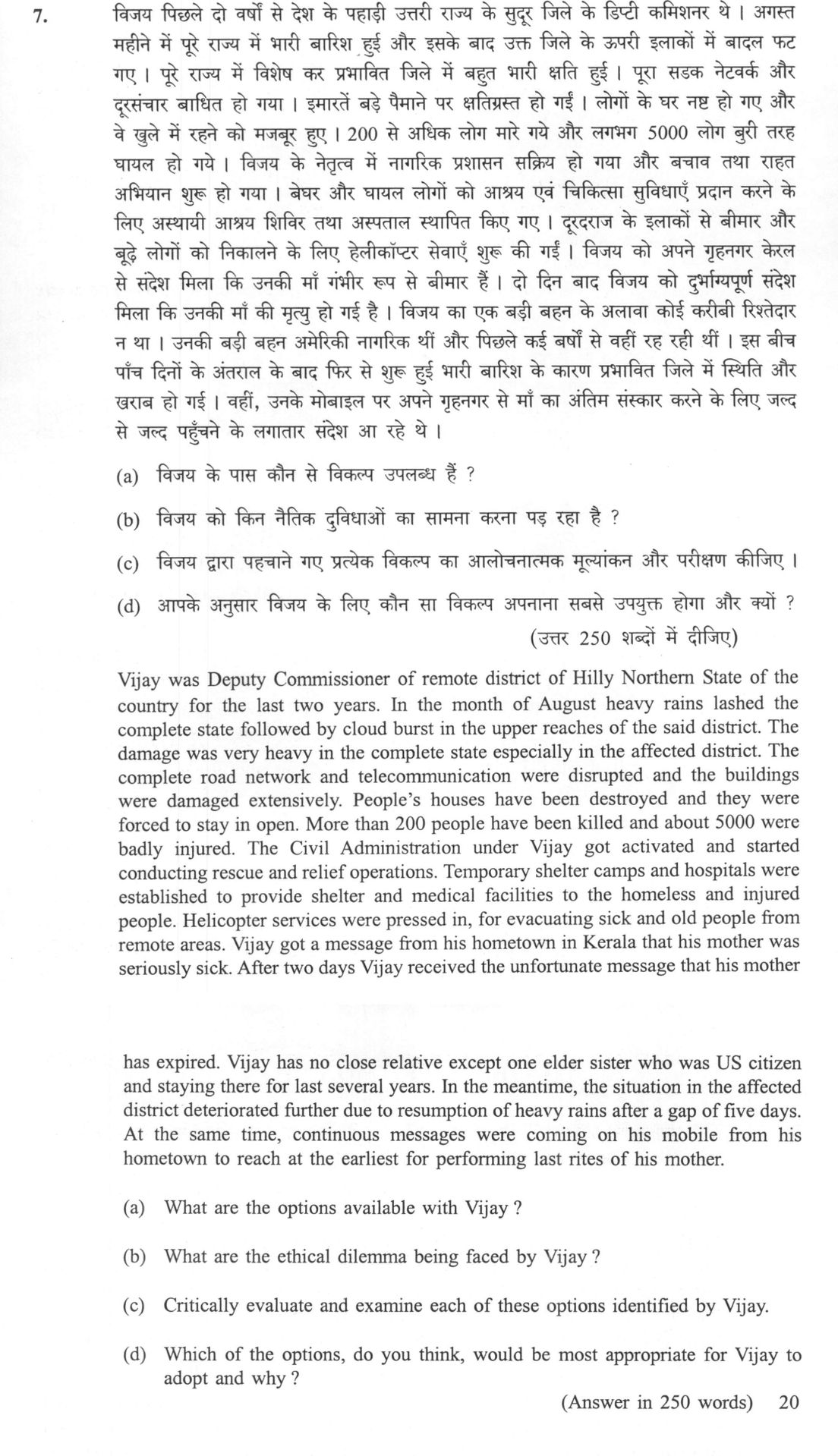
Vijay was Deputy Commissioner of remote district of Hilly Northern State of the country for the last two years. In the month of August heavy rains lashed the complete state followed by cloud burst in the upper reaches of the said district. The damage was very heavy in the complete state especially in the affected district. The complete road network and telecommunication were disrupted and the buildings were damaged extensively. People's houses have been destroyed and they were forced to stay in open. More than 200 people have been killed and about 5000 were badly injured. The Civil Administration under Vijay got activated and started conducting rescue and relief operations. Temporary shelter camps and hospitals were established to provide shelter and medical facilities to the homeless and injured people. Helicopter services were pressed in, for evacuating sick and old people from remote areas. Vijay got a message from his hometown in Kerala that his mother was seriously sick. After two days Vijay received the unfortunate message that his mother has expired. Vijay has no close relative except one elder sister who was US citizen and staying there for last several years. In the meantime, the situation in the affected district deteriorated further due to resumption of heavy rains after a gap of five days. At the same time, continuous messages were coming on his mobile from his hometown to reach at the earliest for performing last rites of his mother.
What are the options available with Vijay?
What are the ethical dilemma being faced by Vijay?
Critically evaluate and examine each of these options identified by Vijay.
Which of the options, do you think, would be most appropriate for Vijay to adopt and why?
हिंदी में प्रश्न पढ़ें
विजय पिछले दो वर्षों से देश के पहाड़ी उत्तरी राज्य के सुदूर जिले के डिप्टी कमिश्नर थे। अगस्त महीने में पूरे राज्य में भारी बारिश हुई और इसके बाद उक्त जिले के ऊपरी इलाकों में बादल फट गए। पूरे राज्य में विशेष कर प्रभावित जिले में बहुत भारी क्षति हुई। पूरा सड़क नेटवर्क और दूरसंचार बाधित हो गया। इमारतें बड़े पैमाने पर क्षतिग्रस्त हो गईं। लोगों के घर नष्ट हो गए और वे खुले में रहने को मजबूर हुए। 200 से अधिक लोग मारे गए और लगभग 5000 लोग बुरी तरह घायल हो गए। विजय के नेतृत्व में नागरिक प्रशासन सक्रिय हो गया और बचाव तथा राहत अभियान शुरू हो गया। बेघर और घायल लोगों को आश्रय एवं चिकित्सा सुविधाएं प्रदान करने के लिए अस्थायी आश्रय शिविर तथा अस्पताल स्थापित किए गए। दूरदराज के इलाकों से बीमार और बुजुर्ग लोगों को निकालने के लिए हेलीकॉप्टर सेवाएं शुरू की गईं। विजय को अपने गृहनगर केरल से संदेश मिला कि उनकी मां गंभीर रूप से बीमार हैं। दो दिन बाद विजय को दुर्भाग्यपूर्ण संदेश मिला कि उनकी मां की मृत्यु हो गई है। विजय का एक बड़ी बहन के अलावा कोई करीबी रिश्तेदार न था। उनकी बड़ी बहन अमेरिकी नागरिक थीं और पिछले कई वर्षों से वहीं रह रही थीं। इस बीच पांच दिनों के अंतराल के बाद फिर से शुरू हुई भारी बारिश के कारण प्रभावित जिले में स्थिति और खराब हो गई। वहीं, उनके मोबाइल पर अपने गृहनगर से मां का अंतिम संस्कार करने के लिए जल्द से जल्द पहुंचने के लगातार संदेश आ रहे थे।
विजय के पास कौन से विकल्प उपलब्ध हैं?
विजय को किन नैतिक दुविधाओं का सामना करना पड़ रहा है?
विजय द्वारा पहचाने गए प्रत्येक विकल्प का आलोचनात्मक मूल्यांकन और परीक्षण कीजिए।
आपके अनुसार विजय के लिए कौन सा विकल्प अपनाना सबसे उपयुक्त होगा और क्यों?
Model answer
Written by UPSC Answer Check against this question's marking rubric, to the 250-word length. UPSC does not publish answers for Mains — this is one way to score well, not an official key.
The tragic dilemma confronting Vijay places personal filial duty in direct conflict with an urgent, life-and-death administrative obligation. As the District Magistrate and Chairperson of the District Disaster Management Authority (DDMA) under the Disaster Management Act, 2005, Vijay is the single administrative pivot of rescue and relief in a hilly terrain where over 200 lives have been lost, 5,000 are injured, and renewed cloudbursts threaten complete breakdown of civil survival systems.
Options Available to Vijay
Option 1: Hand over charge immediately to the Additional District Magistrate (ADM) or next senior officer and proceed to Kerala by the fastest available route to perform his mother’s last rites in person.
Option 2: Remain at the disaster epicentre to command the DDMA rescue and relief operations, while coordinating with extended family, trusted neighbours, or local community representatives in Kerala to conduct the last rites, participating virtually via video conferencing.
Option 3: Arrange for his mother’s mortal remains to be preserved in a mortuary facility in Kerala until his elder sister arrives from the United States or until the immediate red-alert crisis subsides, allowing him to travel subsequently for the ceremonies.
Option 4: Adopt a hybrid route by attempting a compressed 24-to-36 hour transit visit using rescue aviation channels to reach Kerala for the core rites, leaving operational command temporarily with a constituted crisis management committee.
Ethical Dilemmas Faced by Vijay
Public Duty (Kartavya) versus Filial Obligation (Matru Rna): In Indian ethical thought, the debt to one’s parents (Matru Rna) is profound and sacred, requiring a son to perform antim sanskar. However, an administrative officer’s sworn Kartavya is the preservation of public life (Lok Sangraha). Sacrificing one means an irreparable compromise of the other.
Utilitarianism versus Deontological Duty: From a utilitarian perspective (Jeremy Bentham, J.S. Mill), Vijay’s presence maximizes the greatest good for the greatest number by coordinating helicopter airlifts, clearing roadblocks, and treating 5,000 injured citizens. Conversely, Kantian deontology asserts a categorical imperative towards familial duty and dignity of the deceased parent, which cannot be treated merely as a secondary concern.
Statutory Service Code versus Personal Ethics: Rule 3(1) of the All India Services (Conduct) Rules, 1968 mandates absolute devotion to duty and maintaining the highest standard of public service in crisis situations. Under Section 30 of the Disaster Management Act, 2005, the District Collector is non-substitutable in an ongoing red-alert emergency. Personal ethical integrity pulls him towards his mother's deathbed, creating cognitive and moral dissonance.
Rational Crisis Governance versus Emotional Vulnerability: Bereavement naturally impairs emotional equilibrium. Vijay must suppress intense personal grief to exercise calm, critical decision-making, where one administrative misstep could cause further loss of hundreds of lives.
Critical Evaluation of Identified Options
Evaluating Option 1: Immediate departure to Kerala Leaving the disaster zone allows Vijay to fulfill his traditional filial debt (Matru Rna) and provides emotional closure. However, evaluated against the standard of administrative continuity, this option fails critically. The district faces extreme distress with snapped communications and resumed cloudbursts; a mid-crisis vacuum at the top will demoralize ground rescue teams, slow critical helicopter evacuations, and violate the statutory mandate of the DM Act, 2005. It creates a perilous administrative precedent that personal crisis supersedes non-derogable public duty during catastrophic emergencies.
Evaluating Option 2: Leading the disaster response on-site while delegating rites with virtual participation This option upholds the highest standards of constitutional morality, professional devotion, and utilitarian welfare. The lives of 5,000 injured citizens and thousands in relief camps depend on decisive district leadership. The constraint that Vijay’s elder sister is a US citizen abroad means local arrangements must be managed by trusted proxies. While this option imposes severe emotional pain on Vijay and invites potential societal criticism regarding filial neglect, it strictly aligns with Rule 3 of the AIS Conduct Rules and honors human life as the highest ethical end.
Evaluating Option 3: Preserving remains in a mortuary until arrival of sister or stabilization of crisis This balances both duties temporally. It accords dignity to the mother by allowing both children (including the sister arriving from the US) to be physically present. However, indefinite preservation of remains carries emotional distress and cultural sensitivities regarding timely antim sanskar. Furthermore, with the resumption of heavy rains, the stabilization timeline of the district is unpredictable, potentially delaying the rites for weeks.
Evaluating Option 4: Attempting a rapid transit visit While seemingly a golden mean, this option is practically unviable and administratively irresponsible. Hilly roads are blocked, weather conditions have disrupted air and telecommunication networks, and transiting to Kerala will take at least 48 to 72 hours under disrupted logistics. Vijay risks getting stranded in transit, being neither available for his mother’s timely rites nor present to manage the escalating crisis in his district.
Most Appropriate Option and Justification
The most appropriate course of action is Option 2: Vijay must remain at his duty station to lead the disaster response, while delegating the physical execution of the last rites to trusted community members or extended relatives in Kerala, actively participating through digital media, and scheduling a physical visit once the disaster enters the rehabilitation phase.
This choice is justified on the following grounds:
Non-Derogable Public Duty: Under the Constitution of India (Article 21) and the Disaster Management Act, 2005, the state’s primary obligation is safeguarding life. As head of the district administration, Vijay’s presence is irreplaceable during active search, rescue, and medical triage. Over 200 citizens have died; his departure could directly result in further avoidable casualties.
Primacy of Constitutional Morality over Customary Practice: While performing physical last rites is a significant cultural duty, public service is an ethical trusteeship. True respect to a mother’s values lies in serving humanity. Upholding Rule 3 of the All India Services (Conduct) Rules, 1968 reinforces the ethos of self-sacrifice and integrity expected of civil servants.
Pragmatic Reality: Given that his sister is abroad and logistics are severed, Vijay cannot reach Kerala in time without abandoning his crisis post. Delegating the physical rituals with full spiritual and digital engagement resolves the practical constraints without compromising operational command.
When weighed against the standard of constitutional duty and human life, administrative leadership during an active catastrophe is non-negotiable. Vijay must sublimate his personal grief into operational resolve, saving living citizens as the highest tribute to his departed mother, and perform the post-cremation memorial rituals once the district is safely out of danger.
What "Critically evaluate" is asking you to do
Judge how well something has performed against the standard it set for itself — its stated aim, mandate or promise — and commit to a verdict. Name the yardstick before you judge; an unanchored judgement reads as opinion. “Critically” is not a section added at the end: name the yardstick you are judging by — the evidence, the stated objective, a constitutional principle, a rival explanation — and let a verdict close each part of the body. Where the question quotes a claim, that verdict must land on the claim itself, accepted, qualified or rejected, and not on the theme in general.
Structure that answers it
Name the yardstick — stated aim, mandate or benchmark → performance against it → shortfall against it → why the gap exists → verdict
Where marks are lost
Merits in one paragraph, demerits in the next, and a conclusion calling for a balanced and holistic approach. That is a survey with the judgement left out and it holds the answer in the middle band. The opposite error is reading “critically” as permission to attack — and with the odd pairings, critically describe or critically explain, the exposition still carries most of the marks, the judgement being a layer on it rather than a substitute for it.
How this answer will be evaluated
Approach
Framework: GS4 Ethical Dilemma Framework (Crux, Stakeholders, Dilemmas, Options, Course of Action). (a) enumerate: list the items in order > one line each > no commentary | (b) discuss: intro > 3-4 dimensions > example > balanced close | (c) critically evaluate: positives > negatives/limits > conditions/safeguards > conclusion | (d) justify: claim > 3-4 reasons > evidence > conclusion Full marks: Identifies all options, clearly defines the dilemma, critically evaluates trade-offs, and justifies a balanced course of action with a 3-horizon plan.
Key points expected
- Option to stay and lead relief operations
- Option to leave for mother's last rites
- Option to delegate command and leave
- Option to stay and perform rites later
- Conflict between public duty and personal duty
- Duty to the state/citizens vs duty to family
- Duty of care to victims vs filial piety
- Conflict of interest in decision making
Evaluation rubric
Each sub-part is marked on its own, against the marks and word limit printed on the paper.
- (a) List the distinct courses of action available to Vijay.
enumerate— list the items in order → one line each → no commentary
Must cover
- Option to stay and lead relief operations
- Option to leave for mother's last rites
- Option to delegate command and leave
- Option to stay and perform rites later
Loses marks
- Listing vague or non-actionable sentiments
- Missing the option to delegate authority
Earns more
- Mentioning option to send sister for rites
- Mentioning option to request transfer
Extra mark
- Citing specific administrative protocols for delegation
- (b) Identify the specific ethical conflict between duties.
discuss— intro → 3-4 dimensions → example → balanced close
Must cover
- Conflict between public duty and personal duty
- Duty to the state/citizens vs duty to family
- Duty of care to victims vs filial piety
- Conflict of interest in decision making
Loses marks
- Describing the situation instead of the dilemma
- Failing to name the competing duties
Earns more
- Mentioning emotional vs rational conflict
- Referencing 'dharma' or social contract
Extra mark
- Citing a specific ethical theory (e.g., Utilitarianism)
- (c) Assess the pros and cons of each option identified.
critically evaluate— positives → negatives/limits → conditions/safeguards → conclusion
Must cover
- Evaluation of staying (pros: duty, cons: grief)
- Evaluation of leaving (pros: filial duty, cons: negligence)
- Evaluation of delegation (pros: balance, cons: risk)
- Analysis of consequences for public trust
Loses marks
- Listing options without evaluation
- Ignoring the risk of delegation
Earns more
- Weighing immediate vs long-term impact
- Considering the 'silent stakeholder' (victims)
Extra mark
- Comparing options against a specific ethical framework
- (d) Select the best option and provide reasoned justification.
justify— claim → 3-4 reasons → evidence → conclusion
Must cover
- Clear selection of the most appropriate option
- Justification based on higher duty (public good)
- Action plan: immediate/short-term/long-term
- Mention of mitigation for personal loss
Loses marks
- Choosing to leave without justification
- Preaching values instead of reasoning
Earns more
- Suggesting specific administrative measures
- Balancing empathy with administrative rigor
Extra mark
- Citing a relevant case study or precedent
Practice this exact question
Write your answer and it is marked point by point against the model answer above — what you covered, what you missed, what you got wrong.
Evaluate my answer →More from General Studies 2025 GS Paper IV
- Q4 (a) "For any kind of social re-engineering by successfully implementing welfare schemes,…
- Q5 (a) "One who is devoted to one's duty attains highest perfection in life." Analyse this s…
- Q6 (a) It is said that for an ethical work culture, there must be code of ethics in place in…
- Q7 Vijay was Deputy Commissioner of remote district of Hilly Northern State of the country f…
- Q8 In line with the Directive Principles of State Policy enshrined in the Indian Constitutio…
- Q9 Subash is Secretary, PWD in the State Government. He is a senior officer, known for his c…
- Q10 Rajesh is a Group A officer with nine years of service. He is posted as Administrative Of…