GS Paper IV — Q11
Mahatma Gandhi National Rural Employment Guarantee Program, MGNREGA was earlier known as National Rural Employment Scheme, NREGA…
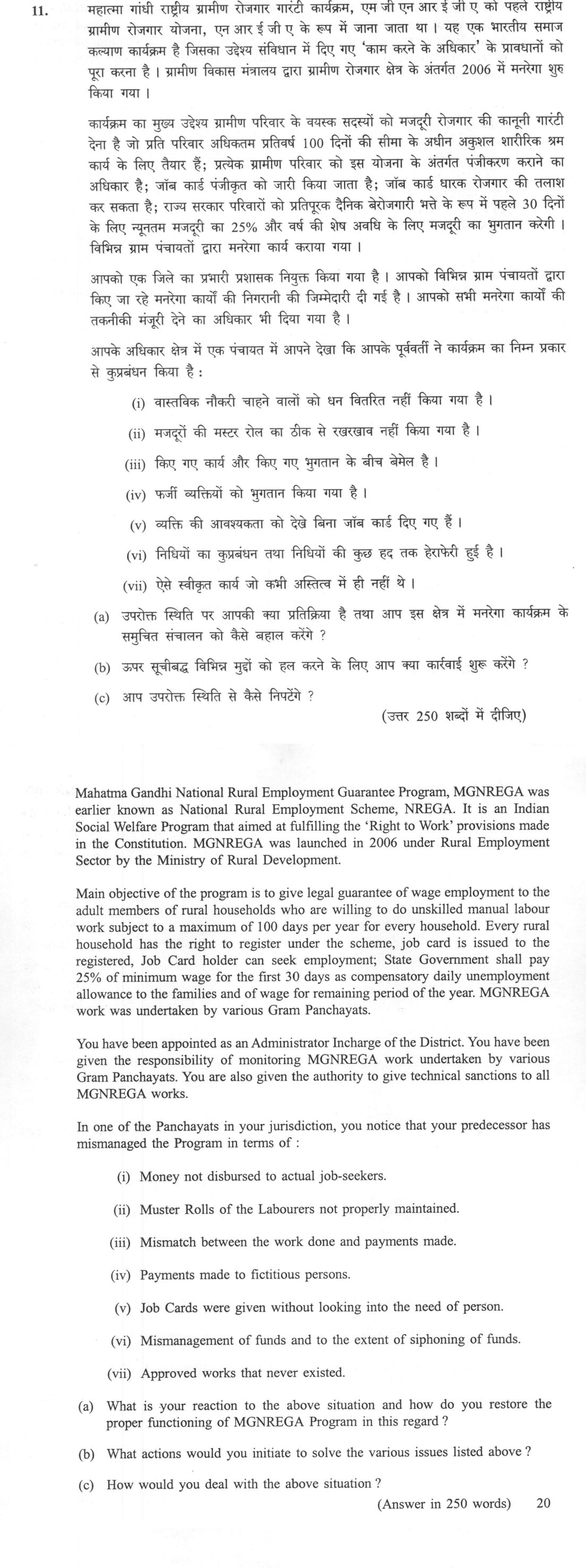
Mahatma Gandhi National Rural Employment Guarantee Program, MGNREGA was earlier known as National Rural Employment Scheme, NREGA. It is an Indian Social Welfare Program that aimed at fulfilling the 'Right to Work' provisions made in the Constitution. MGNREGA was launched in 2006 under Rural Employment Sector by the Ministry of Rural Development. Main objective of the program is to give legal guarantee of wage employment to the adult members of rural households who are willing to do unskilled manual labour work subject to a maximum of 100 days per year for every household. Every rural household has the right to register under the scheme, job card is issued to the registered, Job Card holder can seek employment; State Government shall pay 25% of minimum wage for the first 30 days as compensatory daily unemployment allowance to the families and of wage for remaining period of the year. MGNREGA work was undertaken by various Gram Panchayats. You have been appointed as an Administrator Incharge of the District. You have been given the responsibility of monitoring MGNREGA work undertaken by various Gram Panchayats. You are also given the authority to give technical sanctions to all MGNREGA works. In one of the Panchayats in your jurisdiction, you notice that your predecessor has mismanaged the Program in terms of: (i) Money not disbursed to actual job-seekers. (ii) Muster Rolls of the Labourers not properly maintained. (iii) Mismatch between the work done and payments made. (iv) Payments made to fictitious persons. (v) Job Cards were given without looking into the need of person. (vi) Mismanagement of funds and to the extent of siphoning of funds. (vii) Approved works that never existed. (a) What is your reaction to the above situation and how do you restore the proper functioning of MGNREGA Program in this regard? (b) What actions would you initiate to solve the various issues listed above? (c) How would you deal with the above situation? (Answer in 250 words)
हिंदी में प्रश्न पढ़ें
महात्मा गांधी राष्ट्रीय ग्रामीण रोजगार गारंटी कार्यक्रम, एम जी एन आर ई जी ए को पहले राष्ट्रीय ग्रामीण रोजगार योजना, एन आर ई जी ए के रूप में जाना जाता था। यह एक भारतीय समाज कल्याण कार्यक्रम है जिसका उद्देश्य संविधान में दिए गए 'काम करने के अधिकार' के प्रावधानों को पूरा करना है। ग्रामीण विकास मंत्रालय द्वारा ग्रामीण रोजगार क्षेत्र के अंतर्गत 2006 में मनरेगा शुरू किया गया। कार्यक्रम का मुख्य उद्देश्य ग्रामीण परिवार के वयस्क सदस्यों को मजदूरी रोजगार की कानूनी गारंटी देना है जो प्रति परिवार अधिकतम प्रतिवर्ष 100 दिनों की सीमा के अधीन अकुशल शारीरिक श्रम कार्य के लिए तैयार हैं; प्रत्येक ग्रामीण परिवार को इस योजना के अंतर्गत पंजीकरण कराने का अधिकार है; जॉब कार्ड पंजीकृत को जारी किया जाता है; जॉब कार्ड धारक रोजगार की तलाश कर सकता है; राज्य सरकार परिवारों को प्रतिपूरक दैनिक बेरोजगारी भत्ते के रूप में पहले 30 दिनों के लिए न्यूनतम मजदूरी का 25% और वर्ष की शेष अवधि के लिए मजदूरी का भुगतान करेगी। विभिन्न ग्राम पंचायतों द्वारा मनरेगा कार्य कराया गया। आपको एक जिले का प्रभारी प्रशासक नियुक्त किया गया है। आपको विभिन्न ग्राम पंचायतों द्वारा किए जा रहे मनरेगा कार्यों की निगरानी की जिम्मेदारी दी गई है। आपको सभी मनरेगा कार्यों की तकनीकी मंजूरी देने का अधिकार भी दिया गया है। आपके अधिकार क्षेत्र में एक पंचायत में आपने देखा कि आपके पूर्ववर्ती ने कार्यक्रम का निम्न प्रकार से कुप्रबंधन किया है: (i) वास्तविक नौकरी चाहने वालों को धन वितरित नहीं किया गया है। (ii) मजदूरों की मास्टर रोल का ठीक से रखरखाव नहीं किया गया है। (iii) किए गए कार्य और किए गए भुगतान के बीच बेमेल है। (iv) फर्जी व्यक्तियों को भुगतान किया गया है। (v) व्यक्ति की आवश्यकता को देखे बिना जॉब कार्ड दिए गए हैं। (vi) निधियों का कुप्रबंधन तथा निधियों की कुछ हद तक हेराफेरी हुई है। (vii) ऐसे स्वीकृत कार्य जो कभी अस्तित्व में ही नहीं थे। (a) उपरोक्त स्थिति पर आपकी क्या प्रतिक्रिया है तथा आप इस क्षेत्र में मनरेगा कार्यक्रम के समुचित संचालन को कैसे बहाल करेंगे? (b) उपर सूचीबद्ध विभिन्न मुद्दों को हल करने के लिए आप क्या कार्रवाई शुरू करेंगे? (c) आप उपरोक्त स्थिति से कैसे निपटेंगे? (उत्तर 250 शब्दों में दीजिए)
Model answer
Written by UPSC Answer Check against this question's marking rubric, to the 250-word length. UPSC does not publish answers for Mains — this is one way to score well, not an official key.
Reaction. I would stay calm, fact-driven and non-vendettous, treating predecessor’s mismanagement as a breach of Article 41 and MGNREGA’s legal guarantee. I would immediately freeze further payments/sanctions, preserve records, constitute a district committee with revenue, audit, bank and panchayat representatives, and set up a vigilance cell to prevent tampering.
Restoration. For (i)–(vii), I would order a forensic audit of muster rolls, job cards, bank ledgers and DBT records; revalidate job cards against household need; verify each worker through Aadhaar seeding, biometric attendance and bank-account matching; use GIS/geo-tagging, photographs and Gram Sabha verification to check whether works existed; and reconcile physical work with payments. I would ensure wages and unemployment allowance are paid directly to beneficiaries’ bank accounts, with regular work allocation and timely wage payment. I would restore transparency through social audits, RTI disclosure, grievance redressal and real-time NREGASoft/NMMS integration. For (b), I would initiate disciplinary action under CCS (CCA) Rules, FIR under the Prevention of Corruption Act, 1988 and IPC 420, blacklisting of contractors, recovery proceedings under applicable financial rules, and penalty under Section 27 for false statements. For (c), I would maintain personal integrity through non-negotiables—no cash handling, no private meetings, no sanction without verification—consult Gram Sabha and SHGs, and balance urgency with due process.
Safeguards. I would ensure 100% geo-tagging, DBT with Aadhaar, community monitoring through SHGs, capacity building of Panchayat secretaries, and monthly district-level review. This “trust but verify” approach will restore systemic resilience, protect the poorest, and align MGNREGA with SDG 1 (No Poverty) and Antyodaya.
What "How" is asking you to do
Set out the route by which the outcome comes about, step by step. Many how stems ask how one thing affects another, and there the channel of transmission is precisely what is being marked.
Structure that answers it
Starting condition → step → step → outcome reached → the conditions the route depends on
Where marks are lost
Answering why it happens instead of how, the commonest single misread in the paper. An answer full of causes and significance that never traces the mechanism has answered a different question.
How this answer will be evaluated
Approach
Framework: GS4 Ethical Dilemma & Administrative Action Framework. (a) comment: context > arguments both sides > judgment > close | (b) suggest: the problem in one line > implementable measures > who acts > conclusion | (c) comment: context > arguments both sides > judgment > close Full marks: Identifies the ethical/administrative dilemma, proposes specific legal/technical actions (biometric, audit), and balances worker welfare with fraud control.
Key points expected
- Acknowledge gravity of fraud and public trust breach
- State commitment to rule of law and accountability
- Mention immediate suspension of current irregularities
- Reference to MGNREGA Act 2005 or 100-day guarantee
- Action to verify actual job-seekers (biometric/ID)
- Action to audit Muster Rolls and work done
- Action to recover siphoned funds
- Action to verify existence of approved works
Evaluation rubric
Each sub-part is marked on its own, against the marks and word limit printed on the paper.
- (a) Express reaction to the mismanagement and outline the approach to restore proper functioning.
comment— context → arguments both sides → judgment → close
Must cover
- Acknowledge gravity of fraud and public trust breach
- State commitment to rule of law and accountability
- Mention immediate suspension of current irregularities
- Reference to MGNREGA Act 2005 or 100-day guarantee
Loses marks
- Preaching values without administrative context
- Ignoring the 'predecessor' aspect (political sensitivity)
- Vague reaction without specific administrative stance
Earns more
- Mentioning 'Right to Work' constitutional provision
- Balancing empathy for workers with strictness on fraud
- Referring to 'technical sanctions' authority
Extra mark
- Citing specific MGNREGA Act sections on penalties
- Mentioning CAG or CVC involvement
- (b) List specific actions to solve the seven listed issues (i-vii).
suggest— the problem in one line → implementable measures → who acts → conclusion
Must cover
- Action to verify actual job-seekers (biometric/ID)
- Action to audit Muster Rolls and work done
- Action to recover siphoned funds
- Action to verify existence of approved works
Loses marks
- Generic actions not linked to specific issues (i-vii)
- Ignoring the 'fictitious persons' issue
- Suggesting actions outside administrative authority
Earns more
- Using technology (Geo-tagging, GPS) for verification
- Involving Gram Sabha for transparency
- Freezing accounts of fictitious persons
Extra mark
- Mentioning 'MGNREGA MIS' (Management Information System)
- Referring to 'Social Audit' mechanism
- (c) Explain the overall strategy to deal with the situation (immediate, short, long term).
comment— context → arguments both sides → judgment → close
Must cover
- Immediate: Stop loss and secure evidence
- Short-term: Corrective audit and re-verification
- Long-term: Institutional checks and training
- Balancing political pressure with legal duty
Loses marks
- Repeating points from part (b) without strategic depth
- Ignoring the 'silent stakeholders' (genuine workers)
- Preaching instead of reasoning about the dilemma
Earns more
- Mentioning 'whistleblower' protection if applicable
- Ensuring continuity of work for genuine workers
- Referring to 'District Collector' or 'Administrator' role
Extra mark
- Citing a specific CAG report on MGNREGA
- Mentioning 'Right to Information' for transparency
Practice this exact question
Write your answer and it is marked point by point against the model answer above — what you covered, what you missed, what you got wrong.
Evaluate my answer →More from General Studies 2025 GS Paper IV
- Q8 In line with the Directive Principles of State Policy enshrined in the Indian Constitutio…
- Q9 Subash is Secretary, PWD in the State Government. He is a senior officer, known for his c…
- Q10 Rajesh is a Group A officer with nine years of service. He is posted as Administrative Of…
- Q11 Mahatma Gandhi National Rural Employment Guarantee Program, MGNREGA was earlier known as…
- Q12 Ashok is Divisional Commissioner of one of the border districts of the North East State.…