GS Paper IV — Q6
(a) It is said that for an ethical work culture, there must be code of ethics in place in every organisation. To ensure…
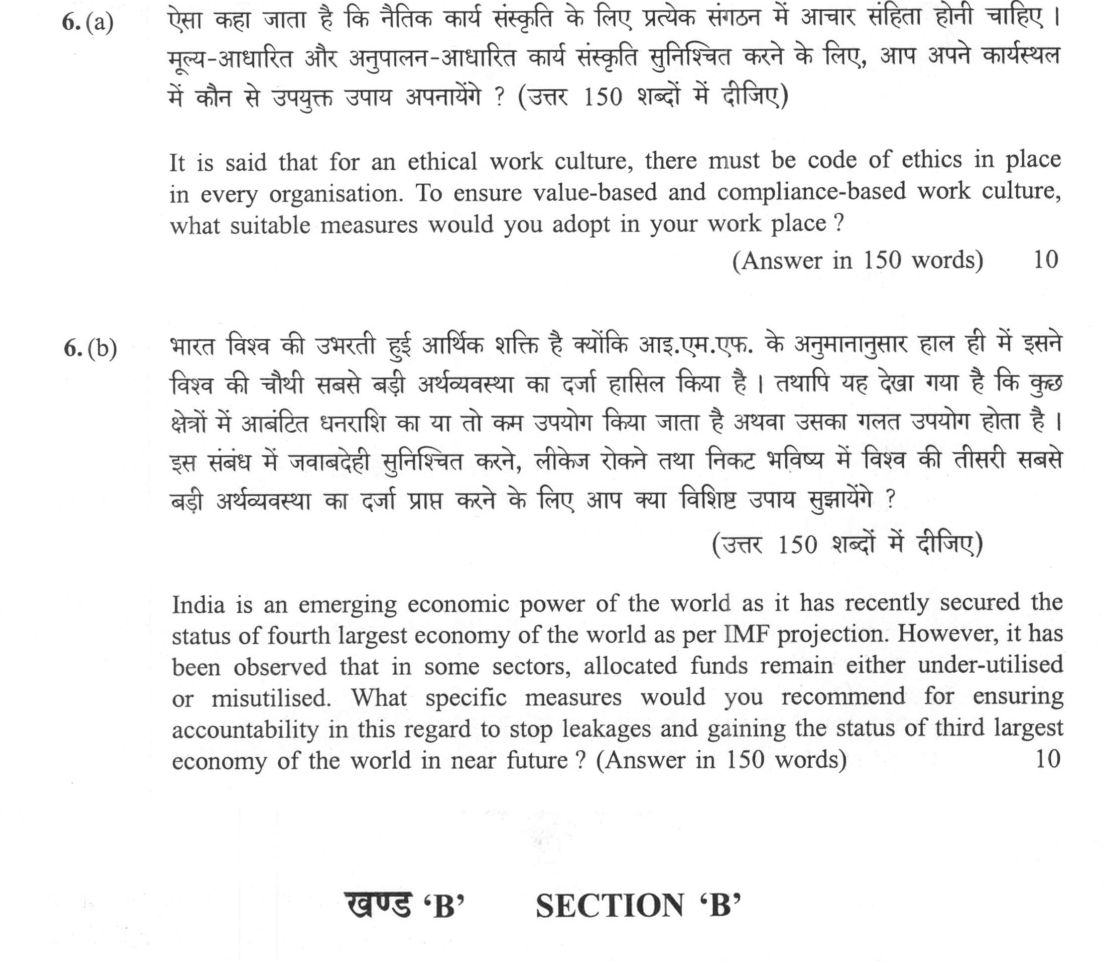
It is said that for an ethical work culture, there must be code of ethics in place in every organisation. To ensure value-based and compliance-based work culture, what suitable measures would you adopt in your work place ? (Answer in 150 words) 10 marks
India is an emerging economic power of the world as it has recently secured the status of fourth largest economy of the world as per IMF projection. However, it has been observed that in some sectors, allocated funds remain either under-utilised or misutilised. What specific measures would you recommend for ensuring accountability in this regard to stop leakages and gaining the status of third largest economy of the world in near future ? (Answer in 150 words) 10 marks
हिंदी में प्रश्न पढ़ें
ऐसा कहा जाता है कि नैतिक कार्य संस्कृति के लिए प्रत्येक संगठन में आचार संहिता होनी चाहिए। मूल्य-आधारित और अनुपालन-आधारित कार्य संस्कृति सुनिश्चित करने के लिए, आप अपने कार्यस्थल में कौन से उपयुक्त उपाय अपनायेंगे ? (उत्तर 150 शब्दों में दीजिए)
भारत विश्व की उभरती हुई आर्थिक शक्ति है क्योंकि आई.एम.एफ. के अनुमानानुसार हाल ही में इसने विश्व की चौथी सबसे बड़ी अर्थव्यवस्था का दर्जा हासिल किया है। तथापि यह देखा गया है कि कुछ क्षेत्रों में आवंटित धनराशि का या तो कम उपयोग किया जाता है अथवा उसका गलत उपयोग होता है। इस संबंध में जवाबदेही सुनिश्चित करने, लीकेज रोकने तथा निकट भविष्य में विश्व की तीसरी सबसे बड़ी अर्थव्यवस्था का दर्जा प्राप्त करने के लिए आप क्या विशिष्ट उपाय सुझाएंगे ? (उत्तर 150 शब्दों में दीजिए)
Model answer
Written by UPSC Answer Check against this question's marking rubric, to the 150-word length. UPSC does not publish answers for Mains — this is one way to score well, not an official key.
Measures for Ethical Work Culture
To integrate compliance-based adherence with value-based internalisation, I would implement:
- Institutional Norms and Training: Codify a clear Code of Ethics alongside mandatory, periodic scenario-based ethics training to internalise core public service values beyond mere rule-compliance.
- Protection and Incentives: Establish a secure, confidential whistleblower protection mechanism and an objective reward-and-punishment framework that links ethical conduct to performance appraisals.
- Ethical Leadership: Practice 'tone at the top' through transparent decision-making, setting personal integrity benchmarks to foster institutional trust.
Measures for Fiscal Accountability and Growth
To eliminate fund leakages and under-utilisation, propelling India toward becoming the third-largest economy:
- Digital and Budgetary Mechanisms: Universalise the Public Financial Management System (PFMS) and DBT, mandate real-time expenditure tracking, enforce geo-tagging of capital assets, and transition strictly to outcome-based budgeting.
- Institutional and Public Oversight: Mandate concurrent CAG performance audits, institutionalise community social audits on the MGNREGA model, and enforce third-party impact assessments under Parliamentary Standing Committee review.
Maximising capital expenditure efficiency and plugging leakages enhances the Ease of Doing Business, ensuring high fiscal multiplier effects to achieve the $5-trillion economic milestone.
What "Suggest" is asking you to do
Propose measures that attach to the causes the question has just had you identify. Each should name who acts, on what, and why it would work; a measure with no actor behind it is a wish rather than a suggestion.
Structure that answers it
The problem in one line → measure 1 with the cause it addresses → measure 2 → measure 3 → how it would be implemented and what it requires
Where marks are lost
Prescriptions that would fit any question on any subject — awareness campaigns, capacity building, better coordination. The examiner checks whether each measure is traceable to a cause the answer itself named.
How this answer will be evaluated
Approach
Framework: GS4 Ethical Governance & Administrative Accountability. (a) suggest: the problem in one line > implementable measures > who acts > conclusion | (b) suggest: the problem in one line > implementable measures > who acts > conclusion Full marks: Precise, actionable measures with clear administrative logic and specific examples.
Key points expected
- Define the specific code of ethics framework
- Measures for value-based culture (e.g., training, role models)
- Measures for compliance-based culture (e.g., audits, reporting)
- Actionable steps for the workplace context
- Measures to address under-utilisation of funds
- Measures to address misutilisation of funds
- Specific accountability mechanisms (e.g., audits, digital tracking)
- Link to the goal of becoming the 3rd largest economy
Evaluation rubric
Each sub-part is marked on its own, against the marks and word limit printed on the paper.
- (a) Implementable measures to ensure value-based and compliance-based work culture. 10 marks · 150 words
suggest— the problem in one line → implementable measures → who acts → conclusion
Must cover
- Define the specific code of ethics framework
- Measures for value-based culture (e.g., training, role models)
- Measures for compliance-based culture (e.g., audits, reporting)
- Actionable steps for the workplace context
Loses marks
- Preaching generic values without administrative application
- Ignoring the 'compliance' aspect of the question
- Vague suggestions without implementation details
Earns more
- Mention of specific compliance mechanisms (e.g., whistle-blower policy)
- Linkage between values and daily administrative decisions
- Reference to institutional trust building
Extra mark
- Citing a specific corporate or government ethics code
- Reference to a specific judicial or administrative case
- (b) Specific measures to ensure accountability and stop fund leakages. 10 marks · 150 words
suggest— the problem in one line → implementable measures → who acts → conclusion
Must cover
- Measures to address under-utilisation of funds
- Measures to address misutilisation of funds
- Specific accountability mechanisms (e.g., audits, digital tracking)
- Link to the goal of becoming the 3rd largest economy
Loses marks
- General talk about corruption without specific measures
- Ignoring the 'under-utilisation' aspect of the prompt
- Failing to link measures to the economic growth goal
Earns more
- Mention of specific audit bodies (e.g., CAG, CVC)
- Reference to digital governance tools for transparency
- Discussion of the 'leakage' in specific sectors
Extra mark
- Citing a specific IMF projection or economic data
- Reference to a specific anti-corruption statute or scheme
Practice this exact question
Write your answer and it is marked point by point against the model answer above — what you covered, what you missed, what you got wrong.
Evaluate my answer →More from General Studies 2025 GS Paper IV
- Q3 Given below are three quotations of great thinkers. What do each of these quotations conv…
- Q4 (a) "For any kind of social re-engineering by successfully implementing welfare schemes,…
- Q5 (a) "One who is devoted to one's duty attains highest perfection in life." Analyse this s…
- Q6 (a) It is said that for an ethical work culture, there must be code of ethics in place in…
- Q7 Vijay was Deputy Commissioner of remote district of Hilly Northern State of the country f…
- Q8 In line with the Directive Principles of State Policy enshrined in the Indian Constitutio…
- Q9 Subash is Secretary, PWD in the State Government. He is a senior officer, known for his c…