GS Paper IV — Q3
Given below are three quotations of great thinkers. What do each of these quotations convey to you in the present context? (a)…
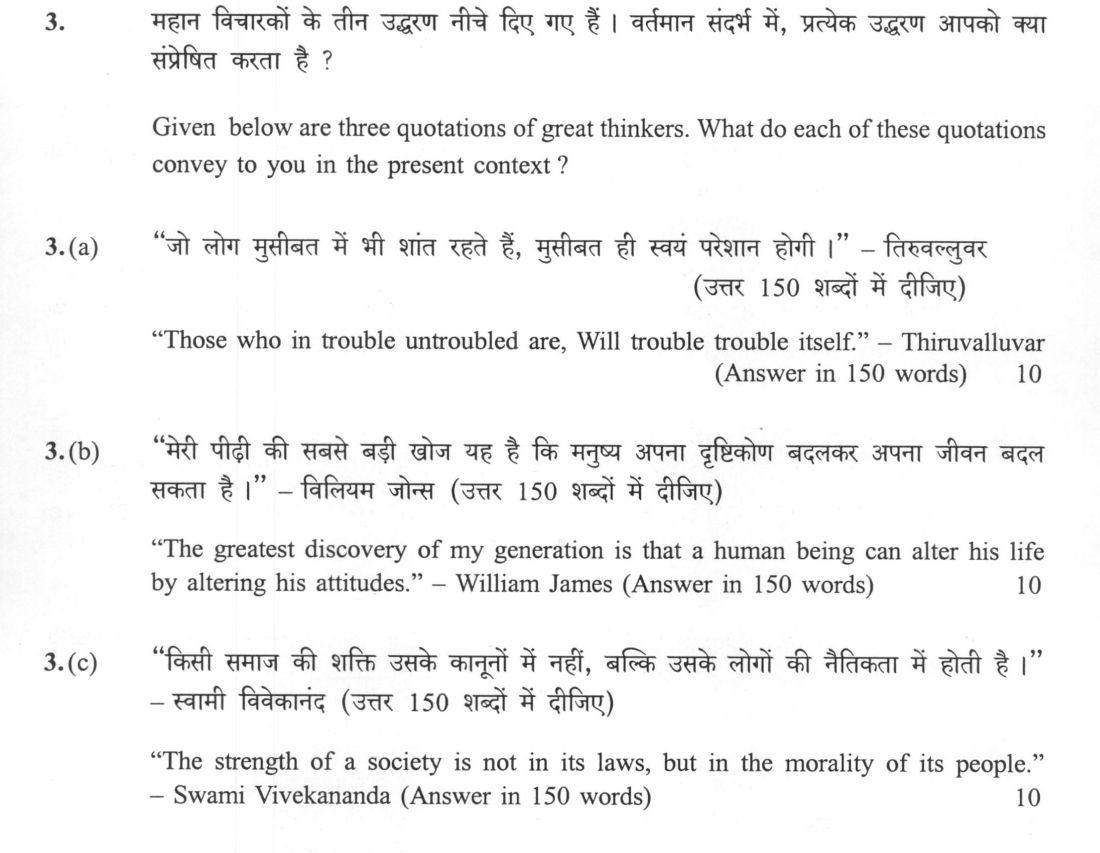
Given below are three quotations of great thinkers. What do each of these quotations convey to you in the present context?
"Those who in trouble untroubled are, Will trouble trouble itself." – Thiruvalluvar (Answer in 150 words) 10 marks
"The greatest discovery of my generation is that a human being can alter his life by altering his attitudes." – William James (Answer in 150 words) 10 marks
"The strength of a society is not in its laws, but in the morality of its people." – Swami Vivekananda (Answer in 150 words) 10 marks
हिंदी में प्रश्न पढ़ें
महान विचारकों के तीन उद्धरण नीचे दिए गए हैं। वर्तमान संदर्भ में, प्रत्येक उद्धरण आपको क्या संप्रेषित करता है ?
"जो लोग मुसीबत में भी शांत रहते हैं, मुसीबत ही स्वयं परेशान होगी।" – तिरुवल्लुवर (उत्तर 150 शब्दों में दीजिए) 10 marks
"मेरी पीढ़ी की सबसे बड़ी खोज यह है कि मनुष्य अपना दृष्टिकोण बदलकर अपना जीवन बदल सकता है।" – विलियम जेम्स (उत्तर 150 शब्दों में दीजिए) 10 marks
"किसी समाज की शक्ति उसके कानूनों में नहीं, बल्कि उसके लोगों की नैतिकता में होती है।" – स्वामी विवेकानंद (उत्तर 150 शब्दों में दीजिए) 10 marks
Model answer
Written by UPSC Answer Check against this question's marking rubric, to the 150-word length. UPSC does not publish answers for Mains — this is one way to score well, not an official key.
Thiruvalluvar on Resilient Equanimity
Thiruvalluvar underscores the power of stoic equanimity and emotional resilience in the face of adversity. When an individual maintains an untroubled mind during distress, panic is arrested, preventing the crisis from clouding rational judgment. Emotional stability preserves cognitive clarity, which allows one to deconstruct complex problems and systematically dismantle their root causes, thereby disarming and exhausting the crisis itself. In contemporary public administration and disaster management, such as the frontline response during the COVID-19 pandemic or supercyclone evacuations, an administrator’s inner calm prevents administrative paralysis and collective hysteria. Equanimity converts acute vulnerability into strategic control, ensuring effective decision-making under severe pressure.
William James on Psychological Agency
William James highlights the human capacity for cognitive reframing and an internal locus of control. External circumstances do not deterministically dictate human destiny; rather, the subjective attitude through which one interprets reality governs behavioral outcomes. By deliberately shifting from a fatalistic, reactive posture to a proactive growth mindset, an individual alters their actions and transforms their life trajectory. In the present context of civil service reforms like Mission Karmayogi, transitioning from a rigid, rule-bound mindset to an empathetic, role-based attitude directly enhances governance outcomes. Similarly, addressing modern mental health challenges and administrative burnout requires this psychological agency, empowering individuals to view structural constraints as opportunities for ethical innovation and service delivery.
Swami Vivekananda on Moral Foundations
Swami Vivekananda posits that the enduring strength of a society lies in the internalized ethical consciousness of its citizens rather than external legal formalism. Laws merely provide a coercive, negative deterrent against egregious misconduct, but they cannot enforce positive virtues such as empathy, civic duty, and integrity. Over-legislation without moral internalization leads to procedural compliance, litigiousness, and corruption, as seen in the evasion of tax laws or traffic regulations. Conversely, when moral values are cultivated through family, education, and social norms, self-regulation replaces surveillance. For issues ranging from digital ethics to women's safety, legal statutes like the Bharatiya Nyaya Sanhita remain hollow without a corresponding moral awakening in the public consciousness.
Ethical Synthesis
These three perspectives form a continuous causal chain from the personal to the collective realm. Thiruvalluvar’s emotional self-mastery combined with James’s cognitive reframing creates resilient, self-directed individuals. When individual character is reformed at scale, it generates the collective moral fabric that Vivekananda identified as the true foundation of national progress. Sustainable societal reform, therefore, cannot be achieved through legislative mandates alone, but must proceed outward from the cultivation of internal ethical discipline and moral agency.
What "Explain" is asking you to do
Make the working of something clear — what sets it off, what follows from what, and what it produces. Explain is the Commission's mechanism word: it dominates the technical papers and the “explain why” stems, where the marks sit in the causal chain and not in the label.
Structure that answers it
State what it is → the initiating condition → the chain of cause, step by step → an instance where it plays out → what the chain produces
Where marks are lost
Describing what something looks like instead of why it works that way. Naming the stages without linking them reads as description too.
How this answer will be evaluated
Approach
Framework: GS4 Ethical Reasoning & Situational Analysis. (a) comment: context > arguments both sides > judgment > close | (b) comment: context > arguments both sides > judgment > close | (c) comment: context > arguments both sides > judgment > close Full marks: Clear interpretation, strong administrative/social application, specific examples, balanced conclusion.
Key points expected
- Define 'untroubled' as composure, not indifference
- Link to administrative decision-making under pressure
- Provide a specific crisis management example
- Conclude on the value of emotional intelligence
- Define 'attitude' as a cognitive framework
- Link to 'service mindset' or 'public interest'
- Provide an example of attitude shift in career
- Conclude on the power of internal change
Evaluation rubric
Each sub-part is marked on its own, against the marks and word limit printed on the paper.
- (a) Interpret Thiruvalluvar's quote on equanimity in crisis and its relevance to public service. 10 marks · 150 words
comment— context → arguments both sides → judgment → close
Must cover
- Define 'untroubled' as composure, not indifference
- Link to administrative decision-making under pressure
- Provide a specific crisis management example
- Conclude on the value of emotional intelligence
Loses marks
- Treating the quote as mere stoicism
- Ignoring the 'present context' of the prompt
- Preaching without administrative application
Earns more
- Mention 'stakeholder calm' or 'public trust'
- Reference a specific disaster or emergency
- Contrast with panic-driven decision making
Extra mark
- Cite a specific leader known for composure
- Reference a specific administrative protocol
- (b) Explain William James' quote on attitude change and its role in personal/professional growth. 10 marks · 150 words
comment— context → arguments both sides → judgment → close
Must cover
- Define 'attitude' as a cognitive framework
- Link to 'service mindset' or 'public interest'
- Provide an example of attitude shift in career
- Conclude on the power of internal change
Loses marks
- Treating attitude as mere 'positive thinking'
- Ignoring the 'greatest discovery' aspect
- Preaching without professional application
Earns more
- Mention 'growth mindset' or 'resilience'
- Reference a specific reform or policy shift
- Contrast with external circumstance blaming
Extra mark
- Cite a specific reformer or administrator
- Reference a specific psychological concept
- (c) Analyze Vivekananda's quote on morality vs. laws as the strength of society. 10 marks · 150 words
comment— context → arguments both sides → judgment → close
Must cover
- Define 'morality' as internalized ethical code
- Contrast with 'laws' as external enforcement
- Provide an example of moral vs. legal conflict
- Conclude on the role of ethical leadership
Loses marks
- Treating morality as subjective or relative
- Ignoring the 'strength of society' aspect
- Preaching without social application
Earns more
- Mention 'social contract' or 'civic duty'
- Reference a specific social issue or reform
- Contrast with 'law and order' focus
Extra mark
- Cite a specific moral leader or reformer
- Reference a specific ethical framework
Practice this exact question
Write your answer and it is marked point by point against the model answer above — what you covered, what you missed, what you got wrong.
Evaluate my answer →More from General Studies 2025 GS Paper IV
- Q1 (a) In the present digital age, social media has revolutionised our way of communication…
- Q2 (a) Carl von Clausewitz once said, "War is a diplomacy by other means." Critically analys…
- Q3 Given below are three quotations of great thinkers. What do each of these quotations conv…
- Q4 (a) "For any kind of social re-engineering by successfully implementing welfare schemes,…
- Q5 (a) "One who is devoted to one's duty attains highest perfection in life." Analyse this s…
- Q6 (a) It is said that for an ethical work culture, there must be code of ethics in place in…