GS Paper IV — Q10
Rajesh is a Group A officer with nine years of service. He is posted as Administrative Officer in an Oil Public Sector…
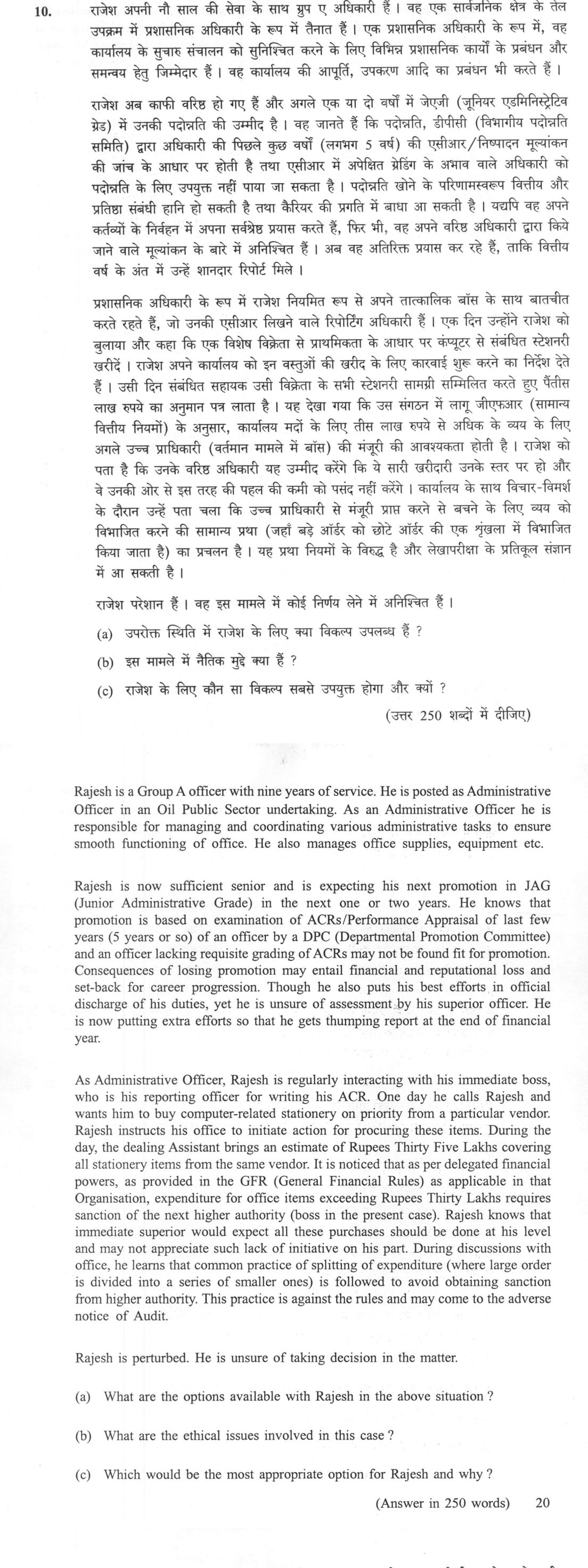
Rajesh is a Group A officer with nine years of service. He is posted as Administrative Officer in an Oil Public Sector undertaking. As an Administrative Officer he is responsible for managing and coordinating various administrative tasks to ensure smooth functioning of office. He also manages office supplies, equipment etc.
Rajesh is now sufficient senior and is expecting his next promotion in JAG (Junior Administrative Grade) in the next one or two years. He knows that promotion is based on examination of ACRs/Performance Appraisal of last few years (5 years or so) of an officer by a DPC (Departmental Promotion Committee) and an officer lacking requisite grading of ACRs may not be found fit for promotion. Consequences of losing promotion may entail financial and reputational loss and set-back for career progression. Though he also puts his best efforts in official discharge of his duties, yet he is unsure of assessment by his superior officer. He is now putting extra efforts so that he gets thumping report at the end of financial year.
As Administrative Officer, Rajesh is regularly interacting with his immediate boss, who is his reporting officer for writing his ACR. One day he calls Rajesh and wants him to buy computer-related stationery on priority from a particular vendor. Rajesh instructs his office to initiate action for procuring these items. During the day, the dealing Assistant brings an estimate of Rupees Thirty Five Lakhs covering all stationery items from the same vendor. It is noticed that as per delegated financial powers, as provided in the GFR (General Financial Rules) as applicable in that Organisation, expenditure for office items exceeding Rupees Thirty Lakhs requires sanction of the next higher authority (boss in the present case). Rajesh knows that immediate superior would expect all these purchases should be done at his level and may not appreciate such lack of initiative on his part. During discussions with office, he learns that common practice of splitting of expenditure (where large order is divided into a series of smaller ones) is followed to avoid obtaining sanction from higher authority. This practice is against the rules and may come to the adverse notice of Audit.
Rajesh is perturbed. He is unsure of taking decision in the matter.
What are the options available with Rajesh in the above situation?
What are the ethical issues involved in this case?
Which would be the most appropriate option for Rajesh and why?
हिंदी में प्रश्न पढ़ें
राजेश अपनी नौ साल की सेवा के साथ ग्रुप ए अधिकारी हैं। वह एक सार्वजनिक क्षेत्र के तेल उपक्रम में प्रशासनिक अधिकारी के रूप में तैनात हैं। एक प्रशासनिक अधिकारी के रूप में, वह कार्यालय के सुचारु संचालन को सुनिश्चित करने के लिए विभिन्न प्रशासनिक कार्यों के प्रबंधन और समन्वय हेतु जिम्मेदार हैं। वह कार्यालय की आपूर्ति, उपकरण आदि का प्रबंधन भी करते हैं।
राजेश अब काफी वरिष्ठ हो गए हैं और अगले एक या दो वर्षों में जेएजी (जूनियर एडमिनिस्ट्रेटिव ग्रेड) में उनकी पदोन्नति की उम्मीद है। वह जानते हैं कि पदोन्नति, डीपीसी (विभागीय पदोन्नति समिति) द्वारा अधिकारी की पिछले कुछ वर्षों (लगभग 5 वर्ष) की एसीआर/निष्पादन मूल्यांकन की जांच के आधार पर होती है तथा एसीआर में अपेक्षित ग्रेडिंग के अभाव वाले अधिकारी को पदोन्नति के लिए उपयुक्त नहीं पाया जा सकता है। पदोन्नति खोने के परिणामस्वरूप वित्तीय और प्रतिष्ठा संबंधी हानि हो सकती है तथा कैरियर की प्रगति में बाधा आ सकती है। यद्यपि वह अपने कर्तव्यों के निर्वहन में अपना सर्वश्रेष्ठ प्रयास करते हैं, फिर भी, वह अपने वरिष्ठ अधिकारी द्वारा किये जाने वाले मूल्यांकन के बारे में अनिश्चित हैं। अब वह अतिरिक्त प्रयास कर रहे हैं, ताकि वित्तीय वर्ष के अंत में उन्हें शानदार रिपोर्ट मिले।
प्रशासनिक अधिकारी के रूप में राजेश नियमित रूप से अपने तात्कालिक बॉस के साथ बातचीत करते रहते हैं, जो उनकी एसीआर लिखने वाले रिपोर्टिंग अधिकारी हैं। एक दिन उन्होंने राजेश को बुलाया और कहा कि एक विशेष विक्रेता से प्राथमिकता के आधार पर कंप्यूटर से संबंधित स्टेशनरी खरीदें। राजेश अपने कार्यालय को इन वस्तुओं की खरीद के लिए कार्रवाई शुरू करने का निर्देश देते हैं। उसी दिन संबंधित सहायक उसी विक्रेता के सभी स्टेशनरी सामग्री सम्मिलित करते हुए पैंतीस लाख रुपये का अनुमान पत्र लाता है। यह देखा गया कि उस संगठन में लागू जीएफआर (सामान्य वित्तीय नियमों) के अनुसार, कार्यालय मदों के लिए तीस लाख रुपये से अधिक के व्यय के लिए अगले उच्च प्राधिकारी (वर्तमान मामले में बॉस) की मंजूरी की आवश्यकता होती है। राजेश को पता है कि उनके वरिष्ठ अधिकारी यह उम्मीद करेंगे कि ये सारी खरीदारी उनके स्तर पर हो और वे उनकी ओर से इस तरह की पहल की कभी को पसंद नहीं करेंगे। कार्यालय के साथ विचार-विमर्श के दौरान उन्हें पता चला कि उच्च प्राधिकारी से मंजूरी प्राप्त करने से बचने के लिए व्यय को विभाजित करने की सामान्य प्रथा (जहाँ बड़े ऑर्डर को छोटे ऑर्डर की एक श्रृंखला में विभाजित किया जाता है) का प्रचलन है। यह प्रथा नियमों के विरुद्ध है और लेखापरीक्षा के प्रतिकूल संज्ञान में आ सकती है।
राजेश परेशान हैं। वह इस मामले में कोई निर्णय लेने में अनिश्चित हैं।
उपरोक्त स्थिति में राजेश के लिए क्या विकल्प उपलब्ध हैं?
इस मामले में नैतिक मुद्दे क्या हैं?
राजेश के लिए कौन सा विकल्प सबसे उपयुक्त होगा और क्यों?
Model answer
Written by UPSC Answer Check against this question's marking rubric, to the 250-word length. UPSC does not publish answers for Mains — this is one way to score well, not an official key.
Options. Rajesh may (i) split the order to avoid higher sanction; (ii) seek his superior’s explicit written direction for the record; (iii) request the superior to exercise delegated financial powers and sanction the purchase directly under GFR; (iv) seek guidance from the vigilance/integrity helpline; or (v) document his objection and proceed only with formal approval. Splitting confuses efficiency with illegality.
Ethical issues. The case pits personal career interest—ACR pressure and promotion—against public interest and fiduciary duty. Splitting violates GFR 2017 Rule 154 and the delegated-financial-powers discipline under Rule 23, invites audit objection, and may amount to abetment under the Prevention of Corruption Act. Supreme Court precedents on vicarious liability make superior direction no shield for corrupt procurement. It also breaches CCS Conduct Rules’ demands for integrity, objectivity and loyalty to law, not merely to a superior. Administrative convenience cannot erode the rule of law. Teleologically, short-term ACR gain risks financial loss, audit censure and reputational/career damage; deontologically, obeying rules is duty. Virtue ethics requires courage and integrity, while Nolan principles demand selflessness and integrity. “Common practice” cannot legalise illegality.
Most appropriate. Rajesh should not split. He should use emotional intelligence, assertively but respectfully, without insubordination, place the estimate before the superior, explain GFR 154 and the sanction threshold, and request written sanction or direction. If the superior insists on splitting, he should seek vigilance/integrity guidance and record his objection, escalating through proper channels. This balances institutional loyalty with rule of law, protects public money, and secures long-term career protection through integrity.
What "Analyse" is asking you to do
Break the subject into its working parts and show how they act on each other. The marks are in the interconnections — which factor drives which, and what the resulting structure explains — not in the inventory of factors.
Structure that answers it
Define the whole → separate it into its parts → show which part drives which → what that interaction produces → what the structure implies
Where marks are lost
A flat list of causes with no account of which drives which. An answer of neatly separated headings, each self-contained, scores as description.
How this answer will be evaluated
Approach
Framework: GS4 Ethical Dilemma Framework (Crux, Stakeholders, Options, Course of Action). (a) enumerate: list the items in order > one line each > no commentary | (b) highlight: name the salient points > one line of substance each > close | (c) justify: claim > 3-4 reasons > evidence > conclusion Full marks: Identifies all options, clearly articulates the career-vs-duty conflict, and justifies the rule-abiding choice with administrative logic.
Key points expected
- Option to split the order to bypass sanction
- Option to seek sanction from higher authority
- Option to negotiate price below the threshold
- Option to refuse the boss's specific vendor instruction
- Conflict between personal career interest (ACR) and duty
- Conflict between boss's pressure and financial rules (GFR)
- Risk of audit objection due to splitting orders
- Conflict between loyalty to superior and public accountability
Evaluation rubric
Each sub-part is marked on its own, against the marks and word limit printed on the paper.
- (a) List the distinct courses of action available to Rajesh.
enumerate— list the items in order → one line each → no commentary
Must cover
- Option to split the order to bypass sanction
- Option to seek sanction from higher authority
- Option to negotiate price below the threshold
- Option to refuse the boss's specific vendor instruction
Loses marks
- Listing only one or two options
- Vague options like 'do the right thing'
Earns more
- Mentioning option to consult legal/audit department
- Option to delay purchase until next financial year
Extra mark
- Citing specific GFR clause on splitting orders
- (b) Identify the specific ethical and administrative conflicts in the case.
highlight— name the salient points → one line of substance each → close
Must cover
- Conflict between personal career interest (ACR) and duty
- Conflict between boss's pressure and financial rules (GFR)
- Risk of audit objection due to splitting orders
- Conflict between loyalty to superior and public accountability
Loses marks
- Generic ethical values without case application
- Ignoring the financial rule violation aspect
Earns more
- Mentioning the 'easy-but-wrong' option of splitting
- Identifying the silent stakeholder: the public exchequer
Extra mark
- Reference to 'Public Trust' as a core value
- (c) Select the best option and provide a reasoned justification.
justify— claim → 3-4 reasons → evidence → conclusion
Must cover
- Selection of seeking sanction from higher authority
- Reasoning based on adherence to GFR and rules
- Argument that integrity outweighs short-term career risk
- Mention of long-term benefit of a clean audit record
Loses marks
- Choosing the option to split the order
- Preaching values without linking to the specific dilemma
Earns more
- Suggesting a way to explain the delay to the boss
- Balancing the 'thumping report' desire with duty
Extra mark
- Citing a specific Supreme Court judgment on public procurement
Practice this exact question
Write your answer and it is marked point by point against the model answer above — what you covered, what you missed, what you got wrong.
Evaluate my answer →More from General Studies 2025 GS Paper IV
- Q7 Vijay was Deputy Commissioner of remote district of Hilly Northern State of the country f…
- Q8 In line with the Directive Principles of State Policy enshrined in the Indian Constitutio…
- Q9 Subash is Secretary, PWD in the State Government. He is a senior officer, known for his c…
- Q10 Rajesh is a Group A officer with nine years of service. He is posted as Administrative Of…
- Q11 Mahatma Gandhi National Rural Employment Guarantee Program, MGNREGA was earlier known as…
- Q12 Ashok is Divisional Commissioner of one of the border districts of the North East State.…