GS Paper IV — Q5
(a) "One who is devoted to one's duty attains highest perfection in life." Analyse this statement with reference to sense of…
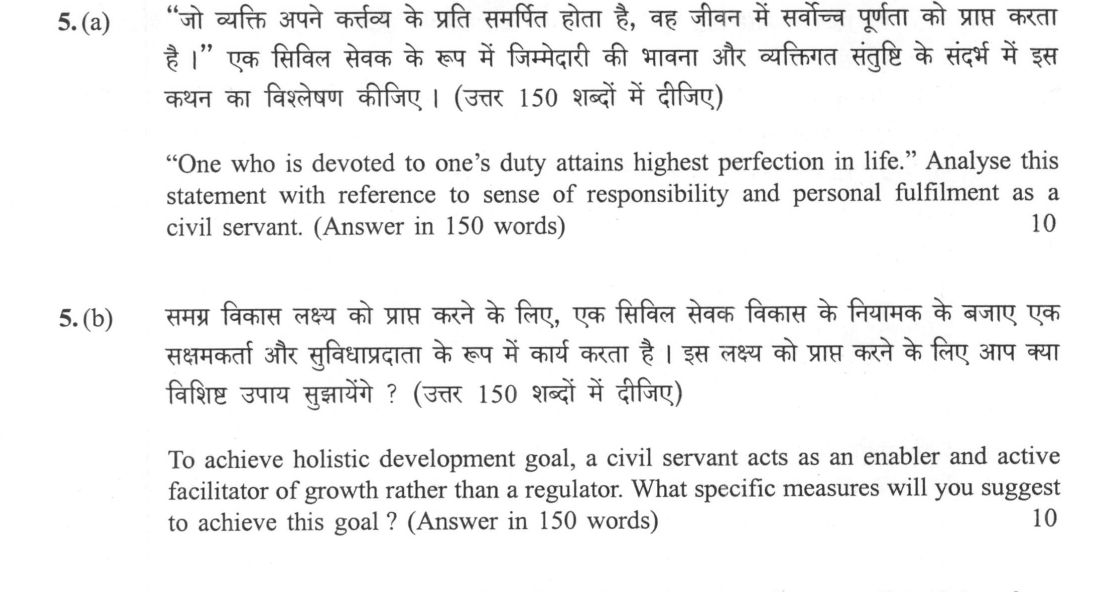
"One who is devoted to one's duty attains highest perfection in life." Analyse this statement with reference to sense of responsibility and personal fulfilment as a civil servant. (Answer in 150 words) 10 marks
To achieve holistic development goal, a civil servant acts as an enabler and active facilitator of growth rather than a regulator. What specific measures will you suggest to achieve this goal ? (Answer in 150 words) 10 marks
हिंदी में प्रश्न पढ़ें
"जो व्यक्ति अपने कर्तव्य के प्रति समर्पित होता है, वह जीवन में सर्वोच्च पूर्णता को प्राप्त करता है।" एक सिविल सेवक के रूप में जिम्मेदारी की भावना और व्यक्तिगत संतुष्टि के संदर्भ में इस कथन का विश्लेषण कीजिए। (उत्तर 150 शब्दों में दीजिए)
समग्र विकास लक्ष्य को प्राप्त करने के लिए, एक सिविल सेवक विकास के नियामक के बजाए एक सक्षमताकर्ता और सुविधाप्रदाता के रूप में कार्य करता है। इस लक्ष्य को प्राप्त करने के लिए आप क्या विशिष्ट उपाय सुझाएंगे ? (उत्तर 150 शब्दों में दीजिए)
Model answer
Written by UPSC Answer Check against this question's marking rubric, to the 150-word length. UPSC does not publish answers for Mains — this is one way to score well, not an official key.
Duty, Responsibility, and Fulfilment Devotion to duty (svadharma) harmonises deontological duty with the teleological outcomes of constitutional morality (Article 51A). For a civil servant, an internalised sense of responsibility elevates administrative functions into a moral vocation. This Public Service Motivation (PSM) transforms external accountability into self-actualisation, generating profound personal fulfilment through public value creation.
Civil Servant as Enabler and Facilitator Fostering holistic growth necessitates shifting from restrictive oversight to collaborative, citizen-centric governance through targeted measures: Capacity Building: Institutionalising behavioral shifts from 'rule to role' via Mission Karmayogi. Participatory Policy: Engaging citizens in co-creation through platforms like MyGov. Regulatory Innovation: Adopting regulatory sandboxes to support emerging sectors and start-ups. Decriminalisation: Promoting ease of doing business and trust-based governance by decriminalising minor technical offences under the Jan Vishwas Act.
Grounded in Gandhian trusteeship, devotion to duty naturally converges with an enabling role, aligning individual ethical perfection with inclusive, holistic national development.
What "Analyse" is asking you to do
Break the subject into its working parts and show how they act on each other. The marks are in the interconnections — which factor drives which, and what the resulting structure explains — not in the inventory of factors.
Structure that answers it
Define the whole → separate it into its parts → show which part drives which → what that interaction produces → what the structure implies
Where marks are lost
A flat list of causes with no account of which drives which. An answer of neatly separated headings, each self-contained, scores as description.
How this answer will be evaluated
Approach
Framework: GS4 Ethical Dilemma & Administrative Action Framework. (a) analyse: intro > causes > effects > stakeholders/linkages > way forward | (b) suggest: the problem in one line > implementable measures > who acts > conclusion Full marks: Precise, actionable, and ethically grounded with specific examples.
Key points expected
- Define 'duty' in civil service context
- Link responsibility to personal perfection
- Explain 'personal fulfilment' as a by-product
- Conclude on the ethical imperative
- Define 'enabler' vs 'regulator' role
- Suggest specific administrative measures (e.g., single window)
- Suggest social/developmental measures (e.g., capacity building)
- Conclude on the shift in mindset
Evaluation rubric
Each sub-part is marked on its own, against the marks and word limit printed on the paper.
- (a) Link duty devotion to personal perfection via responsibility and fulfilment. 10 marks · 150 words
analyse— intro → causes → effects → stakeholders/linkages → way forward
Must cover
- Define 'duty' in civil service context
- Link responsibility to personal perfection
- Explain 'personal fulfilment' as a by-product
- Conclude on the ethical imperative
Loses marks
- Preaching generic values without administrative link
- Ignoring the 'personal fulfilment' aspect
- Vague generalities without specific reasoning
Earns more
- Reference to Kantian duty or Swami Vivekananda
- Distinction between 'job' and 'duty'
- Mention of 'service' as a vocation
Extra mark
- Specific quote from a civil service manual
- Reference to a specific ethical code (e.g., Lokpal)
- (b) List specific measures to act as an enabler/facilitator for holistic development. 10 marks · 150 words
suggest— the problem in one line → implementable measures → who acts → conclusion
Must cover
- Define 'enabler' vs 'regulator' role
- Suggest specific administrative measures (e.g., single window)
- Suggest social/developmental measures (e.g., capacity building)
- Conclude on the shift in mindset
Loses marks
- Listing generic 'good governance' points
- Focusing only on economic growth (ignoring holistic)
- Suggesting measures that are purely regulatory
Earns more
- Mention of 'Ease of Doing Business' reforms
- Reference to 'NITI Aayog' or specific schemes
- Focus on 'holistic' (social + economic) development
Extra mark
- Reference to a specific state's success story
- Mention of 'Digital India' as a facilitator
Practice this exact question
Write your answer and it is marked point by point against the model answer above — what you covered, what you missed, what you got wrong.
Evaluate my answer →More from General Studies 2025 GS Paper IV
- Q2 (a) Carl von Clausewitz once said, "War is a diplomacy by other means." Critically analys…
- Q3 Given below are three quotations of great thinkers. What do each of these quotations conv…
- Q4 (a) "For any kind of social re-engineering by successfully implementing welfare schemes,…
- Q5 (a) "One who is devoted to one's duty attains highest perfection in life." Analyse this s…
- Q6 (a) It is said that for an ethical work culture, there must be code of ethics in place in…
- Q7 Vijay was Deputy Commissioner of remote district of Hilly Northern State of the country f…
- Q8 In line with the Directive Principles of State Policy enshrined in the Indian Constitutio…