GS Paper IV — Q12
Ashok is Divisional Commissioner of one of the border districts of the North East State. A few years back, Military has taken…
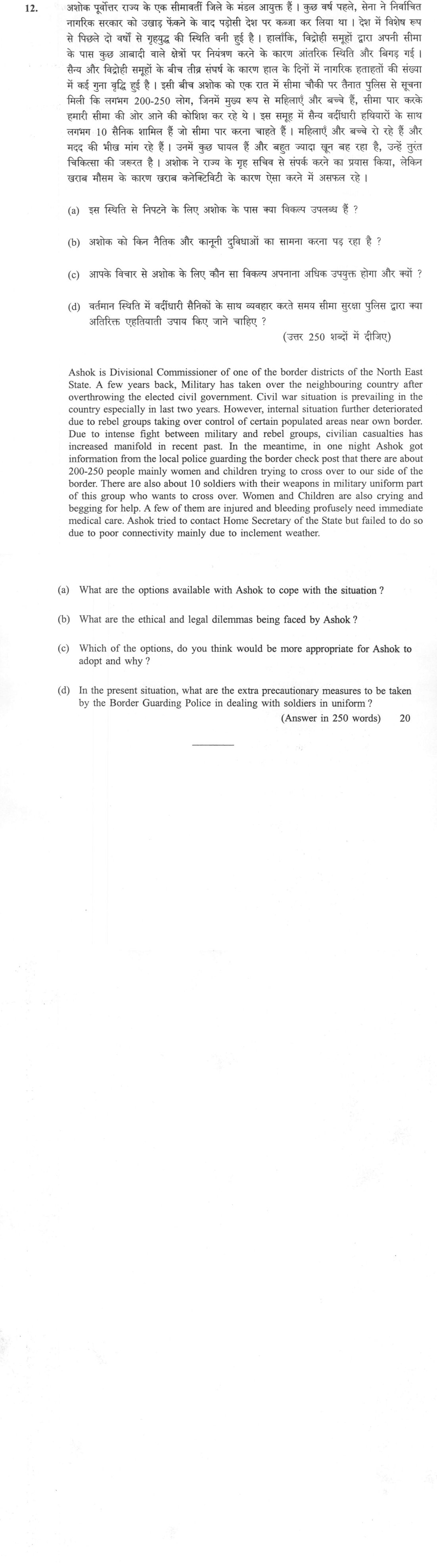
Ashok is Divisional Commissioner of one of the border districts of the North East State. A few years back, Military has taken over the neighbouring country after overthrowing the elected civil government. Civil war situation is prevailing in the country especially in last two years. However, internal situation further deteriorated due to rebel groups taking over control of certain populated areas near own border. Due to intense fight between military and rebel groups, civilian casualties has increased manifold in recent past. In the meantime, in one night Ashok got information from the local police guarding the border check post that there are about 200-250 people mainly women and children trying to cross over to our side of the border. There are also about 10 soldiers with their weapons in military uniform part of this group who wants to cross over. Women and Children are also crying and begging for help. A few of them are injured and bleeding profusely need immediate medical care. Ashok tried to contact Home Secretary of the State but failed to do so due to poor connectivity mainly due to inclement weather.
What are the options available with Ashok to cope with the situation?
What are the ethical and legal dilemmas being faced by Ashok?
Which of the options, do you think would be more appropriate for Ashok to adopt and why?
In the present situation, what are the extra precautionary measures to be taken by the Border Guarding Police in dealing with soldiers in uniform?
हिंदी में प्रश्न पढ़ें
अशोक पूर्वोत्तर राज्य के एक सीमावर्ती जिले के मंडल आयुक्त हैं। कुछ वर्ष पहले, सेना ने निर्वाचित नागरिक सरकार को उखाड़ फेंकने के बाद पड़ोसी देश पर कब्जा कर लिया था। देश में विशेष रूप से पिछले दो वर्षों से गृहयुद्ध की स्थिति बनी हुई है। हालांकि, विद्रोही समूहों द्वारा अपनी सीमा के पास कुछ आबादी वाले क्षेत्रों पर नियंत्रण करने के कारण आंतरिक स्थिति और बिगड़ गई। सैन्य और विद्रोही समूहों के बीच तीव्र संघर्ष के कारण हाल के दिनों में नागरिक हताहतों की संख्या में कई गुना वृद्धि हुई है। इसी बीच अशोक को एक रात में सीमा चौकी पर तैनात पुलिस से सूचना मिली कि लगभग 200-250 लोग, जिनमें मुख्य रूप से महिलाएं और बच्चे हैं, सीमा पार करके हमारी सीमा की ओर आने की कोशिश कर रहे थे। इस समूह में सैन्य वर्दीधारी हथियारों के साथ लगभग 10 सैनिक शामिल हैं जो सीमा पार करना चाहते हैं। महिलाएं और बच्चे रो रहे हैं और मदद की भीख मांग रहे हैं। उनमें कुछ घायल हैं और बहुत ज्यादा खून बह रहा है, उन्हें तुरंत चिकित्सा की जरूरत है। अशोक ने राज्य के गृह सचिव से संपर्क करने का प्रयास किया, लेकिन खराब मौसम के कारण खराब कनेक्टिविटी के कारण ऐसा करने में असफल रहे।
इस स्थिति से निपटने के लिए अशोक के पास क्या विकल्प उपलब्ध हैं?
अशोक को किन नैतिक और कानूनी दुविधाओं का सामना करना पड़ रहा है?
आपके विचार से अशोक के लिए कौन सा विकल्प अपनाना अधिक उपयुक्त होगा और क्यों?
वर्तमान स्थिति में वर्दीधारी सैनिकों के साथ व्यवहार करते समय सीमा सुरक्षा पुलिस द्वारा क्या अतिरिक्त एहतियाती उपाय किए जाने चाहिए?
Model answer
Written by UPSC Answer Check against this question's marking rubric, to the 250-word length. UPSC does not publish answers for Mains — this is one way to score well, not an official key.
The dilemma pits humanitarian protection against border security. (a) Ashok’s options: admit all immediately with medical triage; hold them temporarily at the border for screening; deny entry citing sovereignty/security; admit civilians selectively while detaining soldiers separately; and escalate via alternative channels—radio, Army, local officials, runners. (b) Ethically, balance right to life against territorial integrity, non-refoulement against national security, and impartial humanitarian response against political consequences. Legally, entry falls under the Foreigners Act, 1946 and Passport (Entry into India) Act, 1920; Article 21 protects non-citizens’ life, not automatic asylum. AFSPA may shape disturbed-area security, not foreign soldiers’ entry. IHL-derived norms support humane treatment; Common Article 3 binds belligerents, not India directly. (c) The more appropriate option is prioritized humanitarian admission of injured women and children with segregated security protocol for armed soldiers. This follows proportionality and least harm, mirrors India’s refugee precedents for Tibetans and Sri Lankans, and preserves operational security. Soldiers should be detained as foreign nationals for security screening/internment under the Foreigners Act and border-security rules, not criminally detained absent evidence. (d) Border Guarding Police should seize weapons into safe custody, use a separate interrogation facility, verify military identity, coordinate with Army/intelligence, video-document, maintain chain of custody for possible war-crimes evidence, and treat surrendering combatants humanely with strict adherence to Geneva-derived IHL principles. Since DMA 2005 aids relief but not asylum, Ashok’s ad-hoc decision under the eminent domain of humanitarian protection shows administrative wisdom under uncertainty.
What "Evaluate" is asking you to do
Judge how well something has performed against the standard it set for itself — its stated aim, mandate or promise — and commit to a verdict. Name the yardstick before you judge; an unanchored judgement reads as opinion.
Structure that answers it
Name the yardstick — stated aim, mandate or benchmark → performance against it → shortfall against it → why the gap exists → verdict
Where marks are lost
Presenting both sides and then declining to decide, or delivering a verdict against a standard you never stated, which makes it look arbitrary.
How this answer will be evaluated
Approach
Framework: GS4 Case Study: Crux, Stakeholders, Dilemmas, Options, Course of Action (Immediate/Short-term/Long-term). (a) enumerate: list the items in order > one line each > no commentary | (b) analyse: intro > causes > effects > stakeholders/linkages > way forward | (c) justify: claim > 3-4 reasons > evidence > conclusion | (d) suggest: the problem in one line > implementable measures > who acts > conclusion Full marks: Balances humanitarianism with national security; specific, actionable steps for both civilians and soldiers; clear legal/ethical reasoning.
Key points expected
- Allow entry of civilians (women/children)
- Detain/interrogate the 10 soldiers
- Attempt alternative communication with HQ
- Coordinate with local police/military
- Humanitarian duty vs. National Security
- Legal status of armed soldiers (POCSO/Border Act)
- Duty to protect life vs. Duty to maintain border
- Lack of instructions vs. Immediate need
Evaluation rubric
Each sub-part is marked on its own, against the marks and word limit printed on the paper.
- (a) List distinct courses of action available to Ashok.
enumerate— list the items in order → one line each → no commentary
Must cover
- Allow entry of civilians (women/children)
- Detain/interrogate the 10 soldiers
- Attempt alternative communication with HQ
- Coordinate with local police/military
Loses marks
- Listing vague options like 'think carefully'
- Ignoring the specific presence of soldiers
Earns more
- Option to deny entry to all
- Option to wait for instructions
- Option to provide medical aid only
Extra mark
- Reference to 'discretionary powers' of DC
- (b) Identify specific ethical and legal conflicts in the scenario.
analyse— intro → causes → effects → stakeholders/linkages → way forward
Must cover
- Humanitarian duty vs. National Security
- Legal status of armed soldiers (POCSO/Border Act)
- Duty to protect life vs. Duty to maintain border
- Lack of instructions vs. Immediate need
Loses marks
- Generalizing without linking to the specific case
- Ignoring the legal risk of accepting soldiers
Earns more
- Mention of 'Geneva Convention' principles
- Conflict between 'Rule of Law' and 'Compassion'
Extra mark
- Citing specific Border Act sections
- (c) Select the best option and provide reasoned justification.
justify— claim → 3-4 reasons → evidence → conclusion
Must cover
- Prioritize medical aid for injured civilians
- Separate soldiers from civilians for processing
- Justify based on 'Human Life' as higher right
- Explain why this balances security and ethics
Loses marks
- Choosing to turn everyone away
- Failing to justify the handling of the soldiers
Earns more
- Mentioning 'Silent Stakeholders' (local community)
- Balancing 'Immediate' vs 'Long-term' security
Extra mark
- Reference to 'Nehruvian' foreign policy values
- (d) List precautionary measures for Border Guarding Police regarding soldiers.
suggest— the problem in one line → implementable measures → who acts → conclusion
Must cover
- Disarm the soldiers immediately
- Separate soldiers from the civilian group
- Secure weapons in a safe location
- Conduct background check/interrogation
Loses marks
- Suggesting execution or violence
- Ignoring the threat posed by weapons
Earns more
- Use of non-lethal force if resistance occurs
- Establishing a secure holding area
Extra mark
- Protocol for 'Prisoner of War' handling
Practice this exact question
Write your answer and it is marked point by point against the model answer above — what you covered, what you missed, what you got wrong.
Evaluate my answer →More from General Studies 2025 GS Paper IV
- Q9 Subash is Secretary, PWD in the State Government. He is a senior officer, known for his c…
- Q10 Rajesh is a Group A officer with nine years of service. He is posted as Administrative Of…
- Q11 Mahatma Gandhi National Rural Employment Guarantee Program, MGNREGA was earlier known as…
- Q12 Ashok is Divisional Commissioner of one of the border districts of the North East State.…